

How to Plan Nature Based Learning Activities for Preschoolers
Last Updated: October 30, 2026
Quick Summary
Plan nature based learning by giving preschoolers a short picture checklist of five or six items and taking a 15 to 20 minute nature walk, then turning it into a scavenger hunt with simple clues. Repeat the same weekly rhythm each week with new materials, keeping sessions short at around 20 minutes.
- Aim for 15 to 20 minutes for threes and fours, stretching to 25 or 30 minutes for older pre-K children.
- Walk the route alone first to flag hazards before bringing children.
- Set a rule of one of each item so collecting does not distract from observing and sorting.
- Keep math numbers small, under ten, and praise effort rather than just the right answer.
- Check for poison ivy, sharp sticks, broken glass, and water, and always supervise.
Table of Contents
- Why Nature Based Learning Works for Preschoolers
- Outdoor Activities for Preschoolers: Walks and Scavenger Hunts
- Leaf, Stick, and Rock Activities: Collecting, Sorting, and Leaf Rubbing
- Nature Sensory Activities for Preschoolers: Sensory Walks and Playdough
- Nature Math Activities for Preschoolers: Counting and Sorting Outdoors
- Nature-Based Preschool Lesson Plans: Building a Simple Weekly Rhythm
- Safety, Inclusion, and Indoor Alternatives for Rainy Days
- Pairing Nature Time with Bravo Bear Stories
- Frequently Asked Questions
Why Nature Based Learning Works for Preschoolers
Nature based learning is an approach that uses the outdoors, plants, animals, and natural materials as the classroom for early learning.
The core idea is easy to grasp. A puddle becomes a science lesson. Head Start's early learning guidance notes that hands-on play is central to how young children build thinking and language skills.
Why does it work so well? Because it fits how young children already behave. They want to dig, collect, and explore. Nature gives them endless material for that.
- It builds fine motor skills through grabbing, stacking, and drawing.
- It supports early math and language through real objects.
- It grows environmental awareness and calm.
The best part: you don't need a forest. A yard, a park, or a single tree works.
Outdoor Activities for Preschoolers: Walks and Scavenger Hunts
Outdoor activities for preschoolers work best when they have a simple goal. A nature walk with a short checklist keeps young children focused and gives them a reason to observe closely. But the difference between a walk that fizzles in five minutes and one that fills a full morning comes down to planning: the right checklist length, clear boundaries, and a backup plan for weather, allergies, and mixed-ability groups.
Start with a nature walk
Hand each child a picture checklist of five or six items: a leaf, a rock, a feather, a flower, a stick, and something brown. Keep the list short. Preschoolers lose interest fast, so aim for 15 to 20 minutes for threes and fours, and stretch to 25 or 30 minutes for older pre-K children who can sustain attention longer.
For children who are not yet reading, use photos or simple line drawings. For children learning English or needing visual support, pair each picture with one spoken word as you point. A clipboard with a crayon tied on a string prevents the "I dropped my marker" meltdown that ends walks early.
Turn the walk into a scavenger hunt
Give simple clues like "find something rough" or "find something that is green." This builds observation skills and color recognition. To add a learning-outcome layer, sort clues by domain:
- Science/observation: something that moves, something wet, something that grew.
- Math: find three of one thing, find something round, find something longer than your hand.
- Language: find something soft and tell me a word for how it feels.
- Motor: find something you can carry with two fingers, something you can stack.
Setup guide
- Pick a safe, familiar spot with clear boundaries, a fenced yard, a park loop, or a short trail. Walk the route alone first to flag hazards.
- Print or draw a picture checklist. Laminate it or slip it into a plastic sleeve so it survives dew and drizzle.
- Bring a small basket or paper bag for collected items, plus a backup bag for trash you find along the way.
- Set a time limit and a meeting point. Use a visual timer or a song to signal the end.
- Carry a basic kit: hand wipes, a small first-aid pouch, water, and a phone. Check the forecast and the local air quality index before heading out.
Age and ability adaptations
- Younger preschoolers (around 3): shorter route, three-item checklist, adult carries the basket, focus on one sense at a time.
- Older preschoolers (4-5): five- or six-item checklist, child carries the basket, add a counting or sorting task mid-walk.
- Limited mobility: choose paved or level routes; offer a seated scavenger hunt from a stroller, wagon, or bench with items placed within reach.
- Sensory sensitivities: warn about loud equipment, wet grass, or strong smells; offer gloves or tongs for children who dislike touching natural materials.
- Allergies: check for bee activity near flowers, avoid areas with known poison ivy or stinging nettles, and keep epinephrine and a phone accessible if a child has a diagnosed allergy.
Safety notes
Supervise closely and set a rule that children show an adult each find before handling it. Watch for poison ivy (leaves of three), sharp sticks, broken glass, and standing water. Teach children not to put anything in their mouths, and wash hands after the walk. In hot weather, schedule walks before mid-morning; in cold weather, keep sessions short and check for wet gloves and boots.
Learning outcomes to watch for
You do not need a formal assessment. Jot quick notes on a clipboard or phone: Did the child name a color unprompted? Sort by size? Ask a question about an animal? These observation prompts map to early learning domains, science, math, language, and fine motor, and give you a simple record of progress across the season.
Indoor and bad-weather backup
When weather forces you inside, hide natural materials around a room and run the same checklist as an indoor hunt. A tray of leaves, rocks, and pinecones on a table works as a mini scavenger hunt for children with limited outdoor access. For a bigger list of screen-free ideas to rotate through the week, see our guide to screen-free activities for young children.
Leaf, Stick, and Rock Activities: Collecting, Sorting, and Leaf Rubbing
Collecting and sorting natural materials turns a walk into a full learning session. Leaves, sticks, and rocks are free, easy to find, and perfect for hands-on experiences.
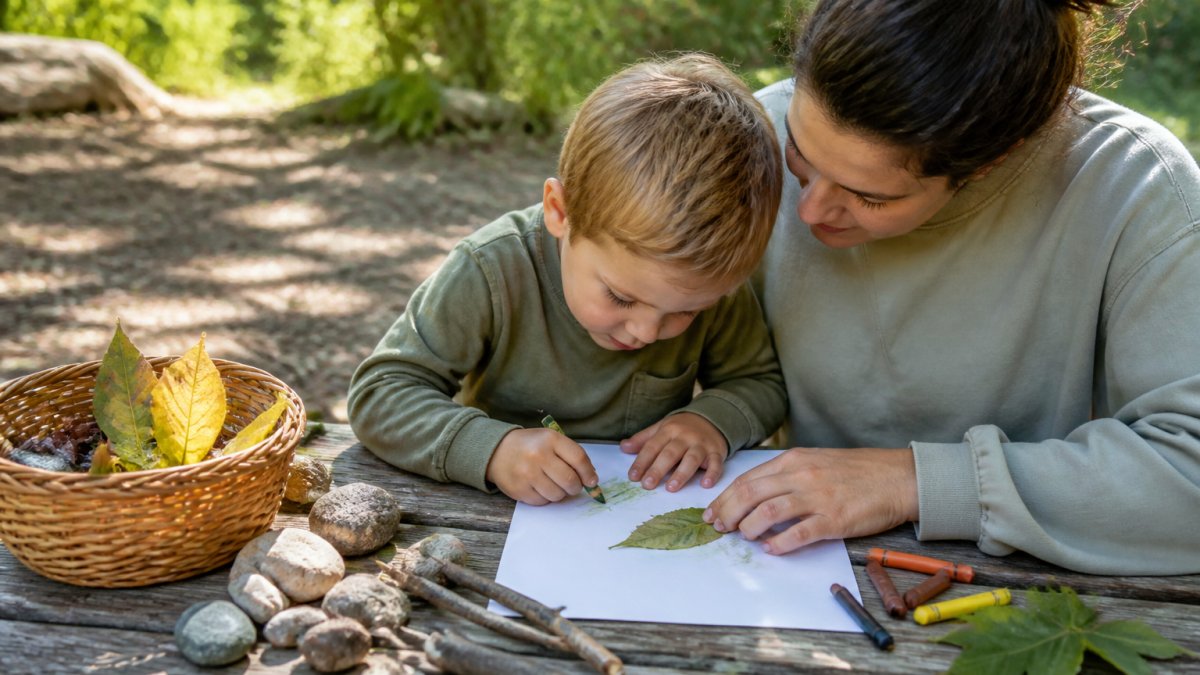
Try these three activities:
Leaf rubbing. Place a leaf under a sheet of paper and rub a crayon over it. The shape appears like magic. This builds fine motor skills and teaches plant parts.
Sorting. Ask children to sort their finds by color, size, or type. Sorting is an early math skill and a calm, focused task.
Leaf imprint art. Press leaves into playdough or clay to make prints. This is creative expression with a science twist.
Collecting too much can distract from the activity. Setting a rule of one of each item keeps the focus on observing and sorting. Watch out: check for poison ivy and sharp sticks before children handle their finds.
Nature Sensory Activities for Preschoolers: Sensory Walks and Playdough
Nature sensory activities for preschoolers build fine motor skills and calm through touch, smell, and sound. A sensory walk is the easiest place to start.
A sensory walk asks children to notice with each sense. "What do you hear? What feels bumpy? What smells like rain?" This builds observation and language.
Then bring the outdoors inside with nature playdough. Make a simple dough and press in leaves, twigs, and seeds. Children model, stamp, and create. This is imaginative play with real natural materials.
For a full walkthrough on setting up sensory play at home, our guide on how to set up sensory bins for toddlers covers the materials and cleanup.
Keep these tips in mind:
- Use washable materials and a tray for mess control.
- Offer a few tools: a scoop, a cup, a small brush.
- Let children lead. Follow their curiosity.
Nature Math Activities for Preschoolers: Counting and Sorting Outdoors
Nature math activities for preschoolers make counting and sorting real. Instead of worksheets, children count acorns, sort rocks, and measure sticks.
Try these simple games:
- Count and collect. "Find five pinecones." Counting with real objects sticks better than counting on a page.
- Sort by size. Line up rocks from small to big. This teaches comparison and order.
- Pattern play. Make a pattern with leaves: red, yellow, red, yellow.
- Measure with sticks. Compare stick lengths. "Which is longer?"
These games build math skills, color recognition, and fine motor skills at once. They also match how pre-K children learn: through play-based learning and hands-on experiences.
A common mistake is making it too hard. Keep numbers small, under ten. Praise the effort, not just the right answer.
Nature-Based Preschool Lesson Plans: Building a Simple Weekly Rhythm
Nature-based preschool lesson plans work best as a simple weekly rhythm, not a rigid schedule. Young children thrive on routine, so repeat the same structure each week with new materials.
Here is a sample week:
| Day | Focus | Example Activity |
|---|---|---|
| Monday | Nature walk | Observation checklist |
| Tuesday | Collecting and sorting | Leaf and rock sort |
| Wednesday | Sensory play | Nature playdough |
| Thursday | Nature math | Counting and patterns |
| Friday | Outdoor art | Leaf rubbing and crafts |
This rhythm can cover early learning objectives such as observation, math, fine motor skills, and creative expression. Adjust it to your season and local plants.
For homeschooling families, this structure works as curriculum support. Each week adds a new theme: trees, animals, habitats, or weather. Keep sessions short, around 20 minutes.
Safety, Inclusion, and Indoor Alternatives for Rainy Days
Safety and inclusion must be built into every plan. Check the space for hazards first: sharp sticks, poison ivy, broken glass, and water. Set clear boundaries and always supervise.
Make activities accessible for all children. Offer seated versions for children with limited mobility. Use larger tools for small hands. Provide picture checklists for children who need visual support.
When weather forces you inside, keep the learning going. Bring natural materials indoors. Our article on screen-free activities for toddlers while cooking dinner has more indoor ideas for busy days.
Watch out: small rocks and seeds can be choking hazards for young children. Supervise closely and choose larger materials for the youngest children.
Pairing Nature Time with Bravo Bear Stories
Nature time and story time make a strong pair. After a walk, children are full of questions and stories. That is the perfect moment to read aloud.
Reading aloud builds vocabulary, attention, and a love of books. Our article on why you should read aloud to preschoolers explains the benefits in detail.
Bravo Bear's edu-tainment series is designed to inspire children to grow with kindness, confidence, and courage. After collecting leaves, children can read a story about trying new things. After a sensory walk, a tale about curiosity fits right in.
For parents who want to foster imagination beyond the walk, our guide on how to foster child imagination daily pairs well with outdoor play.
Frequently Asked Questions
What are some easy nature based learning activities for preschoolers at home?
Start with a 15-minute backyard scavenger hunt for three types of leaves, then sort them by color and size on a porch step. Add a playdough tray with twigs and pinecones for open-ended modeling, or set up a small water play station with cups and natural materials. These need no special equipment and work in small yards or on a balcony.
How can preschoolers learn math through nature?
Nature math activities for preschoolers work best when counting is built into play. Have your child count acorns into groups of five, compare the length of two sticks, or sort rocks by size into small, medium, and large piles. A simple nature checklist with tally marks turns a walk into counting practice without worksheets.
How long should outdoor activities be for preschoolers?
Plan for 20 to 45 minutes of focused outdoor time, with younger threes closer to 20 minutes and four- and five-year-olds able to handle 45. Follow your child's attention rather than the clock. A short, well-planned nature walk with one clear goal, such as finding five different leaves, usually holds attention longer than an unstructured hour.
How do you make a nature walk educational for preschoolers?
Give the walk a single purpose. Bring a nature checklist with pictures of leaves, bark, birds, and insects, and let your child mark each find. Pause to observe one tree closely, touching the bark and counting branches. Ask open questions like what changed since last week. This turns a stroll into observation and early science practice.
Planning nature based learning activities for preschoolers does not require special gear or a big budget. It requires a little structure and a willingness to head outside. That is where Bravo Bear comes in. Our stories blend heart and fun with lessons on kindness, confidence, and courage, giving you a warm way to extend the learning after nature time. Get started with Bravo Bear and turn every walk, leaf, and story into a moment your child will remember.


