

7 Screen-Free Activities for Toddlers While Cooking Dinner
Table of Contents
- How to Keep a Toddler Busy While You Cook
- 7 Screen-Free Activities for Toddlers While Cooking Dinner
- Toddler Cooking Activities That Build Real Skills
- No-Prep Toddler Activities for the Busiest Evenings
- What to Do Instead of Screen Time for Toddlers
- Kitchen Safety Rules Every Parent Should Set First
- Frequently Asked Questions
Last Updated: October 12, 2026
How to Keep a Toddler Busy While You Cook
Dinner hour is the hardest part of the day for many families. Toddlers want attention right when the stove needs it most.
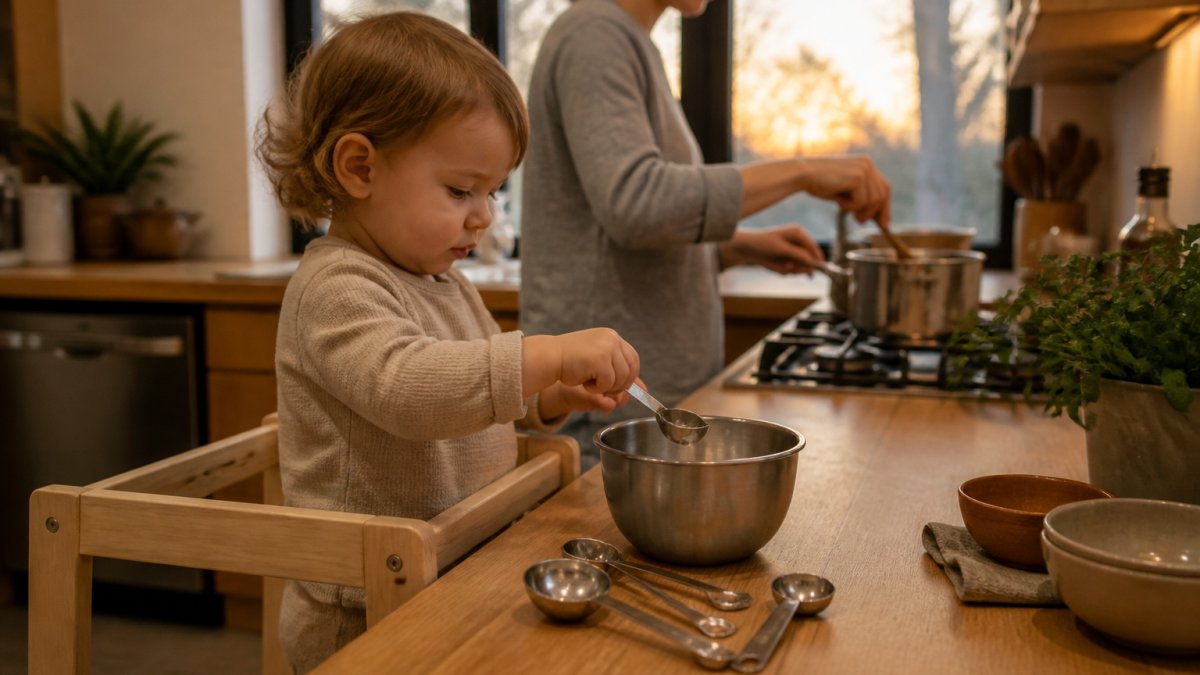
That is why the kitchen, not the living room, is often the best place for independent play.
Below are seven activities that take under two minutes to set up, plus safety rules, skill-building tasks, and what to do on chaotic evenings.
Why the Kitchen Is the Right Place for Independent Play
Out of sight usually means out of luck. A toddler playing alone in another room tends to wander back within minutes, often mid-task.
Independent play is a child's ability to entertain themselves with minimal adult direction.
The kitchen gives you both: your child sees, hears, and copies you while you supervise without leaving the stove.
Set Up a Safe Play Zone Before You Turn On the Stove
Build the zone before the burners go on. Once oil is heating, your attention is split, and that is when accidents happen.
A safe play zone has three parts:
- A dedicated spot for your child, like a learning tower, booster seat, or floor mat
- Only safe items within arm's reach, such as plastic bowls, wooden spoons, and sealed containers
- A clear boundary between the play spot and the stove, ideally a few feet of open floor
7 Screen-Free Activities for Toddlers While Cooking Dinner
Each of these seven screen-free activities for toddlers while cooking dinner takes two minutes or less to set up, uses items you already own, and keeps your child within sight. Ages are approximate; adjust by temperament.
| # | Activity | Setup Time | Cleanup | Best Age |
|---|---|---|---|---|
| 1 | Water play at the sink | 1 min | 2 min | 18 months+ |
| 2 | Measuring spoon scoop and pour | 1 min | 1 min | 12 months+ |
| 3 | Sensory play with dry ingredients | 2 min | 3 min | 18 months+ |
| 4 | Pretend cooking | 1 min | 1 min | 2 years+ |
| 5 | Color sorting | 1 min | 2 min | 2 years+ |
| 6 | Alphabet and I Spy games | 0 min | 0 min | 2.5 years+ |
| 7 | Drawing and coloring books | 1 min | 1 min | 18 months+ |
1. Water Play at the Sink
Water play is the easiest win in the kitchen. Fill a shallow bin or the sink with an inch of lukewarm water and add a few cups and a whisk.
Your toddler scoops, pours, and splashes while you chop vegetables nearby.
- Setup: 1 minute
- Supervision: Stay within arm's reach at all times; never leave a child alone with standing water
- Cleanup: Dump the water, wipe the counter, hang the towel
A towel on the floor under the bin saves you a mopping job later.
2. Measuring Spoon Scoop and Pour
Hand your toddler measuring spoons and two bowls, one filled with dry rice, oats, or beans. Scooping builds fine motor skills and keeps hands busy for a surprisingly long stretch.
- Setup: 1 minute
- Supervision: Skip this activity if your child still mouths small objects; use large pasta shapes instead
- Cleanup: 1 minute with a dustpan or hand vacuum
3. Low-Prep Sensory Play with Dry Ingredients
Sensory play with dry ingredients means letting your child explore texture with their hands. Pour flour, cornmeal, or dry rice into a shallow tray and add a spoon or small toy.
- Setup: 2 minutes
- Supervision: Keep the tray on a stable surface away from the stove
- Cleanup: 3 minutes; a plastic tablecloth under the tray catches most of it
4. Pretend Cooking with Bowls and Utensils
Give your toddler a bowl, a wooden spoon, and a few sealed spice jars, and they become a little chef cooking alongside you. This is the activity toddlers copy most: they stir, taste pretend soup, and serve you a plate.
- Setup: 1 minute
- Supervision: Use only sealed containers; loose spices mean a real mess and possible eye irritation
- Cleanup: 1 minute
5. Color Sorting with Kitchen Items
Color sorting works with what is already in your drawers. Gather red, yellow, and green items, like a red cup, a yellow lid, and a green spatula, and ask your toddler to sort them into piles.
- Setup: 1 minute
- Supervision: Low risk; just keep glass and sharp tools out of the mix
- Cleanup: 2 minutes
This game builds language development too. Name each color out loud as they sort.
6. Alphabet and I Spy Games at the Counter
No supplies needed. Play I Spy with items on the counter ("I spy something red"), or run through the alphabet finding one kitchen item per letter.
- Setup: None
- Supervision: Standard kitchen rules apply
- Cleanup: None
This is the activity to reach for when dinner is already burning and you have zero hands free.
7. Drawing and Coloring Books at the Table
Set your toddler at the table with coloring books, crayons, and stickers. Drawing keeps hands busy and eyes off screens while you finish the meal.
- Setup: 1 minute
- Supervision: Crayons only for kids under three; markers can stain and get chewed
- Cleanup: 1 minute
Toddler Cooking Activities That Build Real Skills
The activities above keep your toddler busy. The next step is letting them help, which builds fine motor skills, patience, and purpose. Toddler cooking activities work best when the task is simple, safe, and repeatable.
When to Use a Learning Tower or Kitchen Helper
A learning tower or kitchen helper brings your child up to counter height safely. Use one when your toddler wants to stand and participate rather than sit. Look for a wide base, a safety rail, and an adjustable platform; if your kitchen is too tight for a stable footprint, a booster seat at the table works just as well.
Simple Tasks Toddlers Can Do Safely
Start with tasks that cannot hurt anyone, then add more as your child grows:
- Wiping the table with a damp cloth
- Tearing lettuce for a salad
- Stirring cold ingredients in a large bowl
No-Prep Toddler Activities for the Busiest Evenings
Some nights you have nothing left to give. No-prep toddler activities are the backup plan for evenings when dinner is late, the toddler is melting down, and setting up a sensory bin is not happening. These need zero setup and zero cleanup, and keep your child within sight of the stove.
The Five-Minute Rotation
Most toddlers last five to ten minutes on a single activity before attention fades. Instead of hunting for one magic activity, plan a rotation of three or four short ones and swap when interest drops, a 20-minute dinner prep usually means two or three swaps.
Here is a realistic sequence for a busy evening, in the order that tends to work:
- Music and a kitchen dance party (2-4 min). Put on a song and dance with your toddler while you stir. This burns energy first, which makes the quieter activities that follow easier. Supervision: standard kitchen rules; keep the dance area clear of the stove.
- A stack of books at the table (5-8 min). Hand over board books to flip through. Toddlers "read" independently at this age, and the table keeps them contained. Supervision: low risk; just keep hot dishes off the table.
- The missing-object game (3-5 min). Put three safe items on a tray, a spoon, a cup, a lid, let your toddler look, then remove one and ask what is missing. This builds working memory and needs nothing but what is already on the counter. Supervision: use only unbreakable items.
- Find everything that is round (3-5 min). A verbal scavenger hunt your toddler can run from a seated spot or the floor: "Can you find something round?" Repeat with colors, then shapes. Supervision: keep the search area away from the stove and lower cabinets with cleaners.
- "Washing" unbreakable dishes (5-10 min). A sink or shallow bin of warm water with plastic cups and lids buys the longest stretch of the five. Supervision: stay within arm's reach; never leave a child alone with standing water.
Why the Rotation Beats a Single Activity
A single activity that runs out of steam leaves you improvising with a bored, mobile toddler, the worst combination near a hot stove. A rotation keeps a next step ready, so the transition is your decision, not your toddler's. Keep the list to three or four options you can pull from without thinking.
When to Abandon the Plan
Some evenings nothing works, and that is normal. If your toddler is overtired, hungry, or sick, no activity will hold them. Lower the stakes: a simple dinner, a snack while you cook, or handing off to another adult for ten minutes beats forcing a craft.
What to Do Instead of Screen Time for Toddlers
What to do instead of screen time for toddlers comes down to one idea: replace the screen with a hands-on task your child can do near you. The American Academy of Pediatrics recommends consistent limits on screen use for young children and prioritizes hands-on, interactive play, as outlined in AAP guidance on screen time for young children.
Screens are not the enemy. The problem is what they replace: parent-child interaction, movement, and pretend play.
When dinner is the trigger, the fix is a rotation, not a single magic activity: keep three or four ideas ready and switch when attention fades.
For quieter moments after dinner, stories do the work screens used to do. At Bravo Bear, our edu-tainment series was built for exactly this: short, memorable tales that teach kindness, confidence, and courage without a screen in sight.
Kitchen Safety Rules Every Parent Should Set First
Kitchen safety comes before any activity. Set these rules once, repeat them often, and hold the line every time. The goal is not to scare your toddler away from the kitchen but to draw a clear line between supervised participation (at counter height, doing a task with you) and independent play (in a defined zone while you cook).
Set the Distances Before You Set the Rules
Vague rules ("stay back") fail because toddlers cannot estimate. Give them a physical marker instead.
- Stove and oven: Keep independent play at least three feet from any active burner or open oven door. Three feet is roughly one toddler arm-span plus a step, far enough that a sudden lunge does not reach a pan handle. If your kitchen is too narrow for three feet, move the play zone to the table or a floor mat on the far side of the room and use a baby gate at the doorway.
- Pan handles: Turn every handle inward, toward the back of the stove, the moment a pan lands on a burner. A handle that overhangs the front edge is the single most reachable hot surface in most kitchens.
- Counter edges: Anything within about six inches of the counter edge is reachable by a toddler on a learning tower. Push knives, graters, peelers, hot mugs, and appliance cords back past that line before your child climbs up.
Match the Rule to Your Toddler's Stage
Safety rules are not one-size. A 12-month-old and a 3-year-old need different boundaries in the same kitchen.
- Under 18 months: Independent play only. No counter height, no stove proximity, no "helping" with food. Mouthing is constant at this stage, so anything smaller than a choke-test tube stays out of the play zone entirely.
- 18 months to 2.5 years: Supervised participation at the table or in a learning tower, limited to cold, unbreakable, low-stakes tasks. Still no stove, no oven, no knives, even "just holding" a knife.
- 2.5 years and up: Can begin simple food tasks with you standing beside them, such as tearing lettuce, stirring a cold bowl, or sprinkling a pinch of salt. Knife skills and stove work stay adult-only at this age.
The Choking-Hazard Line
Food-based activities are where parents most often relax safety. Any food smaller than a nickel, whole grapes, cherry tomatoes, popcorn, nuts, raw carrot coins, hard candy, marshmallows, is a choking risk for children under four. Use large, soft, or cut-safe items instead: quartered grapes, halved cherry tomatoes, large pasta shapes, torn bread, or big lettuce leaves.
Rules to Repeat Out Loud
Say these in the same words every time so they stick:
- Stay three feet back from the stove while it is on.
- Never touch the oven door or handles.
- Knives, graters, and peelers are grown-up tools.
One more rule for you, not your toddler: never carry a hot pan over a child's play zone. Walk around, not over.
The U.S. Consumer Product Safety Commission publishes free home safety guidance for families with young children, including kitchen and burn-prevention tips. Reviewing it once a year is a smart habit.
Frequently Asked Questions
What are some easy cooking activities for toddlers?
Toddlers can help with simple tasks like washing vegetables, stirring batter, tearing lettuce, and pouring pre-measured ingredients into bowls. Set them up at a learning tower or a sturdy stool so they can reach the counter safely. Give them their own small bowl and spoon so they can mimic what you are doing. These toddler cooking activities build fine motor skills and keep them engaged while you finish dinner.
How can I keep my toddler busy while I cook dinner?
Set up a low-prep activity before you start cooking. Water play at the sink, scooping dry ingredients, or a coloring book at the table all work well. The key is choosing something with minimal setup and easy cleanup. Rotate between two or three activities if your toddler loses interest. A learning tower near the counter also lets them feel involved without getting in the way.
What can kids do instead of screen time?
Screen-free activities for toddlers include water play, sensory bins with dry pasta or rice, pretend cooking with real bowls and utensils, I Spy games, alphabet games, drawing, and looking at books. These activities support language development, fine motor skills, and attention span. Keep a small bin of kitchen-safe items your toddler can access independently while you cook.
How long can a toddler stay engaged with one activity?
Most toddlers stay engaged with a single activity for 5 to 15 minutes, depending on their age and interest. Younger toddlers lean toward the shorter end. Plan to offer two or three activities during dinner prep rather than expecting one to last the whole time. Rotating activities keeps attention fresh and reduces the chance of meltdowns while you finish cooking.


