

How to Teach Kindness to Preschoolers: 7 Steps That Work
Table of Contents
- Step 1: Build the Foundation With Empathy and Social-Emotional Learning
- Step 2: Model Kindness for Children Every Day
- Step 3: Try 8 Kindness Activities for Preschoolers That Stick
- Step 4: Read Books About Kindness for Preschoolers Together
- Step 5: Use Positive Reinforcement to Encourage Prosocial Behavior
- Step 6: Handle Unkind Behavior With Conflict Resolution, Not Shame
- Step 7: Extend Kindness Beyond the Classroom: Digital Kindness and Cultural Perspectives
- Conclusion: How to Teach Kindness to Preschoolers One Small Moment at a Time
- Frequently Asked Questions
Last Updated: September 15, 2026
Step 1: Build the Foundation With Empathy and Social-Emotional Learning
Teaching kindness to preschoolers starts with empathy, not manners drills. This guide from Bravo Bear walks through seven steps that work, beginning with the emotional foundation every other step depends on. Children who understand how someone else feels are far more likely to act on it; skip this step and later activities become performances rather than habits.

Why Empathy Matters in Early Childhood Development
Empathy is the ability to recognize and share another person's feelings. It is the root system beneath kindness, and it grows fastest in the preschool years, when children move from parallel play toward real peer interaction. Treating kindness as rules to memorize misses the point: children who can name emotions, in themselves and others, are the ones who share, take turns, and comfort a crying friend without being told.
Social-emotional learning programs in early childhood education consistently point to the same sequence: self-awareness first, then emotional regulation, then empathy for others. The Collaborative for Academic, Social, and Emotional Learning framework describes this progression in detail. Talk about feelings during ordinary moments, not just conflicts. "You look frustrated. That block tower kept falling." Naming an emotion validates it and builds the vocabulary a child needs to recognize it in someone else.
Step 2: Model Kindness for Children Every Day
Children copy what they see far more than what they are told. Modeling kindness means letting your preschooler witness compassion, cooperation, and active listening in your daily actions. If you snap at a driver and then remind your child to be nice, the lesson lands on the wrong side.
Everyday Moments That Teach Compassion
The teaching happens in small, unglamorous moments. Hold the door and say why. Let your child see you thank the cashier by name. When a sibling scrapes a knee, kneel down and comfort them where your preschooler can watch.
- Repair out loud. When you lose your temper, say so: "I raised my voice. That wasn't kind. I'm sorry." Repairing a rupture teaches more than never having one.
- Narrate your choices. "That woman looked like she needed help carrying her bags, so I offered."
- Share your own hard feelings. "I didn't want to share my snack, but I did, and it felt good."
Modeling is not about being perfect; it is about being visible. A parent who admits a mistake and fixes it gives a child permission to do the same.
Step 3: Try 8 Kindness Activities for Preschoolers That Stick
These activities work because they are concrete, hands-on, and repeatable, turning an abstract idea into something a small child can see, touch, and do. Rotate through them rather than running all eight in a week.
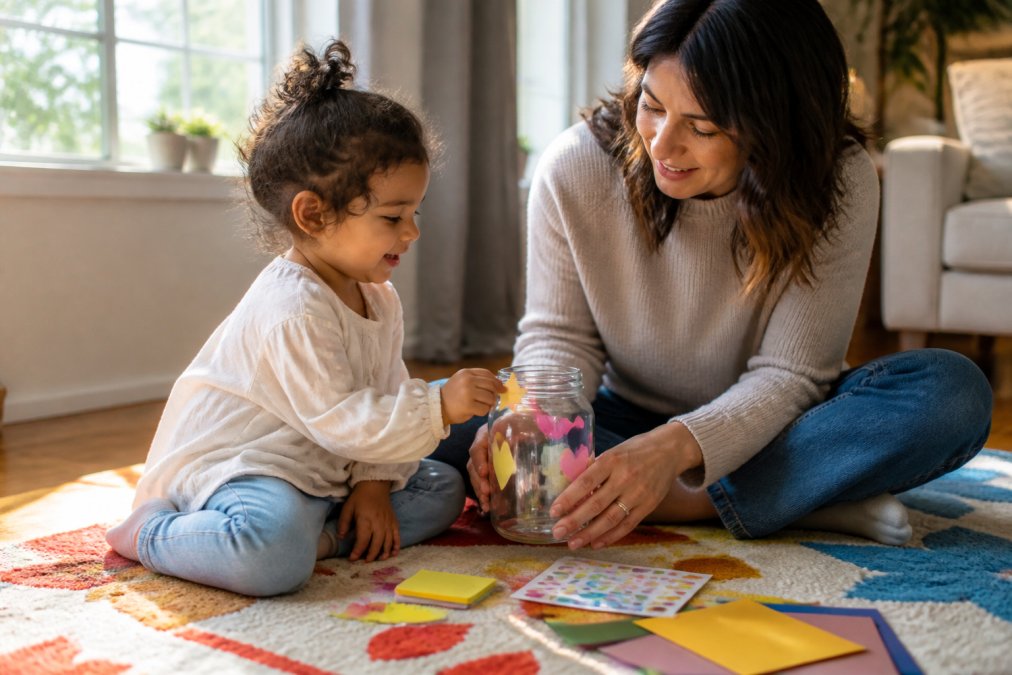
- Kindness jar. Fill a clear jar with a pom-pom or slip of paper each time someone in the family does something kind, then celebrate together when it fills.
- Kindness challenge. Give a simple daily mission: "Find one person to help today."
- Object lesson with a wrinkled heart. Have a child crumple a paper heart while you name unkind words, then try to smooth it flat. The creases stay. Say that words leave marks too.
- Feelings charades. Act out an emotion and let others guess, building the empathy vocabulary from Step 1.
- Turn-taking games. Board games and building blocks teach sharing and patience in a low-stakes setting.
- Gratitude round at dinner. Each person names one good thing from the day.
- Helping hands chart. A simple sticker chart for acts of cooperation and respect.
- Community helper visit. Talk about what a nurse, mail carrier, or librarian does for others.
Step 4: Read Books About Kindness for Preschoolers Together
Books about kindness for preschoolers give children a safe rehearsal space for compassion. A story lets a child feel what a character feels, then talk about it afterward with no real-world stakes. That conversation is where the learning happens, so do not close the book and move on.
What the Science Says About When Empathy Develops
A common misconception is that preschoolers are too young for real empathy. Developmental research describes a predictable sequence: around ages 2 to 3, children begin to recognize that others have feelings different from their own; by ages 3 to 4, most can name basic emotions and offer simple comfort, a hug, a toy, when someone is sad. True perspective-taking, understanding why someone feels a certain way, typically emerges closer to ages 4 to 5 and continues into the school years.
This matters for book selection. A 3-year-old may grasp that a character is sad but not why; a 5-year-old can follow a more complex story about exclusion or unfairness. Matching the book to the child's stage prevents frustration and keeps the conversation productive.
How to Choose Books That Actually Teach Kindness
Look for stories with clear emotional stakes, relatable characters, and a problem resolved through an act of care rather than a lecture. Avoid books where kindness is preached at the reader, children tune out moralizing. The best kindness books show a character noticing someone's distress and choosing to act.
- Clear emotion cues. Illustrations that show facial expressions and body language give children something concrete to read.
- Relatable stakes. A lost toy, a new kid at school, a friend who is left out, situations your child has seen or lived.
- A repair or resolution. The story should show what kindness looks like in action, not just that it is good.
- Room for questions. Books that leave space for "What would you do?" work better than books that answer everything.
The Dialogic Reading Method
Shared reading supports both language and social-emotional growth when adults talk about the story, not just read it. The American Academy of Pediatrics guidance on reading with children notes that back-and-forth conversation during reading is where the developmental benefit lives.
A simple method practitioners use is called dialogic reading, turning the book into a conversation:
- Pause before the page turn. "What do you think will happen next?"
- Ask about feelings. "How do you think she feels right now? How can you tell?"
- Connect to their life. "Remember when you shared your truck with your cousin? How did that feel?"
- Wonder together. "What could he do to help?"
Let your child answer without correcting them. The goal is not the right answer but the habit of noticing and wondering about another person's inner world.
Step 5: Use Positive Reinforcement to Encourage Prosocial Behavior
Why Some Praise Backfires
A Script You Can Use Today
When to Use Rewards, and When to Fade Them
Step 6: Handle Unkind Behavior With Conflict Resolution, Not Shame
Walk through a simple conflict resolution script:
Step 7: Extend Kindness Beyond the Classroom: Digital Kindness and Cultural Perspectives
Conclusion: How to Teach Kindness to Preschoolers One Small Moment at a Time
Frequently Asked Questions
What are some simple kindness activities for preschoolers?
Try a kindness jar where your child adds a pom-pom each time they do something kind, or set up a kindness challenge with one small act per day, like helping a sibling put away toys. Role-play sharing and turn-taking with stuffed animals. Create a gratitude ritual at dinner where everyone names one kind thing they saw. These activities work because they make kindness visible and repeatable, not abstract.
How do you explain kindness to a 3-year-old?
Use concrete words and actions. Say, 'Kindness is when you help someone feel happy. Like when you gave Grandma a hug, that was kind.' Point out kindness as it happens: 'Look, that boy shared his truck. That was kind.' Avoid abstract definitions. Three-year-olds learn through what they see and feel, so pair your words with examples from their own day.
How can parents model kindness for children at home?
Let your child see you being kind in ordinary moments. Thank the cashier out loud. Help a neighbor carry groceries. Speak gently when you are frustrated. Narrate your choices: 'I'm going to call Grandpa because he sounded lonely.' Children copy what they observe far more than what they are told. Modeling kindness for children means making your kind actions visible and naming them.
How do you handle a preschooler who is not being kind?
Stay calm and get curious. Ask, 'What happened? How do you think she felt?' Help your child connect the action to the feeling. Then guide a repair: 'Let's go check on her and see if she's okay.' Avoid shaming or forcing an apology. Instead, practice the missing skill through role-play later. Unkind behavior is usually a signal that a child needs help with emotional regulation or conflict resolution, not punishment.
Kindness in a preschooler is not a personality trait, it is a skill built through daily practice, and it grows fastest when the adults around a child make it visible. Bravo Bear is designed to make that practice joyful, with stories that blend heart and fun into meaningful life lessons about kindness, confidence, and courage. Explore the Bravo Bear Complete Set or start with the Bravo Bear Monthly Book Club and give your child a world where making dreams come true begins with caring for others.


