

How to Foster Child Imagination Daily: 7 Proven Steps
Table of Contents
- Why Daily Imagination Practice Matters for Child Development
- Step 1: Build a Screen-Free Daily Routine for Young Children
- Step 2: Learn How to Encourage Open-Ended Play at Home
- Step 3: Protect Free Time and the Importance of Boredom for Child Creativity
- Step 4: Use Storytelling and Interactive Reading to Grow Imagination Skills
- Step 5: Ask Questions That Build Creative Thinking and Curiosity
- Step 6: Adapt Imagination-Building for Neurodivergent Kids
- Step 7: Balance Screens and Imagination in the Digital Age
- Frequently Asked Questions
Last Updated: September 13, 2026
Why Daily Imagination Practice Matters for Child Development
Learning how to foster child imagination daily is less about adding one more task to your routine and more about protecting the conditions where creativity already grows. Imagination is the mental workspace where children rehearse language, test social roles, and solve problems before the stakes are real. This guide from Bravo Bear walks through seven concrete steps you can start using today.

A common mistake is treating imagination as a weekend activity, something you "get to" when chores and screens allow. In practice, the opposite is true: short, repeated doses beat occasional grand gestures. Ten minutes of pretend play on a Tuesday does more for cognitive growth than a two-hour craft session once a month (zerotothree.org).
Zero to Three on how play builds early brain development notes that play is how young children learn to think, remember, and connect ideas. Daily practice turns that learning into a habit rather than an event.
Step 1: Build a Screen-Free Daily Routine for Young Children
The most reliable way to protect imagination is to schedule the screen-free windows first, then let everything else fill the gaps. Parents often reverse this: screens expand to fill whatever time is left. Flip the order and the default changes.
Start with two protected blocks: one in the morning and one after lunch or before dinner. Keep them short enough that you will actually honor them on a hard day.
- Morning block (15-20 minutes): Open-ended toys or drawing before any screen turns on
- Afternoon block (30-45 minutes): Free play, ideally outdoors when weather allows
- Wind-down block (20 minutes): Books, storytelling, or quiet pretend play
Sample Screen-Free Schedule by Age (3-5 and 6-8)
Children at different ages need different amounts of structure. Younger children do better with shorter blocks and more adult presence; older children can sustain longer stretches independently.
| Age | Morning Block | Afternoon Block | Wind-Down Block | Adult Role |
|---|---|---|---|---|
| 3-5 | 15 min free play | 30 min outdoor or sensory play | 15 min read-aloud | Present and guiding |
| 6-8 | 20 min independent play | 45 min creative project | 20 min storytelling | Nearby, lightly involved |
The schedule is a frame, not a rulebook. What matters is that the screen-free windows happen daily, not that they happen at exactly 8:15.
Step 2: Learn How to Encourage Open-Ended Play at Home
Open-ended play means giving children materials with no fixed outcome. A toy with one button teaches one thing; a cardboard box teaches a hundred. When you learn how to encourage open ended play, you are really learning to step back and let your child set the direction.
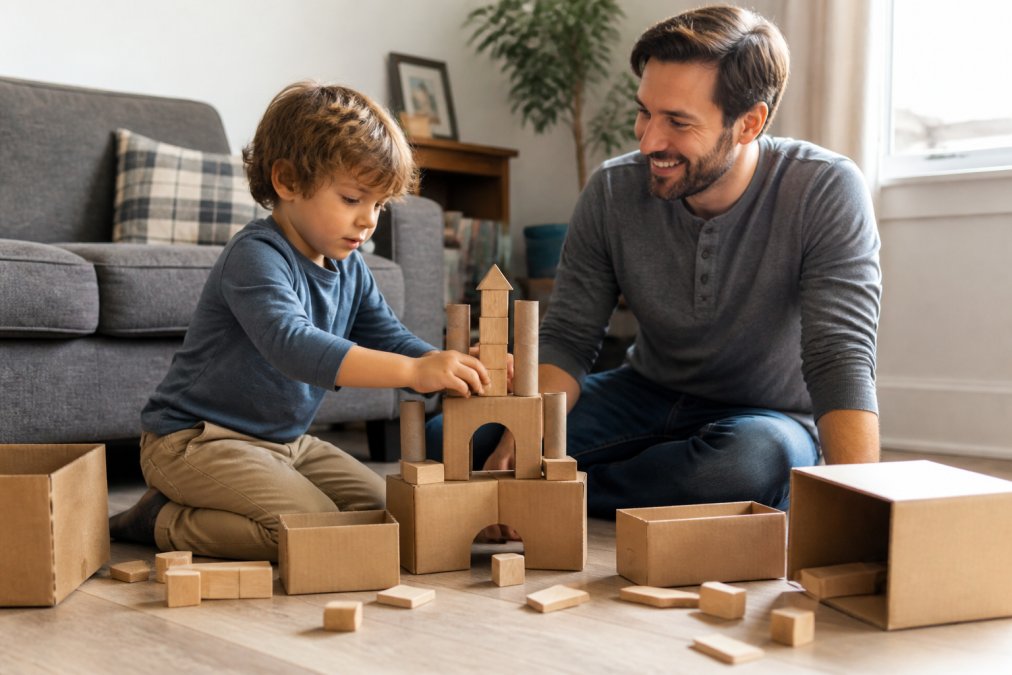
The biggest mistake here is over-directing. If you narrate every move or correct the story, the play becomes yours instead of theirs. Sit nearby, answer questions, and follow their lead.
Simple Materials That Spark Pretend Play
You do not need an expensive toy haul. The best pretend play materials are cheap, flexible, and slightly unfinished:
- Cardboard boxes and tubes
- Fabric scraps and old scarves
- Wooden blocks and stacking cups
- Kitchen tools, empty containers, and measuring spoons
- Drawing paper, crayons, and tape
Step 3: Protect Free Time and the Importance of Boredom for Child Creativity
Understanding the importance of boredom for child creativity changes how you respond to "I'm bored." Boredom is not a failure of your planning. It is the pause where a child's mind starts generating its own material.
Many parents fill every quiet moment with an activity, a question, or a screen. That instinct is understandable but counterproductive. Children need unstructured play and free time to practice divergent thinking, the ability to generate multiple solutions to the same problem.
When your child says they are bored, resist the urge to solve it immediately. Offer a single open prompt ("What could we build with this?") and then wait. The first few minutes are uncomfortable; the next twenty are usually where the good ideas show up.
Step 4: Use Storytelling and Interactive Reading to Grow Imagination Skills
Storytelling and interactive reading are the fastest tools for building imagination skills because they ask a child to hold a picture in their head and add to it. Instead of reading straight through, pause and invite participation.
- Ask "What do you think happens next?"
- Change a character's name to your child's
- Let your child "read" the pictures to you
- Add sound effects and voices
Interactive reading builds literacy and listening skills alongside imagination, which is why it earns a permanent slot in any daily routine.
How Bravo Bear Stories Make Daily Reading Stick
The hardest part of daily reading is consistency. Bravo Bear's edu-tainment series, created by CJ Hainsworth, is built around stories that blend heart and fun with meaningful life lessons, which gives children a reason to ask for the next one. The series is designed to help children grow with kindness, confidence, and courage, so the reading habit and the values habit reinforce each other. You can start with the Bravo Bear Monthly Book Club at $14.99, or pick up the Bravo Bear Complete Set at $79.99 if you want a full shelf ready to go.

Step 5: Ask Questions That Build Creative Thinking and Curiosity
Curiosity is a skill you can practice through questioning. The trick is to ask questions that have no single right answer, then genuinely listen to the response.
Try swapping closed questions for open ones:
- Instead of "Did you have fun?" ask "What was the most surprising part?"
- Instead of "What color is this?" ask "What else could this be?"
- Instead of "Is that right?" ask "How did you figure that out?"
These prompts build critical thinking and self-expression. They also signal to your child that their ideas are worth hearing, which is one of the strongest predictors of a child who keeps creating.
Step 6: Adapt Imagination-Building for Neurodivergent Kids
Neurodivergent children often need the same ingredients with different proportions: more predictability, more sensory support, and more time. The goal is not to force a neurotypical play script but to find the entry point that works for your child. What follows are concrete adjustments organized by the profile you are most likely to see.
For Children Who Crave Predictability
Autistic children and others who thrive on routine often find open-ended play overwhelming because the possibilities are too wide. Narrow the frame without narrowing the imagination:
- Offer a choice between two activities rather than an open "what do you want to do?"
- Use a visual schedule with picture cards so the child knows play time comes before or after a specific event
- Introduce one new material at a time, keeping the rest of the setup identical
- Build on a preferred interest, trains, dinosaurs, maps, rather than redirecting away from it
A common pattern is that when the environment is predictable, the play itself becomes more elaborate, not less. The child is not less imaginative; they needed the runway cleared first.
For Children With High Sensory Needs
Sensory-seeking and sensory-avoidant children need opposite adjustments, and mixing them up backfires.
- Sensory-seeking: heavy work before play (carrying books, pushing a laundry basket), textured materials like kinetic sand, play dough, or water beads, and permission to move while playing
- Sensory-avoidant: a quieter corner, fewer materials visible at once, soft lighting, and noise-reducing headphones available but not forced
Watch for the moment your child's play shifts from engaged to frantic or from engaged to withdrawn. That shift is the signal to adjust the environment, not to push through.
For Children With ADHD
Sustained pretend play can be hard when attention pulls in every direction. Shorter bursts work better than long blocks:
- Set a five-minute timer and let the child reset when it goes off
- Allow the story to change direction mid-play without correction
- Use movement as part of the play, acting out a story, building an obstacle course, narrating while jumping
- Keep materials in one visible bin so setup does not become the barrier
Language and Communication Differences
Some children show imagination through movement, building, or sound rather than spoken storytelling. Do not equate quiet with uncreative. A child who arranges blocks into a complex city but does not narrate it is still doing imaginative work. Follow the channel your child uses.
Longer Wait Times and Parallel Play
Many parents find that when the environment fits the child, imaginative play emerges on its own schedule. Two adjustments help most:
- Wait a full ten seconds after asking a question before offering a prompt
- Allow side-by-side play before expecting collaborative pretend play, parallel play is a legitimate destination, not just a stepping stone
Patience here is not passive; it is the active ingredient. The child is not behind. They are building the same skill through a different door.
Step 7: Balance Screens and Imagination in the Digital Age
Most guides treat screens as something to subtract. That framing misses half the picture. The real skill is teaching your child to move between two modes: consuming media and creating with it. A child who watches a show and then rebuilds the story with toys is doing creative work. A child who watches for four hours straight is not. The difference is not the screen itself, it is whether the screen is the endpoint or the starting point.
The Consume-to-Create Rule
Try a simple handoff: every screen session ends with a creative prompt tied to what your child just watched or played. This turns passive input into imaginative output and gives you a natural off-ramp instead of a power struggle.
- Watched an animal documentary? Ask them to draw the creature they would invent.
- Played a building game? Hand them blocks and ask them to rebuild it in real life.
- Listened to a song? Have them make up new words to the tune.
The prompt does not need to be elaborate. The point is that the screen feeds the imagination instead of replacing it.
Creative Apps Worth Using on Purpose
Not all screen time is equal. Some tools are built for making rather than watching, and those are the ones worth putting in front of your child deliberately:
- Drawing and animation apps that let kids build a character and move it
- Story-creation apps where a child records narration over their own pictures
- Music-making apps with simple loops and sound effects
- Coding-for-kids platforms that turn logic into a playable game
A common pattern is that parents who curate two or three of these tools see their children treat the tablet as a workshop rather than a TV. The screen becomes a material, like clay or cardboard.
Digital Storytelling as a Family Habit
One of the strongest bridges between screens and imagination is digital storytelling. Your child can dictate a story while you type it, then illustrate it with drawings or photos, and read it aloud at bedtime. This combines literacy, sequencing, and self-expression in a single activity, and it produces something your family keeps.
Where Limits Still Matter
None of this replaces the need for screen-free windows. The ordering rule still holds: screens come after a screen-free block, not before, so the imaginative habit gets protected first. For age-based guidance, the American Academy of Pediatrics guidance on screen time offers a framework for appropriate limits by developmental stage.
The families who sustain this long-term tend to do one thing well: they make the imaginative option the easy default. Books within reach, materials visible, screens out of the room during play. Environment does more work than willpower, and when screens are used, they are used to make something, not just to fill time.
Frequently Asked Questions
What is the 3-3-3 rule for kids and can it help with imagination?
The 3-3-3 rule is a simple daily structure: three minutes of focused connection, three minutes of child-led play, and three minutes of quiet reflection or storytelling. For imagination, the child-led segment matters most because it hands control to your child and lets pretend play, storytelling, and divergent thinking develop without adult direction. It works well as a starter habit if you are just beginning to foster child imagination daily, and you can stretch each block as your routine settles in.
What are the best screen free activities for young children to boost imagination?
Open-ended materials do the heavy lifting: cardboard boxes, blankets, dress-up clothes, crayons, and plain paper. Add sensory experiences like play dough or a bin of dried beans, and rotate in storytelling games where your child invents the ending. Unstructured play outdoors, such as collecting leaves or building with sticks, also counts. The key is that the activity has no fixed outcome, so your child decides what it becomes. Aim for at least one long screen-free stretch each day.
How long should I let my child be bored before stepping in?
Give it 10 to 15 minutes of genuine free time before offering anything. The importance of boredom for child creativity shows up in that uncomfortable gap: when nothing is provided, kids start generating their own ideas, games, and stories. If your child complains, acknowledge the feeling without fixing it, then point to available materials rather than suggesting a specific activity. Most children move from whining to playing within a few minutes once they realize the entertainment is their job.
Can the same stories work for a 3-year-old and a 7-year-old?
Yes, with different framing. Younger children respond to the pictures, repetition, and simple emotional beats, while older kids can discuss the character's choices, predict what happens next, and retell the story from another character's view. A series like the Bravo Bear books works across that range because the lessons about kindness, confidence, and courage scale with the conversation you have. Read together and let each child engage at their own level.


