

How to Build Confidence in Young Children: 7 Steps
Table of Contents
- Step 1: Model Confidence and Self-Talk in Daily Life
- Step 2: Praise Effort, Not Just Results
- Step 3: Let Your Child Experience Safe Failure
- Step 4: Use Activities to Build Self-Esteem in Children
- Step 5: Learn How to Help Children Overcome Fear
- Step 6: Practice Positive Affirmations for Kids
- Step 7: Encourage Independence and New Challenges
- Common Mistakes to Avoid When Building Confidence
- Frequently Asked Questions
Last Updated: September 12, 2026
Step 1: Model Confidence and Self-Talk in Daily Life
Children learn how to build confidence in young children by watching the adults around them first. Before a child can believe in themselves, they need to see what self-belief looks like in action. That means modeling calm self-talk when things go wrong, not just when they go right.
When you spill coffee or miss a turn, narrate your recovery out loud: "That was frustrating. I'll try again." This gives your child a template for handling their own mistakes.
A common mistake is hiding all struggle from kids. They don't need to see you fall apart, but they do need to see you recover. Self-efficacy, the belief that your actions produce results, starts with watching someone else try again after a setback.
Step 2: Praise Effort, Not Just Results
Praising effort over results is one of the most reliable ways to build confidence in young children. When you say "you worked so hard on that" instead of "you're so smart," you teach your child that ability grows with practice, not that it's fixed at birth.
This is the difference between a growth mindset and a fixed one. A child praised only for outcomes learns to avoid anything they might fail at. A child praised for trying learns that effort itself has value.
Try swapping a few phrases this week:
- "You kept going even when it got tricky."
- "I noticed you tried a different way when the first one didn't work."
- "That took real focus."
Step 3: Let Your Child Experience Safe Failure
Safe failure is a controlled, low-stakes mistake your child can recover from without real harm. Letting a child fail at something small, like a puzzle or a board game, builds resilience in a way that success never can.
Many parents instinctively swoop in to fix things. Resist that urge. A child who never experiences a small setback has no practice for the bigger ones. Coping mechanisms are built through repetition, not protection.
Start with low-stakes situations. Let them lose a game, struggle with a zipper, or watch a tower of blocks fall. Then stay nearby and let them decide what to do next. Your calm presence matters more than your help.
Step 4: Use Activities to Build Self-Esteem in Children
Activities to build self-esteem in children work best when they match your child's current skill level and stretch it just slightly. Too easy and there's no accomplishment. Too hard and the child gives up before the payoff. Developmental researchers often describe this as the "zone of proximal development", the gap between what a child can do alone and what they can do with a little help.
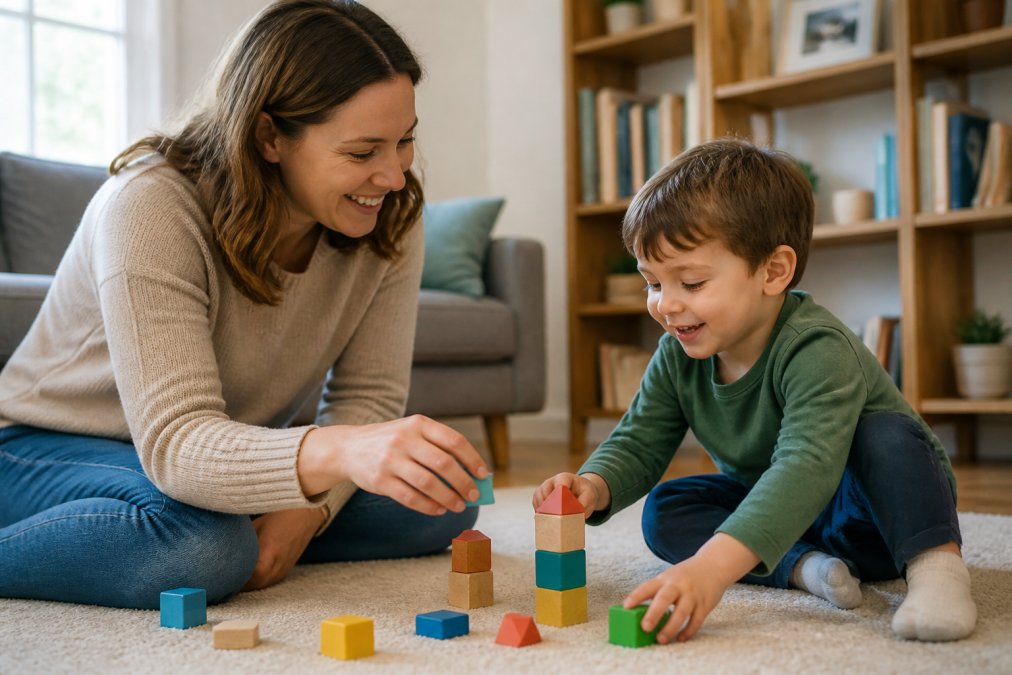
The activities that actually move the needle share three traits: they have a clear finish line, they require the child's own effort, and they allow for a do-over. Here's how that looks by age band.
Ages 2-3: Cause and effect. Stacking cups, shape sorters, and simple put-in/take-out toys. The win is immediate and visible. Let your child knock the tower down and rebuild it, the rebuild is the confidence rep.
Ages 4-5: Turn-taking and pretend play. Board games with one simple rule, dress-up, and pretend kitchen play. These build the idea that their choices shape what happens next. Resist the urge to let them win every time; a child who never loses a round of Candy Land has no practice recovering from a loss.
Ages 6-8: Real contribution. Setting the table, feeding a pet, packing their own backpack, riding a bike without training wheels. These are the years when "I helped" becomes "I can." Assign one chore that is genuinely theirs, not a favor you could do faster.
Ages 9-12: Skill-building with feedback. Learning an instrument, joining a rec team, cooking a full recipe, coding a simple game. At this stage, confidence comes from visible improvement over weeks, not from a single success. Help them track progress, a practice log, a photo of each attempt, a chart on the fridge.
A few practical guardrails:
- Simple turn-taking games that require patience
- Chores matched to age, like setting the table
- Creative projects with no "right" answer
- Physical challenges like climbing or balancing
The goal isn't the finished product. It's the moment your child realizes they did it themselves. That moment is where self-worth gets built, and it can't be handed to them.
Step 5: Learn How to Help Children Overcome Fear
Learning how to help children overcome fear starts with validation, not reassurance. Telling a scared child "there's nothing to be afraid of" dismisses the feeling. Naming it, "that does look scary," tells them you take them seriously.
Once the feeling is acknowledged, you can work on the fear in small steps. If your child is afraid of the dark, don't remove the nightlight all at once. Dim it gradually over a week or two. Each small success builds the confidence to try the next step.
Emotional regulation develops slowly. Your job isn't to eliminate fear. It's to show your child that fear is survivable and that they have tools to handle it.
Step 6: Practice Positive Affirmations for Kids
Positive affirmations for kids work when they're specific, believable, and repeated. A generic "I am amazing" rarely lands. A concrete "I can try again when something is hard" gives a child something to actually use.
Here's the mechanism most advice skips: affirmations don't overwrite a child's self-belief, they compete with it. If a child already believes "I'm bad at math," repeating "I'm great at math" creates what psychologists call cognitive dissonance, and the brain usually resolves that by rejecting the affirmation, not the belief. The fix is to aim affirmations at the process the child can actually control, not the trait they doubt.
So instead of "I'm smart," try:
- "I can ask for help when I need it."
- "Mistakes help me learn."
- "I am brave enough to try."
- "I can do hard things slowly."
- "My brain grows when I practice."
Introduce affirmations as part of a routine, like bedtime or the car ride to school. Keep them short. Let your child pick one or two that feel true to them. Forced positivity backfires, so skip anything that feels like a stretch.
A few things that make affirmations stick:
Pair them with evidence. After your child says "I can do hard things," ask them to name one hard thing they did today. The affirmation plus a real memory is far more durable than the phrase alone.
Let them write their own. A seven-year-old's version of "I am brave" might be "I pet the big dog even though I was scared." That specificity is the point.
Model them out loud. Kids copy what they hear. Say your own affirmation in front of them: "I'm nervous about this meeting, and I'm going to try anyway."
Watch for the eye-roll. If your child is mocking the affirmation, it's not landing. Drop it and try a different phrasing, or switch to a question: "What's something you did today that was a little hard?"
Over time, these phrases become the voice in your child's head when you're not there to offer them, but only if the child has real evidence to back them up.
Step 7: Encourage Independence and New Challenges
Encouraging independence means letting your child do things you could do faster yourself. It's slower, messier, and often frustrating. It's also how autonomy and competence get built.
Give your child real choices within safe limits. Let them pick their outfit, pour their own drink, or decide the order of the bedtime routine. Each small decision reinforces that their judgment matters.
New challenges should feel like invitations, not tests. Offer them without pressure. "Want to try?" works better than "You should try." If they say no, leave the door open and try again another day.
Common Mistakes to Avoid When Building Confidence
The biggest mistake parents make is confusing confidence with constant praise. Overpraising a child for ordinary things, like finishing a snack, dilutes the value of real encouragement and can create anxiety about living up to the hype.
Other common missteps:
- Rescuing too quickly instead of letting a child struggle briefly
- Comparing siblings or peers, which fuels rivalry rather than self-worth
- Ignoring your child's temperament in favor of a one-size-fits-all approach
- Overlooking how digital media shapes self-image, especially for kids who spend hours on screens
Sibling dynamics matter too. A child who feels constantly measured against a brother or sister will struggle to build confidence on their own terms. Give each child separate praise and separate challenges.
For children who are neurodivergent, standard advice may need adjusting. A child with ADHD or autism may need more explicit modeling, more repetition, and more patience before a new skill sticks. The principles are the same, but the pace and the cues change.
Classroom confidence deserves attention as well. Talk with teachers about how your child participates, and look for small wins you can reinforce at home. A child who feels capable at school carries that feeling into everything else.
Stories can help here. A well-told tale about a character who tries, stumbles, and keeps going gives your child a model they can return to again and again. That's the idea behind the Collaborative for Academic, Social, and Emotional Learning's framework for social-emotional learning, which emphasizes modeling and practice over instruction.
This is where Bravo Bear fits naturally. The edu-tainment series from CJ Hainsworth was built around kindness, confidence, and courage, and each story gives children a character to root for and a lesson to absorb without feeling lectured. If you want a structured way to bring those themes into your routine, the Bravo Bear Monthly Book Club delivers a new story each month for $14.99, and the Bravo Bear Complete Set collects the full library for $79.99.


For guidance on how children develop these skills at different ages, the American Academy of Pediatrics' resources on child development offers practical, age-specific advice. And for parents navigating screen time and digital media, the American Psychological Association's guidance on children and media is worth reviewing.
Frequently Asked Questions
What causes low self-esteem in young children?
Low self-esteem often stems from repeated criticism, unrealistic expectations, or too few chances to succeed on their own. Children who hear constant correction or who are compared to siblings may start believing they cannot do things right. Other causes include limited opportunities for independent problem-solving, frequent failure without supportive guidance, and environments where mistakes are punished instead of treated as learning moments. Confidence builds when children feel capable and accepted, not perfect.
How can I help my child overcome fear and try new things?
Start by validating the fear instead of dismissing it. Say something like, 'That does look scary. Let's try it together.' Break the new experience into small steps so your child can succeed at each stage. For example, if they fear the slide, begin by sitting at the bottom together. Praise each attempt, not just the final result. Children who feel safe taking small risks build the resilience to face bigger ones over time.
What role does praise play in building a child's self-esteem?
Praise shapes how children see themselves. Praising effort, strategy, and persistence teaches them that growth comes from trying, which supports a growth mindset. Generic praise like 'You're so smart' can backfire when tasks get harder because children may avoid challenges to protect that label. Specific praise such as 'You kept trying even when it was tricky' builds intrinsic motivation and shows your child that their actions matter more than a fixed trait.
What are some daily habits that foster confidence in toddlers?
Give toddlers simple choices, like picking between two shirts or two snacks, to build autonomy. Let them try self-care tasks such as putting on shoes, even if it takes longer. Narrate their successes: 'You climbed those stairs all by yourself!' Read stories that model courage and kindness, and talk about the characters' choices afterward. Consistent routines also help toddlers feel secure, which is the foundation confidence grows from.
Building confidence in a young child is slow work. It happens in small moments: a recovered mistake, a game lost without tears, a choice made alone. Bravo Bear was created to support exactly that kind of growth, with stories that model kindness, confidence, and courage in ways children actually remember. Shop the series and give your child a world where trying is the win.


