

How to Teach Gratitude to 4 Year Olds Through Daily Habits
Last Updated: November 7, 2026
Quick Summary
To teach gratitude to 4 year olds, build small daily habits instead of giving lectures: ask one bedtime question like "What was one good thing today?" and name your own answer. Preschoolers learn by imitation, so model thank-yous out loud and keep activities under 10 minutes.
- Gratitude activities for preschoolers should feel like play and last under 10 minutes.
- Bedtime is the easiest place to build the habit because it already happens every night.
- A four-year-old's attention for a seated task is often only three to five minutes.
- Start with one row of the weekly plan and add another only when the first feels automatic.
- A robotic thank you is a normal stepping stone, not a failure, at age four.
Table of Contents
- Why Gratitude Fits a 4-Year-Old's Brain
- How to Explain Gratitude to a Child in Words They Understand
- Gratitude Activities for Preschoolers That Take Under 10 Minutes
- Ways to Model Gratitude for Children Without Lecturing
- Gratitude Books for Preschoolers That Open the Conversation
- What to Do When Your Child Says Thank You on Autopilot
- Building a Gratitude Routine You Can Actually Keep
- Frequently Asked Questions
Why Gratitude Fits a 4-Year-Old's Brain
Gratitude is the habit of noticing something good and naming where it came from.
Parents often ask how to teach gratitude to 4 year olds without turning it into a lecture. The answer is repetition, modeling, and tiny moments.
Preschoolers are wired for imitation, not instruction. A child who hears "thank you" a hundred times a week will start saying it.
So the goal is simple: build small habits that make gratitude feel normal, not forced.
How to Explain Gratitude to a Child in Words They Understand
Gratitude for a four-year-old is not an abstract virtue. It is a feeling tied to a moment: the warm cookie, the friend who shared a toy, the grandparent who called.
Here is a simple script you can use:
- "Gratitude means noticing something good and feeling glad about it."
- "It's when you say 'thank you' and really mean it."
- "It's also when you help someone else feel glad."
Keep it short. One sentence is plenty. Then point to a real example: "Remember when Grandpa brought you that book? That's a moment to feel grateful for."
Young children learn best when the concept is attached to something they can see, touch, or remember.
Gratitude Activities for Preschoolers That Take Under 10 Minutes
Quick activities work better than long lessons for this age group. For story-based activities that pair well with gratitude practice, see teaching empathy to preschoolers through stories.
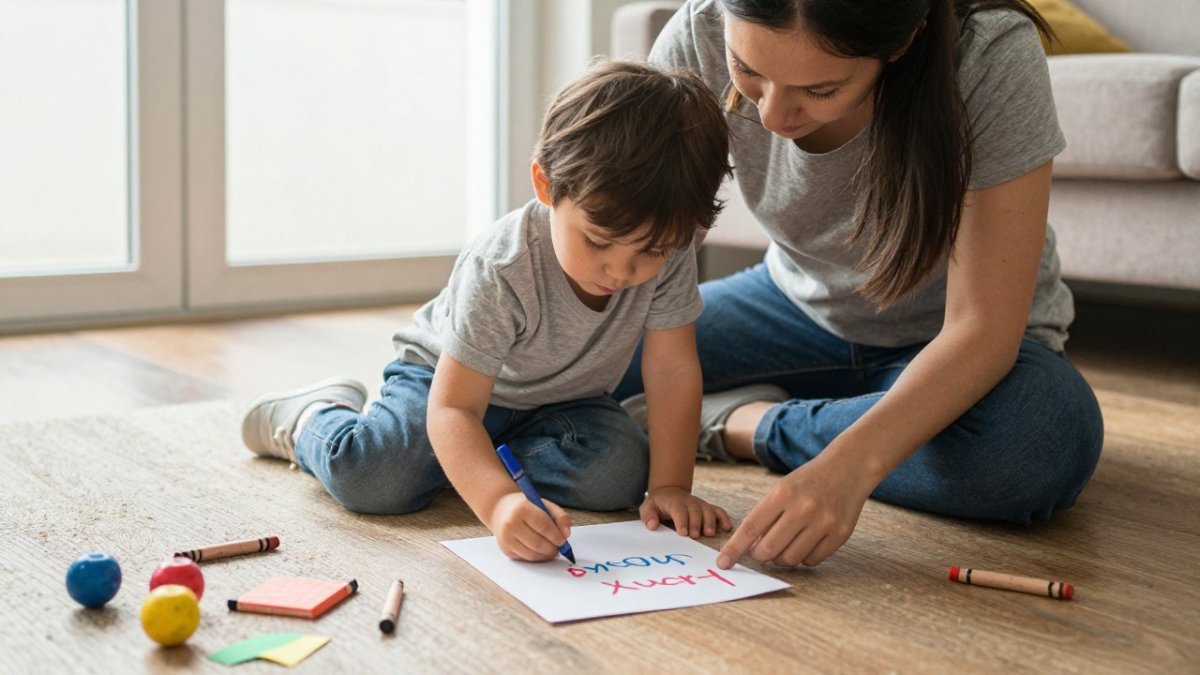
Everyday Play Ideas
- Thank-you cards: Draw one for a neighbor, a teacher, or a grandparent. Five minutes, one crayon, done. Keep the card to one folded sheet, a four-year-old's attention for a seated task is often only three to five minutes, so plan to stop while it is still fun.
- Gratitude jar: Drop a small note or drawing in a jar each night. Read them together on Sundays. Let the child choose the jar and decorate it; ownership is what makes them return to it.
- The "thankful walk": Point out three things outside you're glad about, like the sun, a bird, or a favorite tree. This one works especially well for high-energy children because the body is moving while the brain is noticing.
A Simple Thank-You Ritual for Bedtime
Bedtime is the easiest place to build a habit because it already happens every night. Ask your child one question: "What was one good thing today?" Then name your own answer.
If your child struggles with bedtime or anxiety, this ritual can double as a calming routine. For more ideas, see what is the best bedtime routine for anxious children.
What to Do When the Activity Goes Sideways
Gratitude activities can go sideways in predictable ways. Having a response ready can keep the moment from turning into a power struggle.
- Child refuses to participate: Offer a choice between two versions ("Do you want to draw the card or pick who we send it to?"). If they still decline, do the activity yourself out loud and let them watch. Modeling beats forcing every time.
- Child runs off mid-activity: Follow the body, not the craft. Turn the activity into a movement version, walk to the mailbox to deliver the card, or do a "thankful lap" around the yard naming one thing per lap.
- Child gets silly or disruptive: Name the energy without shaming it ("Your body has a lot of wiggle right now") and give a physical outlet before returning. A thirty-second jump break often buys five more minutes of focus.
Watch out: turning an activity into a test ("Now tell me three things you're grateful for") can produce resistance at four. The activity is the point, not the output.
Adapting Activities for Sensory and Developmental Needs
A four-year-old with sensory sensitivities, ADHD traits, or developmental differences may need the activity reshaped rather than repeated. A few adjustments to consider:
- Swap the craft for the body: For children who avoid fine-motor tasks, a "thankful stomp" (one stomp per thing you're glad about) delivers the same noticing with none of the table time.
- Shorten the window: Two minutes of a preferred version beats ten minutes of a resisted one. Set a visual timer so the child can see the end.
- Reduce the audience: Some children freeze when asked to perform gratitude in front of others. A private ritual with one trusted adult is still a real ritual.
If a child consistently cannot engage with even two-minute activities, or if high activity and refusal are paired with other developmental concerns, that is a conversation for a pediatrician rather than a parenting article. The activities here are not a screening tool.
Ways to Model Gratitude for Children Without Lecturing
Children learn gratitude by watching, not by being told. Ways to model gratitude for children come down to what you do out loud.
Try these:
- Say thank you to the cashier, the mail carrier, and your child.
- Name your own gratitude: "I'm glad the sun came out today."
- Point out kind acts: "That driver let us go. That was nice of them."
If you want a deeper step-by-step approach to teaching a related trait, our guide on how to teach kindness to preschoolers walks through seven practical steps.
Gratitude Books for Preschoolers That Open the Conversation
Stories do something a lecture cannot: they let a child feel gratitude from the inside.
A few things to look for:
- A clear moment of giving or receiving
- Simple language a four-year-old can repeat
- Pictures that show emotion on faces
At Bravo Bear, our edu-tainment stories are built around kindness, confidence, and courage. You can shop the Bravo Bear collection to find stories that open these conversations naturally.
Before choosing titles, it helps to know what makes a book right for your child's reading stage. Our parent's guide on how to choose books for early readers covers what to look for.
What to Do When Your Child Says Thank You on Autopilot
A robotic "thank you" is not a failure. It is a stepping stone.
Four-year-olds repeat phrases before they understand them. That is normal and healthy. The understanding comes later.
Here is how to gently add meaning:
- Ask a follow-up: "What are you thankful for about that?"
- Connect the words to the action: "Grandma drove all the way here to see you."
- Praise the noticing, not just the words: "I love that you saw how kind that was."
Watch out: correcting a child in the moment ("Say it like you mean it") tends to backfire. It turns gratitude into a performance.
Building a Gratitude Routine You Can Actually Keep
A routine only works if it survives real life. Keep it small enough to do on a tired Tuesday. The mistake most parents make is building a routine for their ideal week rather than their actual one, so the plan below is designed to be trimmed, not expanded.
Here is a simple weekly plan:
| Day | Habit | Time |
|---|---|---|
| Monday | Thank-you card to someone | 5 minutes |
| Wednesday | Gratitude jar note | 2 minutes |
| Friday | Thankful walk outside | 10 minutes |
| Every night | Bedtime "one good thing" | 2 minutes |
Time
Start with one row. Add another only when the first feels automatic. Parents often quit because they aim too high. A two-minute bedtime question beats a forgotten weekly craft every time.
An Age-Banded Plan for the Four-Year-Old Year
A four-year-old in September and a four-year-old in June are not the same child. Adjust the routine to the developmental moment rather than the calendar.
- Early four (still mastering language): Keep the whole routine to the bedtime question and one modeled thank-you per day. Skip the jar and the cards; the child is still learning that words connect to feelings.
- Mid four (imitating and repeating): Add the gratitude jar. Let the child draw rather than write. Expect repetition of the same answer for weeks, that is normal, not a failure.
- Late four (starting to notice others): Add the thank-you card and the helper job. This is when "Grandma drove here to see you" starts to land as a concept rather than a phrase.
Coordinating the Routine Across Caregivers
A gratitude habit collapses when the language changes from house to house. A few practical moves keep it consistent:
- Pick one shared phrase. If bedtime is "one good thing" at home, ask grandparents and childcare providers to use the same phrase rather than inventing their own.
- Share the jar. A small notebook that travels in the backpack lets a childcare provider add a note the child can read at home.
- Agree on what not to do. Ask caregivers not to quiz the child ("What are you thankful for?") as a performance. The routine is a habit, not a test.
Measuring Progress Without Expecting a Quieter Child
The goal is not a child who says thank you on command. Observable signs that the routine is working include:
- Faster recovery after frustration, the child returns to a calm state in minutes rather than tens of minutes.
- Safer transitions, leaving a preferred activity with fewer protests, because the routine has taught the child that good things return.
- Spontaneous noticing, the child points out a kind act or a nice thing without being prompted.
Watch out: if you find yourself measuring the routine by how often the child says "thank you," you will misread progress. At four, the words lag the noticing, sometimes by months.
When to Adjust or Stop
A routine that produces tears, resistance, or dread is not working, and the fix is almost always smaller, not bigger. Drop to the single bedtime question for two weeks and rebuild from there.
Teaching gratitude to a four-year-old takes patience, repetition, and stories that make the lesson stick. At Bravo Bear, we create edu-tainment stories that help children grow with kindness, confidence, and courage, so the values you teach at home have a world to live in.
Frequently Asked Questions
How do you explain gratitude to a 4-year-old?
Keep it concrete. A 4-year-old understands gratitude as a warm feeling that comes when someone helps them or gives them something. Try saying, "Gratitude is the happy feeling you get when someone shares with you, and it's the feeling you give back when you say thank you." Tie it to a moment they remember, like a friend sharing a toy at the park, rather than abstract ideas about being thankful.
What gratitude activities work best for preschoolers?
Short, hands-on activities work best for this age. Try a daily thank-you jar where your child drops in a drawn picture of something good that happened, a bedtime round of naming one person who helped them that day, or drawing a thank-you card for a neighbor. Keep each activity under 10 minutes and repeat it often. Repetition, not length, is what builds the habit.
Can books and stories help teach gratitude to young children?
Yes. Stories give a 4-year-old a character to watch being thankful, which is easier to copy than a rule to follow. Choose picture books where a character notices something kind and responds to it, then ask one simple question afterward, like "What made the bear feel happy?" A short story at bedtime turns gratitude into a shared moment instead of a lesson, and children often bring the language back on their own.
How can parents model gratitude for preschoolers without making it feel forced?
Say your thanks out loud in ordinary moments. Thank the cashier, thank your child for handing you a shoe, and name why: "Thank you, that helped me." Let your child see you appreciate small things, like sunshine or a good meal. When you model gratitude for children this way, they copy the tone and the words without being prompted, and it feels like part of family life rather than a performance.


