

How to Choose Books for Early Readers: A Parent's Guide
Last Updated: November 5, 2026
Quick Summary
To learn how to choose books for early readers, pick books a child can mostly read alone, with about one to three unknown words per page. Check reading levels from the teacher's system, run the five finger test, and favor decodable books with repeated sound patterns.
- Pick books where a child reads most words and needs help with only a few
- Use the five finger rule: one to three fingers up means a good fit
- Ask the teacher which reading level system the classroom uses
- Check that a phonics book follows a scope and sequence of sounds
- For four-year-olds, choose large illustrations and short, repeated text for read-aloud
Table of Contents
- Why the Right First Books Matter for Early Readers
- How to Use the 5 Finger Rule to Test a Book
- Identifying Reading Levels Before You Buy
- Choosing Early Reader Books with Phonics Support
- Picking First Reading Books for 4 Year Olds
- Selecting Books Your Child Will Actually Want to Read
- Building a Starter Reading Set Your Child Can Grow With
- Frequently Asked Questions
Why the Right First Books Matter for Early Readers
Choosing how to choose books for early readers can feel overwhelming when the shelves are full of bright covers. Bravo Bear builds edu-tainment stories around kindness, confidence and courage, and a well-chosen first book can turn a hesitant child into a willing one. The wrong book, though, can make a child feel behind before they have even started.

Early readers need books they can mostly read on their own. A book that is too hard causes frustration. A book that is too easy bores them. The sweet spot is a book where a child can read most words and still needs a little help with a few.
That is why the first choice matters so much. Confidence grows with each small win, so pick books that give your child those wins.
- Wins build confidence, and confidence keeps kids reading
- Frustration with hard text often ends the reading session early
- Books a child enjoys get read again and again
How to Use the 5 Finger Rule to Test a Book
The five finger rule is one of the simplest ways to check if a book fits your child. Have your child read one full page aloud. Each time they hit a word they cannot read, they hold up one finger. Stop at five fingers, and check how the page went.
If your child has no fingers up, the book may be too easy. If they have one to three fingers up, the book is a good fit. If they have four or five fingers up before the page ends, the book is probably too hard for independent reading.
Use this quick check before you buy:
- 0 fingers: Too easy, good for a confidence boost
- 1-3 fingers: Just right for independent practice
- 4-5 fingers: Better for read-aloud time with a grown-up
We recommend running the test on two or three pages, not just one. A single page can mislead you, especially if it has a lot of repeated words.
Identifying Reading Levels Before You Buy
Reading levels are the part of book selection that confuses parents most, because there is no single national standard. Three systems show up most often on American bookshelves, and each measures something slightly different.
Guided Reading levels (A-Z). Used by many school districts and printed on the back of many leveled readers, this system runs from A (the simplest) to Z (middle-school range). A typical kindergartner works in levels A-D, and a first grader often moves through D-J across the year.
Lexile measures. A Lexile score is a number, usually with an "L" after it (for example, 200L or 450L), and it estimates text complexity from sentence length and word frequency.
Developmental or grade bands. Labels like "Level 1," "Step into Reading," "I Can Read," and "Ages 4-6" are publisher-specific. Two books both marked "Level 1" from different publishers can differ by a full grade level in difficulty. Treat these labels as a shelf-sorting shortcut, not a measurement.
Because the systems do not line up, use them in this order:
- Ask your child's teacher which system the classroom uses and what level your child is working at right now.
- Match that system first when you shop, and ignore conflicting labels on the same book.
- Run your own five finger check on the first two pages before you commit, because a level is an average, not a guarantee.
Watch out: A printed level tells you how hard the text is, not how hard the topic is. A Level 2 book about losing a pet can be emotionally harder for a child than a Level 3 book about trucks, so pair the level with a flip through the story itself.
The printed level is a starting point only. When the level and the child disagree, trust the child.
The three reading-level systems parents most often see differ in what they measure, so here is how they compare.
| System | What it shows | Typical use |
|---|---|---|
| Guided Reading (A-Z) | Support a reader needs | A (simplest) to Z (middle-school range) |
| Lexile measure | Text complexity | Number with an "L", e.g. 200L |
| Publisher bands | Shelf-sorting label | "Level 1", "Ages 4-6" |
| Guided Reading, grade 1 | Typical level range | Often D-J across the year |
| Kindergarten, Guided Reading | Typical level range | Usually A-D |
Choosing Early Reader Books with Phonics Support
Phonics-based books help children connect letter sounds to written words, but "phonics" on a cover does not mean the book is actually decodable. A decodable book is built so that most words use sound-spelling patterns the child has already been taught, which lets them sound out the text instead of guessing from pictures or context.
Decodable books are usually sequenced. Early titles stick to short vowels and a handful of consonants (cat, sit, hop, mud), then add blends (stop, flag), then digraphs (ship, chat, thin), then long vowels and vowel teams (cake, rain, boat).
Predictable books work the other way. They repeat a phrase or sentence frame ("I see a red bird. I see a blue bird.") so a child can join in and predict the next line.
To check whether a book is genuinely decodable, open to a middle page and look for these signs:
- Most words can be sounded out with the phonics the child knows; only a few are "tricky" heart words taught by sight (the, said, was).
- The same sound-spelling pattern repeats across the page rather than appearing once.
- Pictures support meaning but do not give away the word, so the child cannot simply look at the drawing and guess.
- The sentences are short enough that a child can hold the whole line in mind while decoding.
A quick test: cover the picture and ask your child to read one sentence. If they can decode most of it without the picture, the text is doing its job. If they need the picture for every word, the book is relying on guessing.
Watch out: Many books marketed as "phonics readers" are actually predictable books with a phonics label. Flip to a random page and count how many words follow the same pattern, if the page is full of different vowel sounds and irregular spellings, it is a leveled reader, not a decodable one.
Picking First Reading Books for 4 Year Olds
Four-year-olds are usually not reading on their own yet. At this age, the best books are often ones a grown-up reads aloud while the child looks at the pictures and joins in. Interactive books that ask questions or invite pointing keep little ones engaged.
Read-aloud time also builds vocabulary and story sense, even before a child can decode a single word. Choose books with bold, clear pictures and short text. Stories with rhyme and rhythm are especially helpful for young ears.
For first reading books for 4 year olds, look for:
- Large, clear illustrations on every page
- Short lines of text, ideally one or two sentences
- Repeated phrases that your child can say along with you
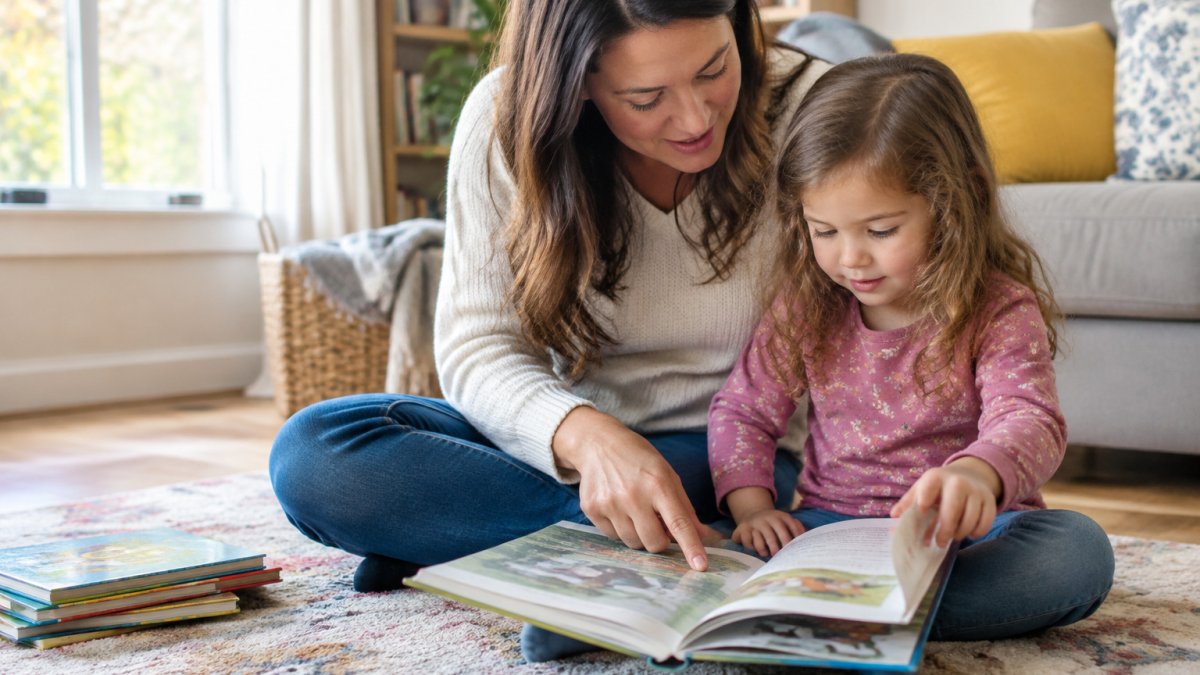
A four-year-old child sits cross-legged on a rug in a bright living room, turning the pages of a picture book while a parent points at the illustrations. Both are American.
Rhythm, Repetition and Illustrations
Books with a steady rhythm are easier for early readers to follow. Repetition gives children a pattern they can predict, which lowers stress and builds confidence. A phrase like "Can you see the red fox?" repeated across pages lets a child say the words before they read them.
Illustrations do real work too. Pictures give clues to unfamiliar words, and they help children retell the story in their own words. Strong illustrations also make a book worth picking up again.
When you judge illustrations, ask yourself:
- Do the pictures match the words on the page?
- Do they show details that help explain the story?
- Would your child want to look at them again?
Selecting Books Your Child Will Actually Want to Read
The best reading level in the world does not help if your child refuses to open the book. Start with your child's interests. A child who loves trucks, animals or princesses will work harder on a book about something they care about.
Try including your child in the choice. Let them pick between two or three books at the store or library. Ownership makes a big difference, and kids are more likely to read a book they chose themselves.
Consider these questions when choosing:
- What does my child talk about most right now?
- Does this book show characters who feel familiar to my child?
- Will my child want to hear this story more than once?
A book that holds your child's attention is worth more than one that scores well on a chart.
Building a Starter Reading Set Your Child Can Grow With
A small, well-chosen set of books works better than a huge pile. Aim for a mix of read-aloud favorites, easy books your child can read alone, and a few slightly harder books for growth. Rotate them so the set stays fresh.
Our Bravo Bear Complete Set brings together stories built around kindness, confidence and courage. You can find it here: Bravo Bear Complete Set for $79.99.
As your child grows, move up gradually. Keep a few favorites on the shelf for comfort reading, and add new titles as their skills grow. Over time, the set becomes a record of how far your child has come.
Frequently Asked Questions
What is the 5 finger rule for choosing books?
The 5 finger rule is a quick test for reading level. Have your child open a book to any page and read it aloud. Each time they hit a word they cannot read, they raise one finger. If you reach five fingers before finishing the page, the book is likely too hard for independent reading. Two to three fingers on a page usually means the book is a good challenge with some support. Zero to one finger means the book is comfortable and builds fluency. Use the test on several pages, not just one, because a single page can be misleading.
What are some recommended books for early readers?
Look for books with short sentences, repeated phrases, strong picture support, and a clear story. Decodable books that focus on the letter sounds your child is learning are useful for building phonics skills, while predictable books with repeated patterns help children build confidence. Bravo Bear's Complete Set is a good starting point for families who want stories that teach kindness, confidence and courage. Mix a few books that stretch your child with several they can read easily.
How do I know if a book is at the right reading level for my child?
Start with the 5 finger rule, then check whether your child can retell the story in their own words after reading. If they can explain what happened, the text is probably the right level. If they struggle to decode most words, the book is too advanced for now. Also notice whether they stay engaged. Interest matters as much as difficulty, so a slightly harder book about a topic your child loves can still work well with adult help.
Should I choose books with pictures or text-heavy books for beginners?
For most children starting out, books with strong illustrations are the better choice. Pictures give visual cues that help a beginner guess words from context, which supports comprehension while decoding skills develop. As your child gains confidence, move gradually toward books with more text and fewer images. Keep at least one picture-rich book in the rotation so reading stays enjoyable rather than becoming a chore.
Ready to start your child's reading adventure? Explore the Bravo Bear collection and find stories that build kindness, confidence and courage, one page at a time. Shop now.


