

9 Best Interactive Books for 4-Year-Olds That Kids Love
Last Updated: October 29, 2026
Quick Summary
Interactive books are picture books built around participation, such as flaps to lift, textures to touch, or prompts to point or press. For four-year-olds, they keep children engaged longer and support early language and listening skills. Choose sturdy board construction, simple actions, and a story worth repeating.
- Look for board or thick card flaps with reinforced folds, since thin paper flaps tear quickly.
- Aim for roughly eight to twelve flaps per sitting, and one or two moving parts per spread.
- Match the format to your child: avoid loud press-and-point books if they dislike unexpected sounds.
- Pause before reveals and ask follow-up questions to stretch the interaction beyond the physical action.
Table of Contents
- Why Interactive Books Work So Well at Age Four
- What to Look for in Interactive Books for Preschoolers
- Lift-the-Flap Books for Preschoolers That Hold Up to Repeat Reading
- Touch-and-Feel, Press-and-Point and Movement Books
- Read-Aloud Books for 4-Year-Olds That Invite Participation
- Books That Teach Kindness to Preschoolers
- Choosing the Right Book for Your Four-Year-Old's Next Read
- Frequently Asked Questions
Interactive books give four-year-olds something screens rarely do: a reason to hold a book, turn it, touch it and talk about it with someone they love. This guide covers what makes an interactive book work at this age, how to choose one, and how to get the most out of it at home. Interactive books are picture books built around participation, with flaps to lift, textures to touch, or prompts that ask the child to point, press or move.
Parents of young children are often looking for screen-time alternatives that still feel fun. Bravo Bear, an edu-tainment series created by CJ Hainsworth, centers on kindness, confidence and courage, and we have built this guide around those values as well as around play. The picks below are the kinds of books we would reach for at this age, along with the practical details that decide whether a book gets read once or a dozen times.
Why Interactive Books Work So Well at Age Four
Four-year-olds are curious about cause and effect. They want to open things, find things and make things happen, and an interactive book gives them a safe way to do that. A flap that reveals a surprise teaches anticipation. A texture to touch builds vocabulary around sensation.
Participation also keeps attention on the page. Many four-year-olds have short stretches of focus during a read-aloud, and interaction gives them a job to do between sentences. Adults often notice that a child who wanders off during a plain picture book will stay put for a story that asks them to find the hidden animal.
A common mistake is treating interactive books as only a novelty. The best ones pair the action with a story a child wants to hear again, and that repetition is where early language and reading habits form.
What to Look for in Interactive Books for Preschoolers
Not every interactive book suits a four-year-old's hands and attention span. Before buying, check these points:
- Sturdy construction. Flaps should be board or thick card, with reinforced hinges. Thin paper flaps tear within days of daily use.
- Simple, clear actions. One or two interactions per spread is plenty. Too many moving parts overwhelm a child and make the book harder to share.
- A story worth repeating. Look for rhythm, repetition and a clear arc. Preschoolers ask for the same book often, so the text needs to hold up.
- Safe for little hands. Check that small parts are attached firmly and that textures and mechanisms are age-appropriate.
- Room for the adult's voice. The book should invite a parent or caregiver to read, ask questions and react, not just run on its own.
We would skip any book whose mechanism is fragile or whose text is hard to read aloud. Those books tend to end up on a shelf rather than in a child's lap.
Lift-the-Flap Books for Preschoolers That Hold Up to Repeat Reading
Lift-the-flap books are the classic choice for this age, and they are also where the widest quality gap sits.
What separates a four-year-old book from a toddler flap book is the question on the flap. Toddler titles tend to hide a single object behind a single flap.
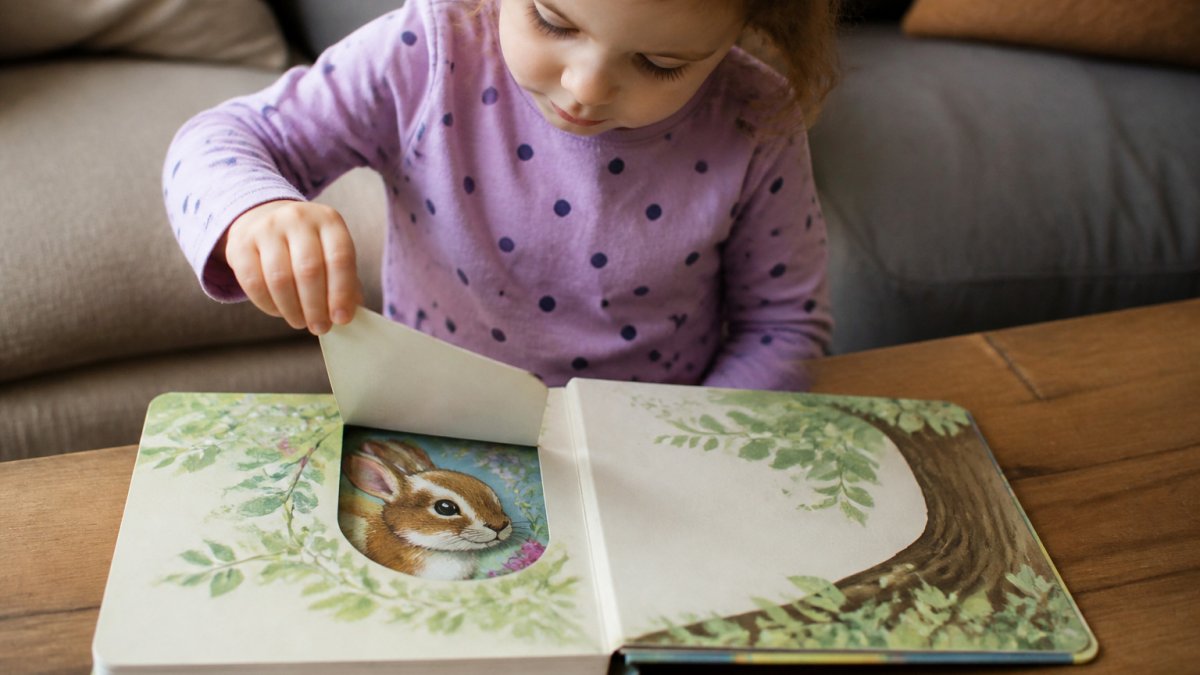
A comfortable flap count for one sitting is roughly eight to twelve. Books with dozens of flaps run longer than a four-year-old's attention allows, and the later flaps tend to get skipped.
When you read aloud, pause before the reveal and let your child name what they think is underneath. Run a finger under the flap question as you read it.
Durability notes to check before buying:
- Board versus paper flaps. Board flaps with a double-thick fold outlast single-layer paper flaps by a wide margin in daily use.
- Flap size. Larger flaps are easier for four-year-old fingers to catch, but they also catch on clothing and tear more easily. Mid-size flaps with a small tab are the most forgiving.
- Binding. A stitched or glued board binding holds up better than a thin paperback spine when a child opens the book flat on the floor.
- Number of moving parts per spread. One or two flaps per spread is plenty. Spreads with three or more mechanisms overwhelm a child and make the book harder to share with a sibling.
If your child is rough on flaps, a sturdy board lift-the-flap title is a better first purchase than a paper-flap novelty book, even if the paper book has a stronger story.
The article's key durability and sizing points for flap books are easy to compare at a glance:
| Check | Why it matters | What to look for |
|---|---|---|
| Flap construction | Thin paper flaps tear quickly | Board or thick card with a reinforced fold |
| Flap count per sitting | Too many flaps overwhelm attention | Roughly eight to twelve flaps |
| Moving parts per spread | Three or more mechanisms are hard to share | One or two flaps per spread |
| Flap size | Large flaps catch and tear | Mid-size flaps with a small tab |
| Binding | Thin spines fail when opened flat | Stitched or glued board binding |
Touch-and-Feel, Press-and-Point and Movement Books
Beyond flaps, three other interactive formats suit four-year-olds well, and each has its own buying criteria and realistic lifespan. Most guides lump them together; the practical differences matter more than the category label.
Touch-and-feel books have patches of different textures, such as fur, bumpy scales, soft fabric or smooth foil.
Durability note: glued-on texture patches are the weak point.
Press-and-point books ask the child to press a button, tap a shape or point to a picture, often with a sound or a light in response. They reward quick, deliberate action and suit children who like cause and effect.
Realistic expectation: a press-and-point book is often most enjoyable for the first few reads, then becomes a shared game between you and your child.
Movement books prompt the child to clap, wiggle, stomp or follow an action, sometimes with a song.
Accessibility and sensory considerations matter here more than in any other format. Some four-year-olds are sensitive to loud or unexpected sounds, and a press-and-point book that beeps without warning can end a storytime. Others dislike certain textures, particularly sticky or fuzzy patches. If your child has sensory preferences, preview the book yourself before sharing it, and be ready to skip a page or a patch without making it a battle. For children who do not enjoy noisy or tactile features, a lift-the-flap or a read-aloud participation book is a better fit than a novelty format.
Read-Aloud Books for 4-Year-Olds That Invite Participation
Read-aloud books with built-in participation work well at this age because they turn storytime into a conversation. Look for books that ask questions, repeat a refrain the child can join, or include animal sounds and actions to copy.
Shared reading is one of the most useful habits you can build at this stage. When you read aloud, run your finger under the words, ask the child what might happen next, and let them finish a rhyme or repeated phrase. These small moments build the vocabulary and listening skills that later reading depends on.
Accessibility matters here too. A book with large, clear illustrations and a moderate amount of text is easier to share with a child who is still learning to focus. Heavy text-to-picture ratios often lose preschoolers halfway through.
Books That Teach Kindness to Preschoolers
Many families want books that do more than entertain, and kindness is a common theme for this age. Four-year-olds are learning to notice how others feel, take turns and share, so stories that show these behaviors in simple, relatable situations can open useful conversations.
Books that teach kindness work best when the child can see themselves in the characters and the lesson is clear without being preachy. Look for stories where a character makes a small, brave choice, such as including a friend or trying something new. Afterward, ask your child what the character did and how they think it made someone feel.
Bravo Bear's edu-tainment series is built around this idea. Its stories blend heart and fun to show children growing with kindness, confidence and courage.
Choosing the Right Book for Your Four-Year-Old's Next Read
Start with your child. Notice what they already enjoy: animals, vehicles, bedtime stories, silly rhymes or big feelings. Choose a book that builds on that interest rather than trying to introduce a completely new topic at once.
Next, consider how you will read it. If you have a few minutes before bed, a short lift-the-flap book with a calm story fits well. For a longer, more active session, choose a book with movement prompts or more flaps to explore together.
Also think about how many books you want to add over the year. A single interactive book can be a strong gift, but a regular supply keeps a four-year-old excited about reading.
Check Bravo Bear's website for current prices before you buy. Whichever format you pick, the best interactive book is the one your child asks to read again tomorrow.
Frequently Asked Questions
What are the best interactive books for 4-year-olds?
The strongest picks for four-year-olds combine a simple, repeatable structure with a clear physical action. Lift-the-flap books, press-and-point titles and touch-and-feel books all give a child a reason to keep turning back to the page. Look for sturdy board pages, short text that a child can predict, and illustrations with enough detail to talk about. Stories that also model kindness or confidence add value when you read them together. Pick titles that match your child's current interests, such as animals, vehicles or everyday routines, so the book stays fun on the fifth read as well as the first.
Are lift-the-flap books good for 4-year-olds?
Yes. Lift-the-flap books suit four-year-olds well because they build fine motor control, prediction skills and vocabulary while keeping attention on the page. Children at this age can usually open flaps without tearing them, although thin paper flaps may still need supervision. Check that flaps are attached at both edges and that the hidden content is worth the lift. Books that ask a question before the flap opens, such as what animal is hiding, turn reading into a game and encourage the child to speak in full sentences.
How do I choose an interactive book for a 4-year-old?
Start with durability and the child's interests. Board pages and reinforced flaps hold up better to daily use than standard paper. Next, check the text length: a book with a few lines per page works well for read-aloud time, while longer text suits a child who can already follow a story. Consider the type of interaction you want, whether that is lifting, pressing, touching or moving. Finally, read the book yourself first to see whether the actions feel natural to say aloud. A book you enjoy reading will get read more often.
What kinds of interactive books help preschoolers learn kindness?
Stories that show a character making a kind choice, noticing someone else's feelings or trying again after a setback are useful for preschoolers. Interactive versions add a participation step, such as asking the child what the character should do next or which feeling a face shows. Pausing to connect the story to the child's own day helps the lesson transfer. Bravo Bear's stories are built around kindness, confidence and courage, which makes them a natural fit for this purpose. For current titles and availability, visit the Bravo Bear website and shop directly.


