

What Is the Best Bedtime Routine for Anxious Children?
Last Updated: October 27, 2026
Quick Summary
The best bedtime routines for anxious children are predictable, physical, and validating: dim the room at least 30 minutes before bed, slow your own body down, name the feeling out loud, and offer one physical anchor. Keep the same order every night, from wind-down signal to lights out, and avoid negotiating or talking about worries in the dark.
- Dim the room at least 30 minutes before bed so bright light stops signaling daytime.
- Belly breathing uses four counts in and six counts out to calm kids.
- Say I believe you and I am right here instead of there is nothing to be scared of.
- Staying until your child falls asleep makes your presence the sleep cue.
- Talk about worries earlier in a lit room, because dark rooms amplify scary thoughts.
Table of Contents
- Why Anxious Children Need a Different Kind of Bedtime Routine
- How to Calm a Child With Anxiety at Night
- Relaxation Techniques for Kids Before Bed
- What to Say to a Child Afraid at Night
- Building a Bedtime Routine for Kids That Sticks
- Common Mistakes Parents Make With Anxious Bedtimes
- Choosing Stories and Tools That Support Calm Bedtimes
- Finding the Right Bedtime Stories for Your Anxious Child
- Frequently Asked Questions
Why Anxious Children Need a Different Kind of Bedtime Routine
- Predictability they can count on, night after night
- A physical wind-down that lowers arousal before lights out
- Language that validates fear instead of dismissing it
How to Calm a Child With Anxiety at Night
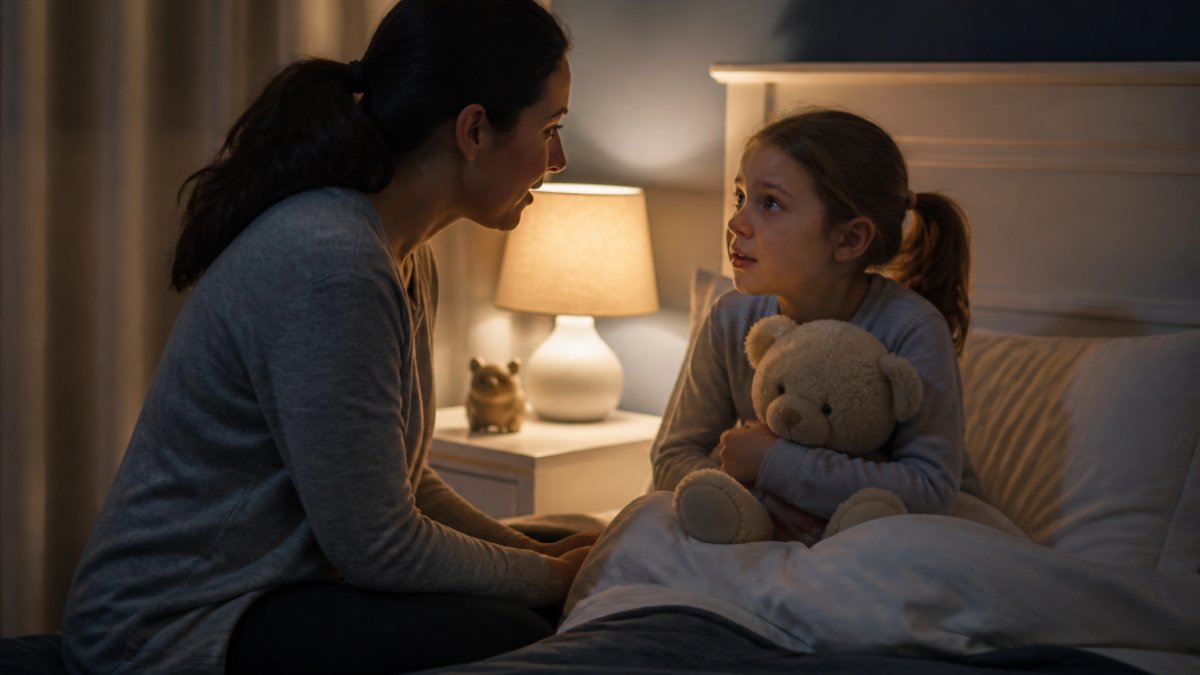
- Dim the room at least 30 minutes before bed. Bright overhead lights signal "daytime" to the brain.
- Slow your own body. Sit down. Lower your voice. Children borrow our calm before they can find their own.
- Name the feeling out loud. "Your body feels jumpy tonight. That's your worry talking."
- Offer one physical anchor. A weighted blanket, a stuffed animal, or a hand on their back gives the nervous system something steady to hold.
If nighttime fear is part of a bigger pattern, our guide on how to help children overcome fear walks through the broader approach.
Create a Calm-Down Corner Before Lights Out
Set it up with:
- One soft pillow or floor cushion
- Two or three familiar books
- A small lamp, not an overhead light
- One sensory item, like a smooth stone or soft toy
Relaxation Techniques for Kids Before Bed
- Belly breathing: "Smell the flower, blow out the candle." Four counts in, six counts out.
- Progressive muscle squeeze: Squeeze toes for five seconds, release. Move up to the shoulders.
- Body scan: "Your feet are heavy. Your legs are heavy." Work slowly from toes to head. Do mindfulness exercises for kids actually reduce anxiety?
What to Say to a Child Afraid at Night
Say this:
- "I believe you. Your body feels scared right now."
- "You are safe, and I am right here."
- "Let's check together, then I'll stay for two minutes."
Avoid this:
- "There's nothing to be scared of."
- "You're too big for this."
- "Just close your eyes and go to sleep."
Phrases That Help and Phrases That Backfire
| What you say | Why it works or backfires |
|---|---|
| "I believe you" | Validates the feeling without confirming danger |
| "There's nothing to be scared of" | Tells the child their fear is wrong |
| "I'll stay for two minutes" | Gives a clear, limited, kept promise |
| "You're too big for this" | Adds shame on top of fear |
| "Let's check together" | Turns fear into a shared, solvable task |
| "Just go to sleep" | Skips the calming step entirely |
Building a Bedtime Routine for Kids That Sticks
- Wind-down signal (dim lights, screens off)
- Body care (bath, pajamas, teeth)
- Connection (one story, one talk)
- Lights out (same words, same order, every night)
Common Mistakes Parents Make With Anxious Bedtimes
- Staying until the child falls asleep. This feels kind, but it makes your presence the sleep cue.
- Negotiating at lights out. Every yes teaches that pushing back works.
- Talking about worries in the dark. Dark rooms amplify scary thoughts. Talk earlier, in a lit room.
- Skipping the wind-down on busy nights. Anxious kids need the routine most on the nights you want to skip it.
- Using screens to settle. Screens delay sleep and raise alertness right when you need the opposite.
If your child needs help learning to settle without you, our guide on how to teach self-soothing to preschoolers covers that step in detail.
Choosing Stories and Tools That Support Calm Bedtimes
Look for stories that:
- End on a calm, resolved note
- Use gentle pacing and warm language
- Model a character handling a big feeling
- Invite a short, quiet conversation after
Our edu-tainment series was built around kindness, confidence, and courage, and our stories blend heart and fun with meaningful life lessons. Bravo Bear Complete Set
Finding the Right Bedtime Stories for Your Anxious Child
A simple test before you commit to a story:
- Does it end calmly, with the problem resolved?
- Can you read it in under 10 minutes?
- Does it give your child a character to think about?
- Would you be happy reading it 20 nights in a row?
Frequently Asked Questions
What is a good bedtime routine for an anxious child?
A good bedtime routine for anxious children is predictable, short, and calming. Aim for 20 to 30 minutes that follow the same order every night: a warm bath or wash-up, pajamas, a small snack, teeth brushing, then quiet time with a story or soft music. Keep the lights low and voices soft during the final ten minutes. The sameness matters more than the activities themselves, because predictability tells an anxious brain that nothing surprising is coming next.
How long should a child's bedtime routine be?
Most anxious children do well with a routine that lasts 20 to 30 minutes. Shorter routines can feel rushed and leave no room to settle, while routines longer than 45 minutes often become a stall tactic and push bedtime later. Pick a length your family can repeat every single night, even on busy evenings. Consistency matters more than duration, so a reliable 20-minute routine beats an elaborate 40-minute one you only manage twice a week.
What relaxation techniques can help children fall asleep?
Try belly breathing, where your child breathes in for four counts and out for six, and progressive muscle relaxation, where they squeeze and release each body part from toes to shoulders. A body scan story, where you narrate each part of the body getting heavy and sleepy, works well for ages 3 to 8. Dim lighting and a slow spoken pace help these relaxation techniques for kids before bed do their job.
Should I let my anxious child sleep with me?
There is no single right answer, but consistency matters most. If your child ends up in your bed some nights and not others, the unpredictability can feed anxiety. Decide on a plan with your partner and stick to it. Many families use a gradual approach: sit by the bed, then move to a chair across the room over several weeks. If sleep problems continue for months, talk with your pediatrician about next steps.
Bedtime with an anxious child is hard, and it will not fix itself in one night. But a short, predictable routine, a calm body first, and the right words can change how your child feels about sleep. Bravo Bear was built for exactly this moment: stories that teach kindness, confidence, and courage, with heart and fun woven into every page. Get started with Bravo Bear and give your child a bedtime they look forward to.


