

Do Mindfulness Exercises for Kids Actually Reduce Anxiety?
Last Updated: October 27, 2026
Quick Summary
Mindfulness exercises for kids reduce anxiety by teaching children to notice the present moment and slow their breath instead of spiraling into worry. Short, daily practice matters more than intensity, and mindfulness works best as one tool alongside sleep, routine, and professional support when needed.
- Practice during a calm moment so your child already knows the steps.
- Offer one tool at a time, such as belly breathing or 5-4-3-2-1, not both.
- Keep sessions short: 1-2 minutes for ages 3-5 and 3-5 minutes for ages 6-8.
- Let resistant kids keep their eyes open and do exercises sitting up or walking.
- Afterward, ask whether it helped a little, a lot, or not at all.
Table of Contents
- How Mindfulness Helps Kids with Anxiety
- Breathing Exercises for Kids with Anxiety
- Grounding Techniques for Children During Anxious Moments
- Mindfulness Scripts for Children: What to Say and How to Say It
- Short Mindfulness Exercises for Kids: 5 Minutes or Less
- Adapting Exercises by Age and Sensory Needs
- A Repeatable Plan for Anxious Moments and When to Seek Help
- Building a Calming Routine with Bravo Bear
- Frequently Asked Questions
How Mindfulness Helps Kids with Anxiety
Mindfulness exercises for kids to reduce anxiety work by teaching children to notice what is happening right now instead of spiraling into worry about what might happen next. At Bravo Bear, our stories are designed to inspire children to grow with kindness, confidence, and courage. The core idea is simple: a child who can name a feeling and slow their breath has two tools that work anywhere, no equipment needed.
What Mindfulness Means for Children
Mindfulness is the practice of paying attention to the present moment without judging it. For a child, that might mean noticing the feel of their socks on the floor or the sound of their own breathing. It is not about emptying the mind or sitting still for long stretches. It is about learning to observe thoughts and feelings as they come and go.
A common mistake is treating mindfulness as a behavior fix. It is not a punishment or a way to make a child quiet. It is a skill, like reading, that grows with practice.
Realistic Expectations: What the Evidence Shows
Mindfulness is not a cure for anxiety, and no honest guide should promise that. A common approach is to treat mindfulness as one tool among several, alongside sleep, routine, and professional support when needed.
What the research base does suggest is that consistent practice matters more than intensity (pubmed.ncbi.nlm.nih.gov). Short, daily moments beat one long session.
The American Academy of Pediatrics guidance on children's mental health is a solid starting point for parents who want a grounded, evidence-aware view of what helps.
Breathing Exercises for Kids with Anxiety
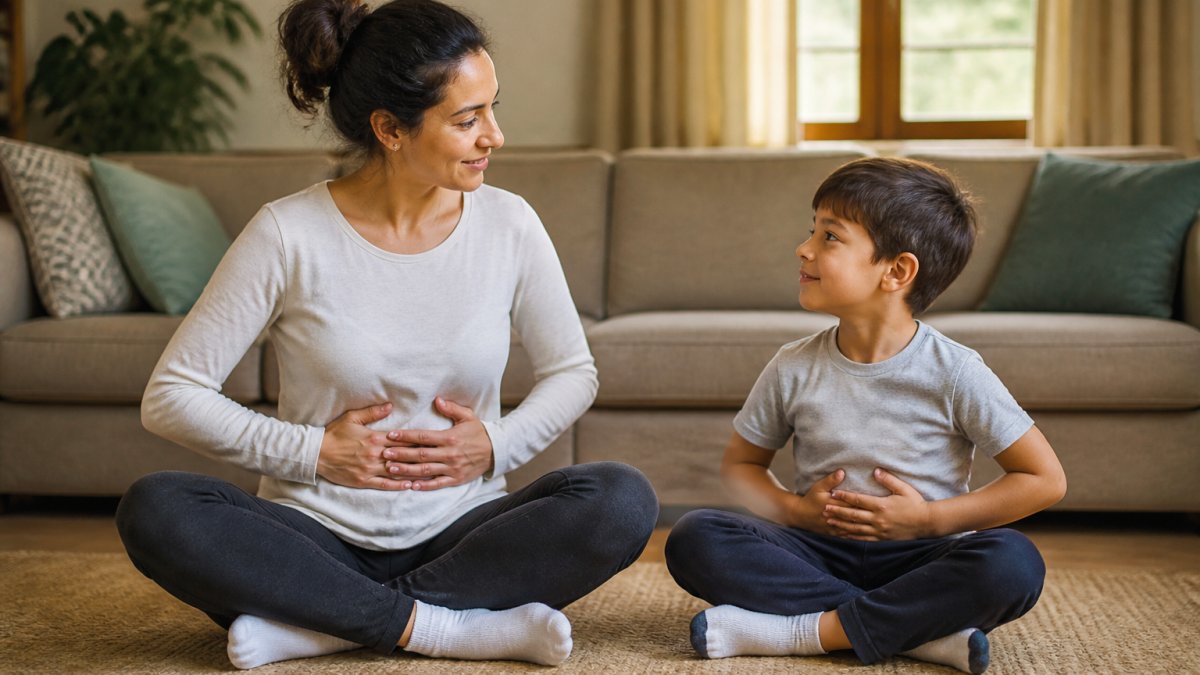
Try these five, matched to your child's age and temperament:
- Belly breathing (ages 3-8): Have your child lie down and rest a small toy on their stomach. Ask them to breathe in and watch the toy rise, then breathe out and watch it fall.
- Balloon breath (ages 4-10): Inhale through the nose for a count of four, then exhale slowly through pursed lips as if blowing up a balloon. For a school-age child, add a hand gesture: spread your hands apart as the balloon inflates, then bring them together as it deflates.
- Five-finger breathing (ages 5-12): Trace up one finger on the inhale and down on the exhale, repeating across all five fingers. This one works well in a classroom or car because it is silent and needs no props.
- Box breathing (ages 8 and up): Inhale for four, hold for four, exhale for four, hold for four. Teens often prefer this because it feels structured and athletic rather than childish. Skip the holds for younger children or anyone who finds breath-holding uncomfortable.
- Humming breath (ages 3-10): Inhale through the nose, then hum on a long exhale.
Watch out: do not force a child to breathe deeply if they are mid-panic. Start with a normal breath and simply slow the exhale. If your child resists closing their eyes or lying still, let them keep their eyes open and do the exercise sitting up or walking. The exhale is what matters, not the posture.
Grounding Techniques for Children During Anxious Moments
The 5-4-3-2-1 method:
- Name 5 things you can see.
- Name 4 things you can touch.
- Name 3 things you can hear.
- Name 2 things you can smell.
- Name 1 thing you can taste.
For a preschooler, shorten it to 3-2-1 and let them point instead of speak. Parents of younger kids can find deeper guidance in how to teach self-soothing to preschoolers. For a teen, drop the counting and ask them to describe one object in detail: color, texture, weight, temperature.
The color hunt: Ask your child to find and name five things in the room that are a specific color, then a second color. This is a good alternative for kids who find the counting structure of 5-4-3-2-1 boring or who are too young to sequence numbers. It also works with eyes open, which matters for sensory-sensitive children.
The body anchor: Have your child press their feet flat on the floor and notice the pressure, then press their hands together and notice the pressure, then touch the chair or couch and notice the texture.
Before, during, and after:
- Before: Practice the technique during a calm moment so the child knows the steps. Name it something short, like 'the five things game,' so you can cue it with two words later.
- During: Cue the technique in a steady voice, do it alongside your child, and do not quiz them on whether it is working. The goal is to ride out the wave, not to score the exercise.
- After: Reconnect with a hug or a few minutes together, then later, when everyone is calm, ask one question: 'Did that help a little, a lot, or not at all?' Their answer tells you whether to keep the technique in your rotation.
For more structured activities that build emotional intelligence in young children, our guide on emotional intelligence activities for 5 year olds pairs well with grounding work.
Mindfulness Scripts for Children: What to Say and How to Say It
Here is a script you can use tonight:
"Let's take a moment together. Put your hand on your belly. Feel it go up when you breathe in. Feel it go down when you breathe out. You don't have to fix anything. Just notice. If a worry comes, that's okay. Picture it floating away like a leaf on a stream. You are safe right here. I am right here with you."
Short Mindfulness Exercises for Kids: 5 Minutes or Less
- One-minute listening: Set a timer and listen for every sound in the room.
- Mindful snack: Eat one raisin or cracker slowly, noticing texture and taste.
- Body scan: Lie down and notice each part of the body from toes to head.
- Mindful walk: Walk slowly and notice each foot touching the ground.
- Gratitude round: Name three good things from today.
Adapting Exercises by Age and Sensory Needs
| Age Group | Best Approach | Keep It Short | Watch For |
|---|---|---|---|
| Ages 3-5 | Breathing with a toy, songs, movement | 1-2 minutes | Restlessness, keep it playful |
| Ages 6-8 | Scripts, grounding, five-finger breathing | 3-5 minutes | Boredom, add a story element |
| Sensory-sensitive | Eyes open, weighted blanket, quiet space | 1-3 minutes | Discomfort with silence or touch |
| High-energy kids | Mindful movement, stretching, walking | 3-5 minutes | Sitting still backfires |
A Repeatable Plan for Anxious Moments and When to Seek Help
- Calm yourself first. Your steady voice is the signal.
- Name the feeling. "It looks like worry is here."
- Offer one tool. Belly breathing or 5-4-3-2-1, not both.
- Reconnect after. A hug or a few minutes together closes the loop.
The National Institute of Mental Health resources on childhood anxiety can help you decide when to reach out.
Building a Calming Routine with Bravo Bear
Our edu-tainment series is designed to inspire children to grow with kindness, confidence, and courage. The stories blend heart and fun with meaningful life lessons. Readers who want to keep the routine going can join the Bravo Bear Monthly Book Club. Parents ready to start a calming routine can see and buy the Bravo Bear set to begin.
Frequently Asked Questions
How long should a mindfulness exercise for a child last?
The length can vary by child. Keep the activity brief and stop if your child is no longer engaged.
Can mindfulness really help children with anxiety?
Mindfulness exercises are one topic parents may explore when looking for ways to support a child. They are not a substitute for professional care.
What is a simple grounding exercise for kids?
One activity you could try is the 5-4-3-2-1 senses game: ask your child to name five things they can see, four they can touch, three they can hear, two they can smell, and one they can taste.
How do I make mindfulness fun for a child who has trouble sitting still?
A child who prefers movement could try a mindful walk, noticing each footstep, or a breathing activity such as pretending to inflate a balloon. Keep the activity brief and follow your child's comfort.
Anxiety in children is real, and it is hard to watch. You do not have to solve it alone, and you do not need a perfect plan. Start with one breathing exercise, one story, and one calm moment a day. Bravo Bear is here to help you build that routine with stories that teach kindness, confidence, and courage, plus a monthly book club that keeps the momentum going. Get started with Bravo Bear and give your child a calm, story-filled path to feeling braver.


