

How to Teach Self-Soothing to Preschoolers
Last Updated: October 23, 2026
Quick Summary
How to teach self-soothing to preschoolers involves giving them concrete tools like deep breathing, sensory activities, and movement to calm down independently when upset. Start with co-regulation, staying calm yourself while helping them settle, then gradually guide them toward managing their emotions alone through consistent practice and modeling.
- Most children ages 2 to 4 can begin learning basic self-soothing skills with support and guidance.
- Co-regulation, where you stay calm and help your child settle together, is a necessary step before independent self-soothing.
- Simple breathing exercises like smell the flowers and bubble breaths work best when taught as playful games, not lessons.
- A calm-down corner with soft blankets, fidget toys, and comfort objects gives preschoolers a safe space to settle independently.
- Modeling self-soothing by narrating how you calm down when frustrated is the most powerful teaching method.
Table of Contents
- Understanding Self-Soothing and Emotional Development in Preschoolers
- The Role of Co-Regulation Before Independence
- Self-Regulation Activities for Preschoolers
- Preschool Breathing Exercises and Calming Techniques
- Setting Up a Calm-Down Corner for Preschoolers
- Calming Scripts for Parents: What to Say in the Moment
- Building Consistent Routines and Predictable Transitions
- Teaching Self-Soothing Through Gradual Practice and Modeling
- Frequently Asked Questions
Understanding Self-Soothing and Emotional Development in Preschoolers
Learning how to teach self-soothing to preschoolers is one of the most valuable skills you can help your child develop. Self-soothing is the ability to calm down on their own when they're upset, frustrated, or overwhelmed, not ignoring their feelings, but giving them tools to manage big emotions independently.
What Self-Soothing Means
Self-regulation is the broader skill of managing emotions and behavior; self-soothing is one technique within that toolkit. A child who can self-soothe is learning emotional regulation, handling big feelings without falling apart.
Preschoolers experience intense emotions and lack the language and brain development to process frustration like adults. Without tools, they melt down; with tools, they learn to pause and recover.
Developmental Readiness and Age Considerations
Developmental readiness matters more than age alone.
Most children between ages 2 and 4 can begin learning basic self-soothing skills with a lot of help. A 2-year-old might not understand "take a deep breath"; a 4-year-old can often follow simple calming routines alone. Temperament matters too, intense and calm children just need different approaches.
Watch for these readiness signs:
- Your child can follow simple two-step directions
- They can sit still for a few minutes without constant distraction
- They understand the difference between calm and upset
- They can use some words to describe how they feel
If your child isn't showing these signs yet, that's normal. You're still building the foundation through co-regulation, staying calm yourself and helping them calm down together. That comes before independent self-soothing.
American Academy of Pediatrics guidance on child development
The Role of Co-Regulation Before Independence
Before preschoolers can self-soothe alone, they need co-regulation: helping them calm down by staying calm yourself, using a soothing voice, and offering physical comfort or reassurance. Learn more about whether emotional coaching is effective for toddlers as a foundation for this development.
Co-regulation isn't a weakness, it's a necessary step.
Think of co-regulation as the bridge between total dependence and independence. You're modeling self-soothing while they're still learning. Over time, they internalize what you do and start doing it themselves.
Research on responsive caregiving and emotional development
The transition to independence is gradual: you give more responsibility while staying close enough to help. Some days they'll surprise you; other days they'll regress and need help again.
Self-Regulation Activities for Preschoolers
Self-regulation activities give preschoolers something concrete to do when upset, tools that calm their nervous system, not just distractions. Discover screen-free activities for emotional development that support this skill.
Sensory-Based Activities
Sensory input is one of the fastest ways to help a dysregulated child settle.
Tactile activities work especially well:
- Fidget toys and chewable jewelry. Some children calm down by squeezing, twisting, or chewing. Offer silicone teethers, stress balls, or textured toys.
- Weighted blankets or compression vests. The gentle pressure helps some children feel grounded and calm.
- Soft textures. Let them hold a soft blanket, stuffed animal, or silky fabric when they're upset.
- Cold water on the face. Splash cool water on their face or hands, it triggers a calming reflex.
Sound and music also regulate the nervous system:
- White noise or nature sounds. Consistent background sound masks jarring noises that might upset them.
- Soft music or singing. Your calm voice is especially soothing.
- Quiet time with minimal sound. Sometimes silence is the best sensory input.
Not every child responds to the same sensory input, some love deep pressure, others find it overwhelming. Watch what actually calms your child down; that's their sensory preference.
Movement and Physical Release
Moving their body helps preschoolers release tension and process big emotions.
Simple movement activities include:
- Dancing or jumping. Let them dance to music or jump on a safe surface. It burns energy and lifts mood.
- Running or climbing. Vigorous outdoor play helps release frustration.
- Stretching or yoga poses. Simple stretches like reaching to the sky or touching toes are calming.
- Swinging or rocking. Rhythmic motion is deeply soothing for many children.
Match the activity to the moment: a wound-up, angry child may need vigorous movement first, while a calm-enough-to-listen child does better with gentle stretching.
Preschool Breathing Exercises and Calming Techniques
Simple breathing exercises work best for preschoolers.
Bubble breaths. Pretend to blow bubbles with a wand. Slow, steady breaths out create the bubbles.
Hot chocolate breaths. Pretend to blow on hot chocolate to cool it down.
Starfish breathing. Lie down or sit and stretch arms and legs out like a starfish.
Make it feel like a game, not a lesson.
Simple breathing exercises work best for preschoolers and can be taught as playful activities.
| Technique | How It Works | Best For |
|---|---|---|
| Smell the flowers, blow out the candles | Slow breath in through nose, blow out through mouth 3-5 times | Teaching slow breathing |
| Bubble breaths | Pretend to blow bubbles with a wand using slow, steady breaths | Making breathing feel like play |
| Hot chocolate breaths | Pretend to blow on hot chocolate to cool it down | Combining breathing with familiar comfort |
| Starfish breathing | Stretch arms and legs while breathing in and out | Pairing movement with breathing |
Setting Up a Calm-Down Corner for Preschoolers
A calm-down corner is a dedicated, safe, quiet space where your child can settle when upset, not a punishment corner.
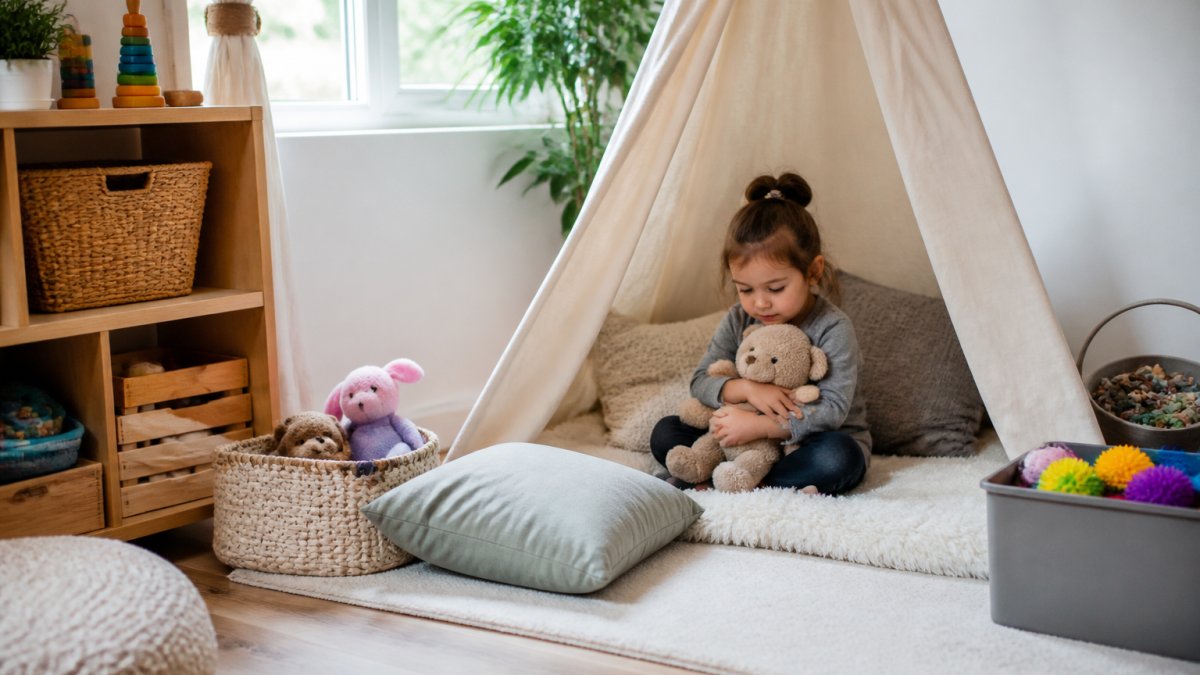
The space should be:
- Quiet and separate from the main activity area. Even a corner of a room works if you can't dedicate a whole space.
- Soft and comfortable. Include cushions, blankets, and stuffed animals.
- Filled with calming tools. Add fidget toys, books, sensory items, and comfort objects.
- Inviting, not isolating. Make it a place they want to go, not somewhere they're sent as punishment.
- Accessible. They should be able to go there on their own when they need to calm down.
Stock it with items that your specific child finds calming:
- Soft blankets or weighted blankets
- Stuffed animals or comfort objects
- Books about feelings or calming stories
- Fidget toys or sensory items
- A small tent or canopy for privacy
The goal is independent use. At first you guide them: "I see you're upset. Let's go to the calm-down corner." Over time, they'll go on their own when overwhelmed.
Calming Scripts for Parents: What to Say in the Moment
What you say during an upset moment either helps them calm down or escalates things.
Scripts for Mild Upset
When your child is frustrated but not in full meltdown:
"I see you're upset. That's okay. Let's take some slow breaths together." This validates the feeling and offers a concrete tool to focus on.
"Your feelings are big right now. Let's sit for a minute and feel calm." This normalizes big emotions without dismissing them and offers a solution.
"What do you need right now? A hug? Some quiet time? A fidget toy?" This teaches them to identify what helps and gives them some control.
"I'm right here. You're safe. Let's calm down together." This reassures them they're not alone.
Scripts for Intense Distress
When your child is in full meltdown mode, use shorter, simpler language:
"I'm here. You're safe." Short sentences work better when they're dysregulated. Your calm presence matters more than your words.
"Let's breathe. In and out. Slow and easy." Demonstrate slow breathing.
"We can try again in a minute." This gives them permission to pause without fixing everything immediately.
"I love you. This big feeling will pass." Reassurance without judgment. Avoid saying "Calm down", it rarely works and often escalates.
What NOT to say:
- "You're being ridiculous." (Dismisses their feelings)
- "Stop crying right now." (Shaming, not helpful)
- "If you don't stop, I'll..." (Threats during meltdowns don't work)
- "You're too old for this." (Shaming)
Remember: during intense distress, your calm presence and simple words matter far more than the perfect script. Stay regulated yourself.
Building Consistent Routines and Predictable Transitions
Preschoolers feel safer when they know what to expect. Consistent routines and predictable transitions reduce upsets in the first place.
Bedtime routines are especially important for teaching self-soothing: a calm, repeated routine signals to your child's brain that it's time to settle and helps them fall asleep independently.
A simple bedtime routine might look like:
- Bath or wash hands and face
- Put on pajamas
- Brush teeth
- Read a calming book
- Cuddle time
Do it the same way every night. After several weeks, just starting the routine helps them begin settling.
Daytime transitions matter too, moving from playtime to lunch or home to preschool can upset dysregulated children. Give warnings:
- "In 5 minutes, we're going to clean up."
- "After snack, we're going outside."
- "We're leaving in 2 minutes."
Use a visual timer so they can see time passing and mentally prepare.
Teaching Self-Soothing Through Gradual Practice and Modeling
The most powerful way to teach self-soothing is to model it.
Start with small, supported steps:
Step 1: Co-regulate together. You calm down together. Use breathing, movement, or sensory input.
Step 2: Guided independence. You're present but they do more of the work.
Step 3: Supported independence. They try to calm down on their own.
Step 4: Independent self-soothing. They calm down on their own.
This progression takes weeks or months.
Practice when they're NOT upset, too.
Emotional coaching strategies for young children
Praise effort, not perfection: "You tried to take deep breaths.
Frequently Asked Questions
How do you teach a preschooler to self-soothe?
Start with co-regulation, model calming techniques like slow breathing and gentle voice while your child is upset. Teach self-soothing through repeated practice during calm moments, not during tantrums. Use sensory tools (weighted blankets, fidget toys), establish predictable routines, and praise effort when your child tries calming strategies. Gradual practice over weeks builds the skill; expect progress to be slow at ages 3-4 and more reliable by age 5-6.
What are some self-soothing techniques for preschoolers?
Effective techniques include preschool breathing exercises (bubble breathing, smell-the-flowers), sensory input (weighted blankets, massage, fidget jewelry), comforting objects (stuffed animals, blankets), predictable routines (bedtime rituals, transition songs), and movement (dancing, stretching). Create a calm-down corner stocked with these tools. Not every technique works for every child; temperament and sensory needs vary, so experiment to find what resonates with your child.
At what age can children learn to calm themselves?
Ages 3-4: Children can begin recognizing emotions and trying simple techniques with heavy adult support. Ages 4-5: Self-soothing skills develop noticeably; children can follow two-step calming routines. Ages 5-6: Most preschoolers can independently use basic strategies. Developmental readiness varies significantly. Some children show readiness earlier; others need more time. Neurodivergent or highly sensitive children may develop these skills on a different timeline, adjust expectations and teaching pace accordingly.
What's the difference between self-soothing and self-regulation?
Self-soothing is calming the body and nervous system when upset (breathing, cuddling, sensory input). Self-regulation is the broader ability to manage emotions, impulses, and responses in different situations. Self-soothing is one tool within self-regulation. Teaching self-soothing builds the foundation for emotional regulation, but emotional regulation also includes recognizing feelings, expressing them appropriately, and adapting behavior to fit the situation.


