

Teaching Empathy to Preschoolers Through Stories
Table of Contents
- Why Stories Build Empathy in Preschoolers
- Choosing Books That Teach Empathy to Preschoolers
- How to Read Stories to Encourage Perspective-Taking
- Questions to Ask Kids While Reading
- How to Talk to Preschoolers About Feelings
- Post-Reading Activities That Make Empathy Stick
- Neurodivergent-Friendly Empathy Strategies and Avoiding Empathy Fatigue
- Making Teaching Empathy a Daily Habit
- Frequently Asked Questions
Last Updated: October 1, 2026
Why Stories Build Empathy in Preschoolers
Teaching empathy to preschoolers through stories works because children practice feelings before they face them in real life. A story lets a child try on another person's experience from a safe distance. This guide from Bravo Bear walks through the read-aloud habits, questions, and activities that turn storytime into real emotional growth.

Stories do the heavy lifting for three reasons:
- Characters show feelings a child can name out loud
- Plots let kids predict what happens next
- Happy endings reward caring behavior
Choosing Books That Teach Empathy to Preschoolers
The best books that teach empathy to preschoolers show feelings clearly and keep the story simple. Look for one main character, one clear problem, and one warm resolution.
What to Look for in an Empathy-Building Story
Pick stories where the character's face and body show how they feel. A picture of a sad bear teaches more than a paragraph explaining sadness.
Check for these traits:
- Clear emotions the child can point to
- A relatable problem, like losing a toy or feeling left out
- A caring response from another character
- Simple words a three-year-old can follow
- Diverse characters so kids see many kinds of people
How to Read Stories to Encourage Perspective-Taking
Perspective-taking grows when you slow down and let your child think. The trick is to pause before you turn the page, and to know exactly what to say when you do.
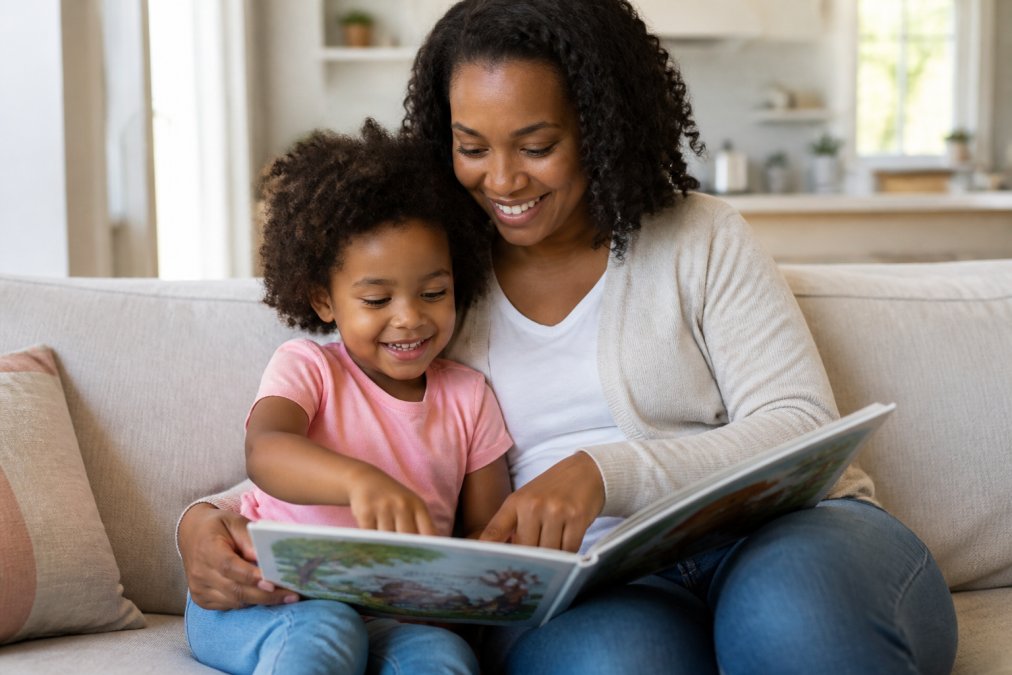
Pause, Point, and Wonder: A Simple Read-Aloud Rhythm
Use this three-step rhythm on every page:
- Pause before turning the page and ask what might happen next
- Point to a character's face and name the feeling you see
- Wonder out loud: "I wonder why she looks sad"
This rhythm turns a passive story into a conversation. It also builds dialogic reading skills, which researchers link to stronger language and social awareness. Reading Rockets on dialogic reading
A Page-by-Page Script You Can Use Tonight
Most parents freeze when they try to "ask better questions." Here is a script that works with almost any picture book. Swap in your child's name and the character's name.
Before you open the book:
- "Let's look at the cover. What do you think this bear is feeling?"
- "Have you ever felt that way?"
On a page where a character looks upset:
- "Stop. Look at her eyebrows. What do you notice?"
- "Her shoulders are down and her mouth is turned down. That's a clue she feels sad."
- "I wonder what she needs right now."
On a page where a character helps:
- "He saw she was sad. What did he do next?"
- "Why do you think he helped her?"
- "When you helped your friend last week, how did it feel?"
At the end:
- "What was the kindest thing anyone did in this story?"
- "What would you have done?"
The Three Cues That Build Perspective-Taking
Perspective-taking is not one skill. It is three, and each one has a cue you can teach:
- Face reading. Point to eyes, mouth, and eyebrows. Say the feeling out loud. "Her mouth is turned down, that's sad."
- Body reading. Point to shoulders, hands, and posture. "His hands are in fists. He might be mad or scared."
- Situation reading. Name what happened. "She lost her bear. That's why she's sad."
Slow Down More Than Feels Natural
A common pattern among early childhood educators is to spend two to three times longer on a page than the text alone would take. A 32-page picture book that reads in four minutes can take twelve when you pause, point, and wonder. That slowdown is the lesson, not the plot.
What to Do When Your Child Won't Engage
Some nights your child will squirm, shrug, or ask for a different book. That is normal. Try these fallbacks:
- Switch to a feeling hunt. "Can you find a face in this picture that looks happy?"
- Let them be the reader. Hand them the book and let them narrate what they see.
- Drop the questions. Just read. Modeling the rhythm still counts.
- Try again tomorrow. One flat storytime does not undo a week of good ones.
Questions to Ask Kids While Reading
The right questions to ask kids while reading turn storytime into a two-way talk. Ask, then wait. Silence usually means your child is thinking.
Try these open-ended prompts:
- "How do you think she feels right now?"
- "Why do you think he did that?"
- "What would you do if that happened to you?"
- "How can we help her feel better?"
- "Have you ever felt like that?"
How to Talk to Preschoolers About Feelings
Learning how to talk to preschoolers about feelings starts with naming emotions out loud every day. Kids need words before they can use them.
Build emotional vocabulary with simple labels:
- Happy, sad, mad, scared, excited, proud
- Frustrated when a tower falls
- Nervous before a new class
- Grateful when someone shares
Post-Reading Activities That Make Empathy Stick
Discussion alone fades fast. Post-reading activities move empathy from the page into your child's hands.
Try these after you close the book:
- Act it out. Have your child play the sad character, then the helper.
- Draw the feeling. Ask them to color what the character felt.
- Retell the story from another character's point of view.
- Make a kind card for someone who needs it.
- Reenact the fix with toys: the bear shares, the friend smiles.
Neurodivergent-Friendly Empathy Strategies and Avoiding Empathy Fatigue
Most empathy-through-stories advice assumes a neurotypical child who reads faces easily, sits still for a full book, and feels refreshed after a sad story. That is not every preschooler. Autistic children, kids with ADHD, and children with sensory processing differences often need a different on-ramp, and the standard advice can backfire.
Why Standard Empathy Lessons Can Miss Neurodivergent Kids
Empathy has two parts: recognizing what someone feels, and responding with care. Many neurodivergent children are strong on the second part and need more support on the first. A child who does not make eye contact during a story may still be tracking every word. A child who covers their ears during a loud page may be regulating, not refusing.
Adjustments That Actually Help
Try these adjustments when the standard read-aloud rhythm is not landing:
- Name feelings directly instead of hinting. "She is sad because she lost her bear." Skip "How do you think she feels?" if it stalls.
- Use pictures and cards to show emotions. A printed face chart next to the book gives a concrete reference point.
- Keep sessions short and end on a good note. Five focused minutes beats twenty strained ones.
- Repeat the same story many times. Predictability lowers the cognitive load so the emotional content can land.
- Skip the pressure to make eye contact or sit still. Fidgeting, lying down, or pacing can all be listening.
- Offer a choice of two books instead of one. Control reduces resistance.
- Preview the story. Flip through the pages first and name what will happen. Surprises are harder when a child is already working hard to process.
A Script for Kids Who Resist "Feelings Talk"
If "How does she feel?" gets a shrug every time, try narrating instead of asking:
- "Her bear is gone. Her tummy probably feels tight. That's a sad feeling."
- "He saw her crying. He walked over. That was kind."
- "I would feel nervous too if I lost my bear."
What Empathy Fatigue Looks Like in a Preschooler
Empathy fatigue is real, and it shows up differently than in adults. Watch for:
- Sudden boredom during a story they usually love
- Tears or anger at a small moment in the plot
- Refusing books that used to be favorites
- Going quiet or flat after a heavy story
- Acting out the sad part later, in play
How to Prevent Empathy Overload
- Alternate heavy and light. Follow a story about loss with one about a silly duck.
- Cap the sad part. If a character is in distress for many pages, summarize instead of reading every word.
- End on repair. Always finish with the fix, the hug, the share, the apology. Do not stop on the sad page.
- Name your own limits out loud. "That story made me feel a little sad. I'm going to take a deep breath." This teaches boundaries alongside empathy.
- Let them opt out. "Do you want to keep reading, or save this one for tomorrow?"
Empathy With Boundaries Is Still Empathy
A child who learns to say "I care about you, and I need a break" is not less empathetic than one who never stops giving. They are more sustainable. The goal is not a child who absorbs every feeling around them, it is a child who notices, cares, and stays steady.
Making Teaching Empathy a Daily Habit
Teaching empathy to preschoolers through stories works best as a small daily ritual, not a weekend project. Ten minutes a night adds up fast.
Build a simple routine:
- Same time, same spot each day
- One story, then one question
- One activity a few times a week
- Name feelings during the day, not just at bedtime
Frequently Asked Questions
What are some children's stories that teach empathy?
Look for picture books where a character faces a feeling or challenge and someone responds with care. Stories with clear emotions, a relatable main character, and a moment of kindness work best. Bravo Bear's edu-tainment series is built around kindness, confidence, and courage, so each story gives preschoolers a concrete example of empathy in action. Choose books your child wants to reread, because repetition is what makes the lesson stick.
How can I teach my preschooler about empathy?
Start with feelings words during everyday moments, then connect them to stories. When a character is sad, name it: 'Bear looks sad because his friend moved away.' Ask your child how they would feel. Keep it short, two or three questions per reading, and follow your child's lead. Over time, this back-and-forth builds emotional vocabulary and perspective-taking, the two building blocks of empathy in early childhood.
How does storytelling build empathy in young children?
Stories let children try on someone else's experience safely. When a preschooler hears about a character's worry or joy, they practice recognizing emotions and guessing what might help. Researchers call this perspective-taking, and it is a core part of social-emotional learning. Pair the story with a simple question like 'What would you do?' and you turn storytime into empathy practice without any extra materials.
How do I facilitate a discussion about feelings after reading a story?
Wait a few minutes after the last page, then ask one open question: 'How do you think Bear felt at the end?' Let silence sit. If your child shrugs, offer two choices: 'Happy or worried?' Connect the feeling to their life: 'Remember when you felt worried about the dark?' Then close with a kind action, like drawing a picture for a friend. Keep it under five minutes so it stays warm, not like a quiz.
Most parents want kind kids but do not know where to start. Stories give you a simple, proven path. Bravo Bear makes that path easier with an edu-tainment series built to grow kindness, confidence, and courage in young children. Shop the collection and turn tonight's storytime into a lesson your child will carry for years.


