

How to Teach Empathy to Toddlers: 7 Proven Strategies
Table of Contents
- Why Teaching Empathy to Toddlers Matters
- Model Empathetic Behavior Consistently
- Teaching Toddlers to Identify Feelings
- Empathy Activities for Toddlers That Build Connection
- Books About Empathy for Toddlers
- Praise and Reinforce Empathetic Actions
- Why Forced Apologies Don't Build Real Empathy
- Supporting Empathy Development in Neurodivergent Toddlers
- Frequently Asked Questions
Last Updated: September 20, 2026
Why Teaching Empathy to Toddlers Matters
Teaching empathy to toddlers is one of the most important foundations you can build. Young children are naturally curious about others, but to teach empathy to toddlers, the ability to understand and share someone else's feelings, requires active guidance. When you teach empathy to toddlers early, you're setting them up to navigate relationships, handle conflict, and show kindness throughout their lives.
Toddlers ages 2-4 are ideal learners for empathy: their brains wire social-emotional skills rapidly, and early emotional literacy builds stronger friendships, better frustration management, and prosocial behavior.
Bravo Bear's edu-tainment series, created by CJ Hainsworth, uses memorable stories to teach empathy through real-world emotional scenarios that resonate with young learners.

The real challenge is knowing how to teach it. Toddlers need concrete examples, repeated modeling, and practice, no special training or expensive programs required.
Model Empathetic Behavior Consistently
Children learn empathy by watching you. Modeling is the single most powerful tool you have.
When you validate your toddler's emotions calmly, "I see you're upset. That's okay. I'm here", they learn their feelings matter and adults respond with care.
Model empathy in everyday moments:
- When your child hurts someone, respond calmly and show concern for both children
- Talk out loud about what you're noticing: "Your sister looks sad. Let's see if she needs help"
- Show empathy toward others in public: acknowledge when someone is struggling
- Respond to your own emotions in healthy ways so they see regulation in action
Consistency matters: your toddler needs to see empathetic behavior repeatedly across situations to internalize it as normal.
Teaching Toddlers to Identify Feelings
Before toddlers can show empathy, they need to recognize emotions and build emotional vocabulary.
Start with basic emotion words: happy, sad, angry, scared. Use these words constantly throughout the day. Point them out in real moments: "You look happy right now" or "Your brother seems angry."
Build a feelings vocabulary through:
- Naming emotions when they happen: "You're frustrated because the block tower fell"
- Using feeling words in conversation without judgment
- Pointing out emotions in picture books and daily life
- Creating simple emotion charts with faces showing different feelings
Emotional development is gradual: 2-year-olds recognize happy and sad; by age 4, they understand frustrated, excited, or embarrassed.
When your child names their feelings, they're less likely to act them out and begin recognizing those feelings in others, the foundation of empathy.
Empathy Activities for Toddlers That Build Connection
Empathy needs practice through fun, age-appropriate activities that combine play, conversation, and real-world scenarios.
Pretend Play and Role-Playing Scenarios
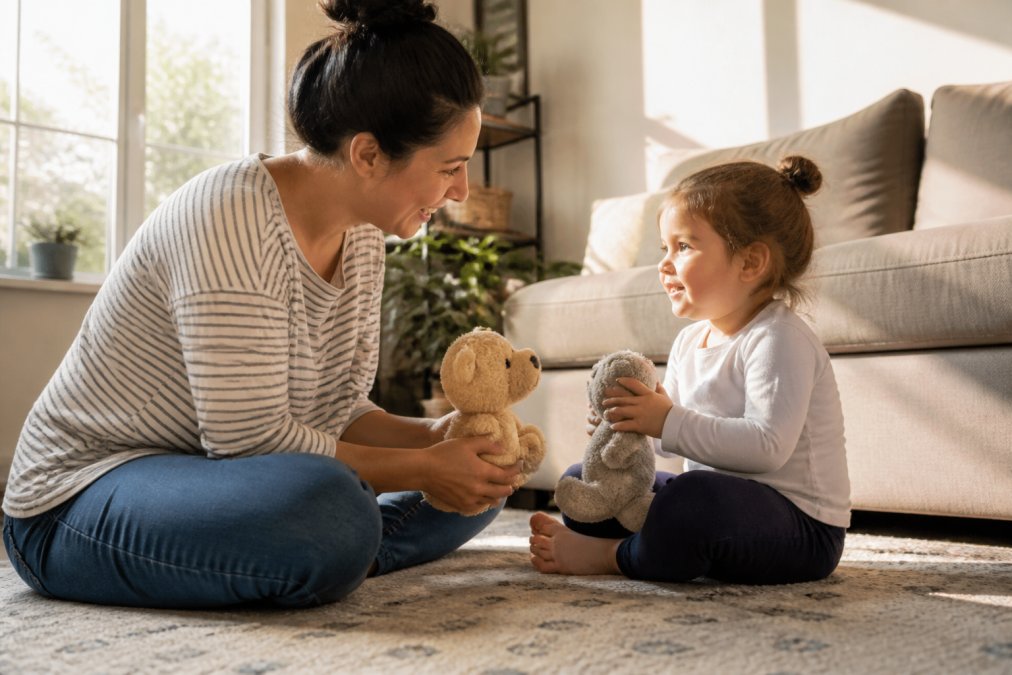
Pretend play lets toddlers practice empathy naturally by stepping into different characters and scenarios.
Set up simple pretend play scenarios:
- Playing house or family with stuffed animals or dolls
- Pretending to be different animals and how they might feel
- Acting out everyday situations: going to the doctor, grocery shopping, visiting grandparents
- Using puppets to act out social situations and emotions
Narrate characters' feelings during play: "The teddy bear is scared of the dark. How can we help him feel safe?" This guides perspective-taking.
Pretend play works because it's low-pressure: your toddler experiments with empathy through imagination, discovering how others experience the world.
Perspective-Taking Games and Conversations
Perspective-taking, imagining how someone else sees a situation, is the cognitive skill behind empathy. Build it through simple games and conversations.
Try these perspective-taking activities:
- "How do you think the dog felt when...?" questions during everyday moments
- Picture books where you pause and ask what different characters might be thinking
- Role-reversal games: "If you were your friend, what would you want?"
- Noticing non-verbal communication: "Look at her face. What do you think she's feeling?"
Books About Empathy for Toddlers
Stories are powerful empathy teachers: characters experiencing emotions and relationships let children practice empathy safely.
Look for books that:
- Show characters experiencing real emotions and conflicts
- Include diverse characters and family structures
- Demonstrate kindness, problem-solving, and emotional growth
- Use language your toddler can understand
- Have illustrations that help convey emotions
Praise and Reinforce Empathetic Actions
What gets praised gets repeated. Celebrating empathetic behavior tells your child: "This matters."
Why Forced Apologies Don't Build Real Empathy
Forced apologies teach compliance and shame, not empathy. Children learn adults want magic words, not that their actions affected others' feelings.
The Problem with "Say Sorry"
Forced apologies backfire: children don't connect action to outcome, learn to perform rather than feel, may experience shame or resentment, and the relationship doesn't repair.
A Better Approach: Guided Conflict Resolution
Real empathy-building guides your child through understanding what happened and what the other person experienced, it takes longer but actually works.
Step-by-step conflict resolution for toddlers:
What Real Apologies Look Like at Different Ages
Ages 2-2.5: Skip verbal apologies; focus on repair actions (helping, comforting, redirecting) while theory of mind develops.
Red Flags: When Forced Apologies Backfire
If your child says "sorry" but repeats the behavior, shows resentment, apologizes to avoid consequences, or becomes defensive, shift to guided conflict resolution. It takes longer but builds actual empathy.
Modeling Genuine Apologies
Model genuine apologies: "I yelled at you. That wasn't okay. I'm sorry. I hurt your feelings." Your child learns that apologies include understanding impact, taking responsibility, and committing to do better.
Supporting Empathy Development in Neurodivergent Toddlers
Neurodivergent toddlers (autistic, ADHD, sensory-sensitive) develop and express empathy differently. They don't lack empathy; they need scaffolding tailored to how their brain works.
Understanding Neurodivergent Empathy Development
Neurodivergent toddlers experience empathy differently: autistic children may show intense empathy for specific people but struggle with rapid social shifts; ADHD children feel empathy but struggle with impulse control; sensory-sensitive children may withdraw from others' big emotions due to overload; language-delayed children may understand emotions but lack words to express them. The key: empathy exists; expression and processing look different.
Concrete Adaptations for Neurodivergent Toddlers
For autistic or literal-thinking toddlers: Use concrete language ("When someone is sad, say 'I see you're sad' or offer a hug"). Create visual supports with real faces and step-by-step social stories. Practice scenarios repeatedly to generalize skills. Recognize action-based empathy: a child who brings a tissue to a crying sibling shows empathy even without words.
For sensory-sensitive toddlers:
- Reduce the sensory intensity of emotional moments when possible. If your child shuts down when others cry, practice empathy in lower-stakes moments first: when a stuffed animal is "sad," when a character in a book looks upset.
- Teach them to name their own sensory experience: "Loud crying is hard for your ears. That's okay. You can move to a quieter spot and still care about them."
- Model empathy from a distance. "Your brother is upset. We can help by giving him space right now. Later, when he feels better, we can play together."
- Use calming tools alongside empathy: "I see your friend is sad and that's a lot for your body right now. Let's take some deep breaths together, then we can help."
Developmental Milestones for Neurodivergent Toddlers
Neurodivergent toddlers may hit empathy milestones on a different timeline or in a different order:
- A 3-year-old autistic child might understand cause-and-effect ("I hit, she cried") before they understand the emotional component ("She felt pain and sadness").
- A 2.5-year-old with ADHD might show spontaneous comfort-seeking (running to hug a crying parent) but struggle with intentional, regulated empathy responses.
- A sensory-processing-sensitive toddler might intellectually understand someone else's feelings but need time to regulate their own nervous system before they can respond.
When to Seek Support
If your neurodivergent toddler shows signs of distress in social situations, extreme difficulty with transitions, or aggressive responses to others' emotions that don't improve with consistent scaffolding, talk with your pediatrician or a developmental psychologist. Some children benefit from occupational therapy (for sensory regulation), speech therapy (for social communication), or behavioral support.
Frequently Asked Questions
At what age do toddlers start to show empathy?
Toddlers begin showing early signs of empathy around 18-24 months, though it develops gradually. By age 2-3, many toddlers can recognize when someone is upset and may offer comfort. Full empathy, understanding another person's feelings and perspective, continues developing into the preschool years. Every child progresses at their own pace, so focus on consistent modeling and practice rather than strict age milestones.
How can I teach empathy to toddlers through books?
Books about empathy for toddlers work best when you pause to discuss feelings and characters' perspectives. Choose stories with clear emotional themes and relatable situations. Ask questions like 'How do you think the character felt?' or 'What would help them feel better?' Stories like Bravo Bear's collection combine engaging narratives with meaningful lessons about kindness and understanding others, making emotional literacy fun and memorable for young learners.
Is it normal for a 2-year-old not to show empathy yet?
Yes, it's completely normal. Two-year-olds are still developing emotional awareness and social skills. They may not yet understand that others have different feelings or perspectives. Continue modeling empathetic behavior, naming feelings, and validating emotions. Avoid forcing apologies or punishing lack of empathy, these strategies backfire. Instead, focus on building emotional vocabulary and giving your toddler time to develop this complex skill naturally.
How do I model empathy for my toddler?
Model empathy by narrating your own emotional responses and showing care for others. When you see someone upset, say out loud: 'That person looks sad. Let me see if I can help.' Validate your toddler's feelings without judgment, listen actively, and show kindness in everyday moments. Your toddler learns empathy by watching how you treat them, family members, and others. Consistent, warm modeling is one of the most powerful teaching tools you have.


