

7 Steps to Encourage Independent Play at Home
Last Updated: October 31, 2026
Quick Summary
To encourage independent play at home, set up a childproof play space your child can own, with toys within arm's reach and one clear open floor area, then step back gradually so your child chooses and directs the activity. Supervision stays part of the setup: stay within arm's reach under 18 months and in the same room for toddlers. Start with short windows and add time as your child handles it well.
- Keep five toys out and rotate them every week or two so they stay interesting.
- Most toddlers manage five to fifteen minutes of solo play at first, growing with practice.
- Step back in three stages: sit close and quiet, move to a nearby chair, then leave the room briefly.
- Fix the cause of breakdowns, such as hunger, too many toys out, or a skill gap, rather than the child.
- Pick the same daily window, starting with ten minutes and adding five each week it goes well.
Table of Contents
- Set Up a Safe Play Space Your Child Can Own
- Pick Independent Play Toys That Do the Work Themselves
- Try Independent Play Activities for Toddlers That Fit Their Attention Span
- How Long Should Toddlers Play Independently? Set Realistic Expectations by Age
- Use Independent Play Ideas for Preschoolers to Stretch Solo Time
- Step Back Gradually and Let Your Child Take the Lead
- Troubleshoot the Moments Independent Play Falls Apart
- Build a Simple Daily Routine and Shop Bravo Bear for Story Time
- Frequently Asked Questions
Set Up a Safe Play Space Your Child Can Own
Independent play is the practice of a child choosing and directing their own activity without an adult leading the way.
You cannot teach independent play from across the room with instructions. You build it with a space. A low shelf, a soft rug, and a few toys at eye level tell a toddler "this is yours" without a single word.
Start with three rules:
- Toys within arm's reach, not in a high bin
- One clear open floor area for building and pretend play
- A cozy corner with a cushion or small chair
That is the whole blueprint. Simple beats fancy every time.
Childproof the Space by Age
A play space that is safe for a 4-year-old is not safe for a 1-year-old, and the reverse is also true, a space stripped bare for a baby gives a preschooler nothing to do. Match the setup to the stage.
Babies and crawlers (6-18 months). The floor is the play space, so the floor is what you childproof. Anchor furniture and TVs to the wall, cover outlet covers, gate stairs, and scan for anything small enough to fit through a toilet-paper tube.
Toddlers (18 months-3 years). Add climbing and pulling to the hazard list. Secure bookshelves and dressers, pad sharp table corners, and lock cabinets that hold cleaning products or medications. Choose toys with no parts smaller than a golf ball, and check stuffed animals and dolls for loose eyes or buttons. Water play requires constant hand-on supervision at this age, even in an inch of water.
Preschoolers (3-5 years). The hazards shift toward tools and projects. Safe scissors are fine with a nearby adult; craft supplies, small beads, and glue need a defined workspace and a cleanup routine. This is the age when a child can follow a "no toys on the stairs" rule, so involve them in the safety rules rather than only enforcing them.
School-age (5-7 years). The play space can include more complex building sets and games with small pieces, but younger siblings may share the room. Store small-piece sets in labeled bins on a high shelf and bring them out for solo play, then put them away.
Supervision Is Part of Independent Play
Independent play is not the same as leaving a child alone.
- Under 18 months: within arm's reach, always.
- 18 months-3 years: in the same room and within sight, checking in every few minutes.
- 3-5 years: nearby, the next room with an open door is reasonable for a calm activity, but not for water, scissors, or climbing.
Some activities require hands-on supervision at every age: water play, anything involving small magnets or button batteries, outdoor play near streets or pools, and any activity with tools.
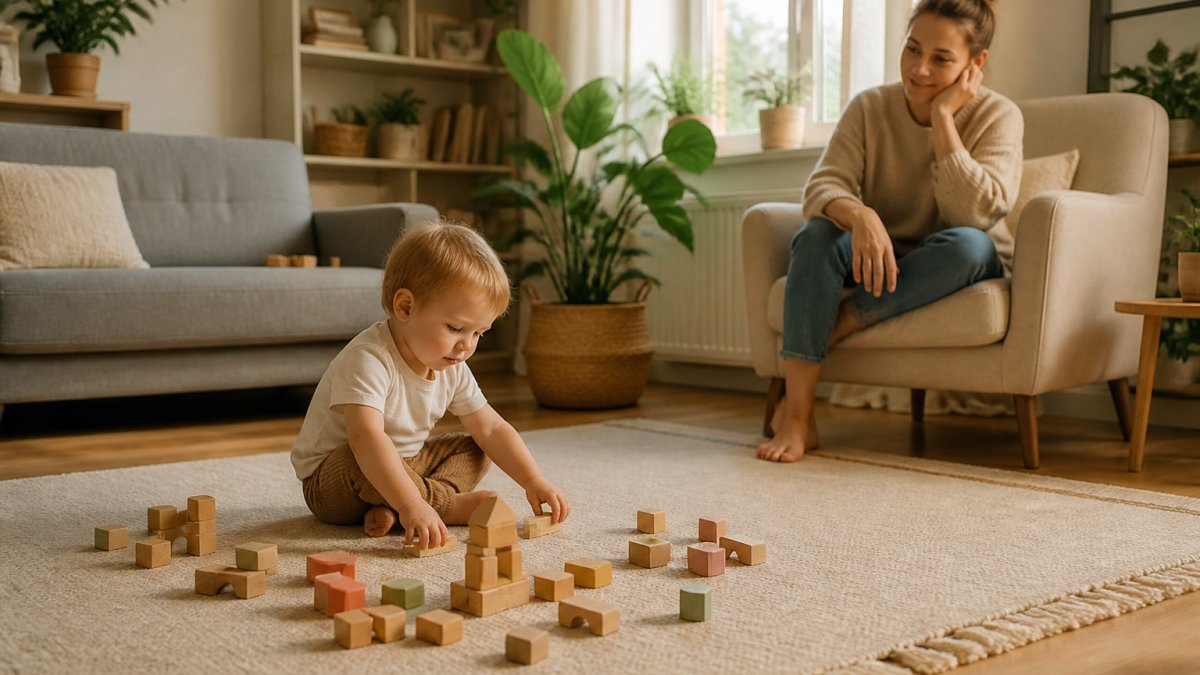
If you want a step-by-step build, our guide on how to set up sensory bins for toddlers walks through the materials and layout.
Pick Independent Play Toys That Do the Work Themselves
The best independent play toys are open-ended toys: blocks, dolls, books, puzzles, and simple pretend props. They have no correct answer, so your child has to supply one.
A common mistake is buying too much. Ten toys on a shelf become wallpaper. Five toys rotated every week or two stay interesting.
What most guides miss is that household items work as well as anything on a shelf.
Try Independent Play Activities for Toddlers That Fit Their Attention Span
Toddlers have short attention spans, and that is normal, not a problem to fix. A two-year-old may play alone for five to ten minutes before checking in with you.
Independent play activities for toddlers that work well:
- Stacking and knocking down soft blocks
- Board books with flaps to lift
- A basket of safe kitchen items to sort
Set one activity out at a time. A single option invites focus. A pile of options invites scattering.
For more ideas that fit short attention spans, browse screen-free activities for toddlers while you cook dinner.
How Long Should Toddlers Play Independently? Set Realistic Expectations by Age
How long should toddlers play independently? Most toddlers manage five to fifteen minutes at first, and that grows with practice.
The table below is a starting point, not a target. Use it to calibrate your expectations, then adjust for your child's temperament and the day's energy.
| Age | Typical solo play window | What to expect | Good first activities | Supervision level |
|---|---|---|---|---|
| 6-12 months | 1-3 minutes | Sensorimotor exploration, lots of mouthing | Soft blocks, board books, a mirror | Within arm's reach at all times |
| 12-18 months | 2-5 minutes | Parallel play nearby, frequent check-ins | Stacking cups, lift-the-flap books, a basket of safe containers | Within sight and reach |
| 18-24 months | 5-10 minutes | Short bursts, loves repetition | Chunky puzzles, pretend food, a cardboard box | Within sight, within a few steps |
| 2-3 years | 10-20 minutes | Pretend play begins, still needs you close | Play dough, dress-up clothes, a doll or stuffed animal | In the same room |
| 3-4 years | 20-30 minutes | Longer stories, more self-direction | Building sets, a pretend shop, wordless picture books | Nearby, checking in every few minutes |
| 4-5 years | 30-45 minutes | Can sustain a chosen activity with a check-in | Craft paper and safe scissors, audiobooks, complex puzzles | In the next room with an open door |
| 5-7 years | 45-60 minutes | Can plan and carry out a multi-step project | LEGO, chapter books, simple board games solo | Available but not present |
Three things to notice in that table. First, the supervision column never says "unattended." Independent play means a child directs the activity while an adult remains responsible for safety, the two are not opposites. Second, the activity column matters as much as the time column: a 2-year-old given a chunky puzzle may last ten minutes, while the same child given a 100-piece set will last two. Third, the windows overlap heavily at the boundaries, which is normal.
Temperament matters more than any chart. A cautious child may need you closer for longer.
For more ideas that fit short attention spans, browse screen-free activities for toddlers while you cook dinner.
Use Independent Play Ideas for Preschoolers to Stretch Solo Time
Preschoolers can go longer, but only if the activity has somewhere to go.
Try these:
- A box of dress-up clothes and a mirror
- Play dough with cookie cutters and a rolling pin
- A "shop" made from a table and empty boxes
When solo play is working, resist the urge to praise every move. A quiet nod from across the room keeps the thread going. Constant "good job" pulls a child out of their own story.
For a bigger bank of ideas, see screen-free activities for young children with over fifty options.
Step Back Gradually and Let Your Child Take the Lead
The real work of encouraging independent play is learning to do less. Most parents step in too fast. A child pauses, and we offer a suggestion. A tower wobbles, and we steady it.
Try a three-stage step-back:
- Sit close and stay quiet. Watch without narrating.
- Move to a nearby chair. Same room, less presence.
- Leave the room briefly. Call out so your child knows you are near.
Move to the next stage only when the current one feels easy. If your child follows you, go back a stage for a week. There is no prize for speed.
Child-led play means the child picks the activity, the rules, and the ending. When you do step back, our guide on how to foster child imagination daily shows how to deepen the solo play that follows.
Troubleshoot the Moments Independent Play Falls Apart
Independent play breaks down for predictable reasons. Fix the cause, not the child. Here are the common ones:
- Hunger or tiredness. Solo play needs energy. Try after a snack and rest.
- Too many toys out. Rotate down to a few and watch focus return.
- A new skill gap. If a puzzle is too hard, swap it for one slightly easier.
Watch out: if your child melts down every time you step away, do not push through it. Shrink the distance and the time, and rebuild slowly. Repeated hard endings teach a child that solo play is something to dread.
When solo play turns into screen requests, keep a short list of reliable swaps ready. Our roundup of screen time alternatives for kids gives you seven you can reach for fast.
Build a Simple Daily Routine and Shop Bravo Bear for Story Time
A routine makes independent play a habit instead of a negotiation. Pick the same window each day, ideally after a meal or rest when energy is steady.
A simple daily rhythm:
- Morning: one open-ended activity on the shelf
- After lunch: quiet solo play while you tidy nearby
- Evening: story time to close the day
Story time is where Bravo Bear fits. Our edu-tainment series, created by CJ Hainsworth, is built around kindness, confidence, and courage.
The two habits feed each other. A child who has practiced playing alone arrives at story time ready to listen.
Frequently Asked Questions
How can I encourage my child to play independently without feeling ignored?
Start with short sessions and stay nearby, checking in with a smile or a comment rather than joining in. Tell your child you are close by and let them see you. Independent play is not the same as being left alone. Ten to fifteen minutes of solo play with a parent in the room builds the same confidence as longer stretches, and the check-ins reassure your child that you are still there.
How long should a toddler play independently?
Most toddlers manage about 5 to 10 minutes of solo play at first, and some reach 15 to 20 minutes by age three. Preschoolers often stretch to 20 or 30 minutes when the activity fits their interests. Watch your child rather than the clock. If they are calm and engaged, let the play continue. If they start asking for you, wrap up and try again later.
What toys and activities help children play on their own?
Open-ended toys work best: blocks, dolls, simple puzzles, books, and play figures that can be used many ways. Household items like measuring cups, cardboard boxes, and laundry baskets also hold attention. Rotate toys every week or two so they feel new. Skip toys with batteries and screens, which tend to direct play instead of letting your child lead it.
What should I do if my child keeps asking me to play?
Acknowledge the request, then redirect with a specific idea: build a tower for me to see, or set up a picnic for your dolls. Offer a short bridge activity, then step back. If your child is tired, hungry, or coming down with something, independent play may not work that day. Try again after a snack or rest, and keep sessions short enough to end on a good note.
Building independent play takes weeks, not afternoons, and the payoff shows up in a child who trusts their own ideas. Bravo Bear supports that growth with memorable stories that teach kindness, confidence, and courage, plus heart and fun on every page. Start with a simple shelf, a short window, and a story at the end of the day. Get started with Bravo Bear and give your child a world where their own imagination has room to grow.


