

Why Complete Educational Book Sets Beat Buying Books One by One
Last Updated: November 2, 2026
Quick Summary
Educational book sets are curated collections sold together that build a coherent reading experience, giving you sequence and consistency that single purchases cannot. A curated set has already matched reading level, theme, and tone, so titles reinforce one another and the next book is always obvious. A complete set often does more work per dollar than a pile of one-off buys.
- Buying individually means paying full retail each time, absorbing shipping on small orders, and ending up with duplicates and duds.
- Repetition across related texts lets children predict, recall, and connect without being prompted.
- Run every set through five checks in order: age fit, thematic coherence, count and format, durability, and total value.
- Track two or three indicators for a month, such as reading frequency and book circulation, rather than everything at once.
- Divide the set price by the number of titles your reader finished or requested again to get cost per engaged book.
Table of Contents
- Why Complete Educational Book Sets Are Worth the Investment
- How Educational Story Books Build Literacy and Vocabulary
- Classroom Sets of Books for Teachers and Shared Reading
- The Importance of School Library for Students and Access to Books
- Building a Home Library for Children That Gets Used
- A Practical Framework for Choosing a Complete Book Set
- Measuring Whether Your Book Set Is Working
- Choosing the Right Set for Your Child
- Frequently Asked Questions
Why Complete Educational Book Sets Are Worth the Investment
Educational book sets are curated collections of titles sold together to build a coherent reading experience, and they solve a problem single purchases create: a shelf of mismatched books with no through-line. A complete set often does more work per dollar than a pile of one-off buys.
Here is the part most buying guides skip. A set is not just a bundle. It is a plan.
What a Complete Set Actually Gives You
A complete set can give you sequence and consistency across titles. When you buy titles individually, you have to judge reading level, theme, and tone each time. A curated set has already done that matching work, so titles can reinforce one another.
The practical difference shows up in how kids use the books. A series with recurring characters and values pulls a child back for the next title. Random single purchases rarely create that pull.
The Cost of Buying Books One at a Time
Buying individually feels cheaper per book. It rarely is per outcome. You pay full retail each time, you absorb shipping on small orders, and you end up with duplicates and duds that never get read.
Then there is the hidden cost: your time. Every separate purchase means another round of research, another checkout, another package.
How Educational Story Books Build Literacy and Vocabulary
Educational story books build literacy by pairing language with story context, so new words attach to characters and events rather than sitting on a flashcard. That context is why vocabulary from stories sticks. Children meet a word inside a feeling, and the feeling anchors the meaning.
Reading Comprehension and Foundational Language Skills
Comprehension grows through repetition across related texts. When a child reads several books with the same characters and themes, they predict, recall, and connect without being prompted. Foundational language skills, from sentence rhythm to narrative order, get reinforced each time the pattern repeats.
That is the quiet advantage of a set over scattered titles: the repetition is built in, not left to chance.
Reading for Enjoyment and the Habit That Sticks
Enjoyment is the engine. A child who associates reading with a favorite character reads more, and reading volume is what compounds into fluency. Sets make the next book obvious, which removes the friction that kills habits.
If your child resists reading, the fix is rarely a stricter routine. It is a better next book. Our guide on how to encourage reading in reluctant children covers the practical moves, and how to make reading fun gives you seven strategies you can start tonight.
Classroom Sets of Books for Teachers and Shared Reading
Classroom sets of books for teachers turn read-aloud time into shared reading that every student can follow. Multiple copies mean the whole group sees the same page, hears the same language, and can discuss the same moment.
For teachers planning group instruction, the case for reading aloud is well established. Our article on why you should read aloud to preschoolers explains the benefits and how to structure a session. A set also simplifies your curriculum resources: one purchase covers a unit, and replacements stay consistent.
The Importance of School Library for Students and Access to Books
The importance of school library for students comes down to access. A school library is often the only place some children meet many books, and consistent book availability is tied to stronger reading exposure and student engagement.
Book circulation depends on having enough copies of the right titles, not just a large count of random ones. Sets support that by giving a library coherent, replaceable collections that hold up to heavy checkout.
Building a Home Library for Children That Gets Used
A home library for children only matters if the books actually get read. A common mistake is buying for the shelf instead of the child: books displayed too high, too crowded, or too random to invite a pick.
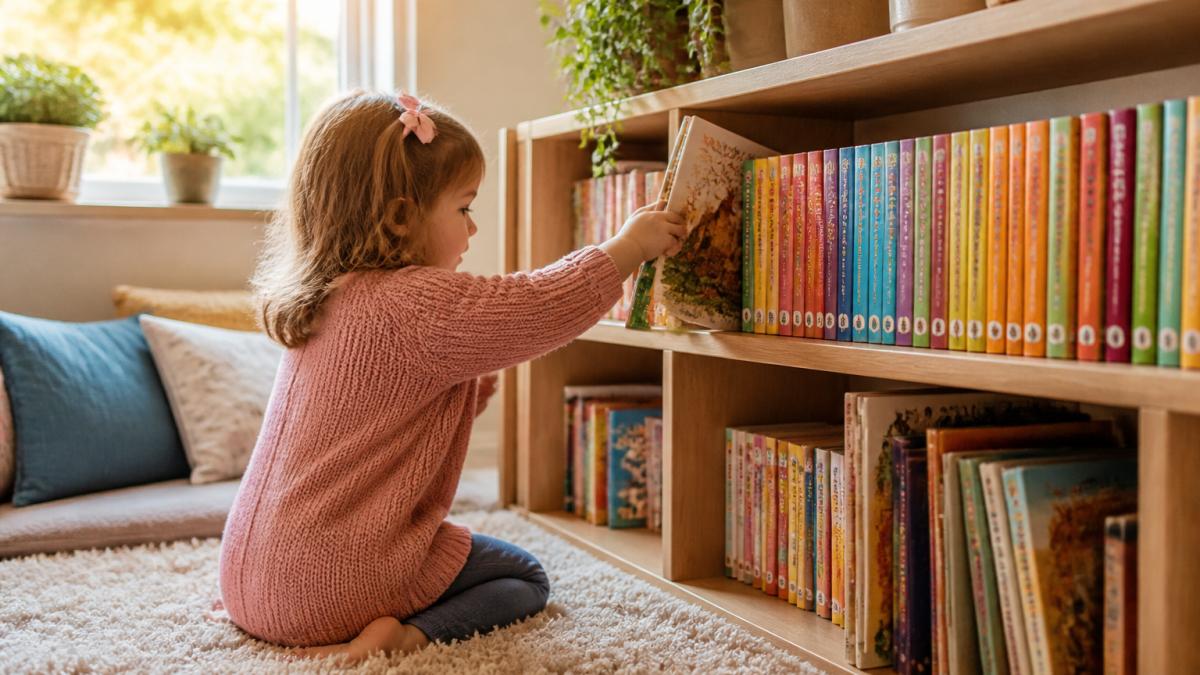
Start with access. Keep books at eye level and within reach, face a few covers outward, and rotate the collection so it feels new. A small, well-chosen shelf beats a packed bookcase every time.
Storage, Labeling, and Keeping Books in Circulation
Storage and labeling decide whether books stay in circulation. Group titles by series or theme so a child can find the next one without help, and label bins with simple words or pictures. Keep a lightweight checkout system at home, even a sticky note chart, so books return to the shelf instead of vanishing under the couch.
Watch out: storing books in deep, closed boxes is the fastest way to kill circulation. If a child cannot see it, they will not ask for it.
A Practical Framework for Choosing a Complete Book Set
Choosing a complete book set comes down to five checks, in this order. Run every option through them before you compare price.
- Age and reading level fit. Confirm the set targets your child's actual stage, not a broad range that overshoots.
- Thematic coherence. Look for a consistent cast or value thread across titles, not a random assortment.
- Count and format. Check how many titles you get and whether the format suits your reader: read-aloud, early independent, or shared.
- Durability. For young children and classrooms, binding quality decides how long the set survives.
- Total value. Divide the set price by the number of titles and compare that to buying the same titles separately.
What to Ignore When Comparing Sets
Ignore cover gloss and marketing language. A shiny box does not show whether the stories hold a child's attention on repeated reads. Ignore inflated title counts padded with thin activity pages. And ignore any set that cannot tell you who created it and why the titles belong together.
What matters is whether the set has a point of view. A curated set reflects a clear intent about what a child should take away.
Run every option through these five checks, in this order, before you compare price.
| Check | What to confirm |
|---|---|
| Age and reading level fit | Set targets your child's actual stage, not a broad range |
| Thematic coherence | Consistent cast or value thread across titles |
| Count and format | How many titles; read-aloud, early independent, or shared |
| Durability | Binding quality decides how long the set survives |
| Total value | Set price divided by number of titles vs. buying separately |
Measuring Whether Your Book Set Is Working
Most advice on book sets stops at "watch whether your child enjoys them." That is not a measurement. A set is an investment, and like any investment it can be checked against a few practical indicators, as long as you are honest about what those indicators can and cannot prove.
Four Indicators Worth Tracking
Pick two or three of these and track them for a month. Do not track everything at once.
- Reading frequency. Count how many days per week your child or students pick up a book from the set unprompted. This is the simplest signal and the least noisy.
- Book circulation. For a classroom or library, track how often set titles leave the shelf versus other titles. High circulation on set titles suggests the curation is working; low circulation suggests a level or interest mismatch.
- Comprehension progress. Ask a retelling question after a read, who, what happened, what comes next. Improvement across related titles is a stronger signal than improvement on a single book, because the set is designed to reinforce patterns.
- Engagement markers. Note requests for the next title, re-reads of favorites, and new vocabulary showing up in a child's own talk. These are behavioral, not test-based, and they show up faster than formal assessments.
Correlation Is Not Causation, Read the Signals Carefully
A jump in reading frequency after a set arrives does not prove the set caused it. A new teacher, a growth spurt, a friend's recommendation, or a schedule change can all move the same needle. A practical approach is to compare against a baseline: track the same indicators for a period before the set arrives, then again after.
This matters because the most common measurement mistake is declaring a set a failure after a single quiet week, or a success after a single enthusiastic one. Neither is data.
A Simple Return-on-Investment Check
You do not need a formal ROI model. You can divide the set price by the number of titles your reader actually finished or requested again in the first month. That gives you a rough cost per engaged book, which you can compare with the cost of buying the same titles individually at retail.
For classrooms and libraries, the same logic applies at the collection level: cost per circulated title, not cost per title purchased, is the number that reflects value.
Choosing the Right Set for Your Child
Match the set to the child in front of you, not to the ideal reader. A 3-year-old and a 7-year-old need different entry points, so choose a set with a clear age target and a strong value thread rather than one that tries to cover every age at once. The Bravo Bear Complete Set is a single collection built around kindness, confidence, and courage.

For more concrete examples of titles that build language skills, browse our picks for educational story books for kids 3-8.
Frequently Asked Questions
Are complete educational book sets a better value than buying individual books?
Often, yes. A complete set bundles a full series at one price. Bravo Bear's Complete Set, for example, is $79.99 for the whole series. You also get a consistent reading level and characters across every title, which can keep children engaged longer than a mixed pile of unrelated books.
How do I choose age-appropriate educational story books for a 3-year-old and a 7-year-old?
Look for sets that work as read-alouds for the younger child and independent reading for the older one. Picture-led stories with short sentences suit a 3-year-old, while a 7-year-old can follow longer plots and read the same titles alone. A single series with recurring characters lets both children share the books at different depths. Read the first title aloud together, then let the older child revisit it solo. One set can serve both ages without buying twice.
How can a home library for children support school learning?
A home library keeps books within arm's reach, so reading becomes a daily habit rather than an occasional trip to the library. Children who own books read more often, and that repeated reading exposure builds vocabulary, reading comprehension, and foundational language skills that carry into classroom instruction. Keep titles at eye level, rotate a few at a time, and let your child pick. Even ten to fifteen minutes a day adds up over a school year.
What should I look for in a children's book set before buying?
Consider reading level consistency, character continuity, physical quality, and whether the stories carry a lesson. A set with the same characters can help build reading habits. Look for durable covers and binding, since books get handled daily. Finally, read a sample page to judge whether the language sounds natural aloud.
The gap between a child who reads and one who doesn't is usually a gap in the next book, not in effort. Bravo Bear builds edu-tainment stories around kindness, confidence, and courage, created by CJ Hainsworth, with memorable characters and meaningful lessons in every title. If you want a shelf that gets used, start with a set that has a point of view. Get started with Bravo Bear and give your child a collection worth returning to.


