

Educational Story Books: Top Picks for Kids 3-8
Table of Contents
- Why Educational Story Books Matter for Early Development
- How to Choose Age-Appropriate Educational Story Books
- Books for Emotional Intelligence: Building Kindness, Confidence, and Courage
- Educational Story Books That Teach Early Literacy and Language Arts
- Interactive and Personalized Reading Experiences: Physical vs. Digital
- STEM-Focused Reading and Neurodivergent-Friendly Book Picks
- Parent-Child Discussion Prompts and Read-Aloud Techniques
- Pricing and Value: What to Expect from a Quality Educational Story Book Set
- Frequently Asked Questions
Last Updated: October 2, 2026
Why Educational Story Books Matter for Early Development
Educational story books are picture-led children's titles built to teach a specific skill or value while still working as a story a child wants to hear again. This guide from Bravo Bear covers how to choose them by age and which titles earn their shelf space. The stakes are higher than most parents realize. A child who hears stories daily walks into kindergarten with a bigger vocabulary and a longer attention span than one who does not, and the gap tends to widen rather than close.

The benefits of reading to children extend well past the page itself. Stories give a child a safe place to rehearse bravery, frustration, and friendship before those feelings arrive for real.
The Benefits of Reading to Children Beyond the Page
Reading aloud builds three things at once: language, attention, and emotional vocabulary. A child who hears "she felt left out" in a story has words ready for the day they feel it themselves.
A common mistake is treating story time as a literacy drill. The parents who get the most out of it ask questions, pause on pictures, and let the child steer.
- Vocabulary building happens through repetition, not flashcards
- Narrative structure teaches cause and effect before math class does
- Read-aloud techniques like pausing and pointing build phonemic awareness naturally
How to Choose Age-Appropriate Educational Story Books
Match the book's format to your child's stage, not their birthday. A three-year-old needs sturdy pages and short sentences; a seven-year-old needs chapters they can retell.
Board books suit ages zero to three. Picture books fit three to eight. Emergent readers, with simple sentences and heavy picture support, bridge the gap around ages five to seven.
Board Books, Picture Books, and Emergent Readers: A Quick Guide
| Format | Typical Age | Page Count | Best For |
|---|---|---|---|
| Board books | 0-3 | 12-24 | Chewing, grabbing, first words |
| Picture books | 3-8 | 24-48 | Read-aloud, values, vocabulary |
| Emergent readers | 5-7 | 32-64 | First independent reading |
If your kids are three and seven, one well-made picture book can serve both. The younger child follows the pictures and rhythm; the older one reads the words and answers the deeper questions.
Books for Emotional Intelligence: Building Kindness, Confidence, and Courage
Books for emotional intelligence work because children copy what characters do. A story about a bear who tries something scary and survives it gives your child a script for their own nervous moment.
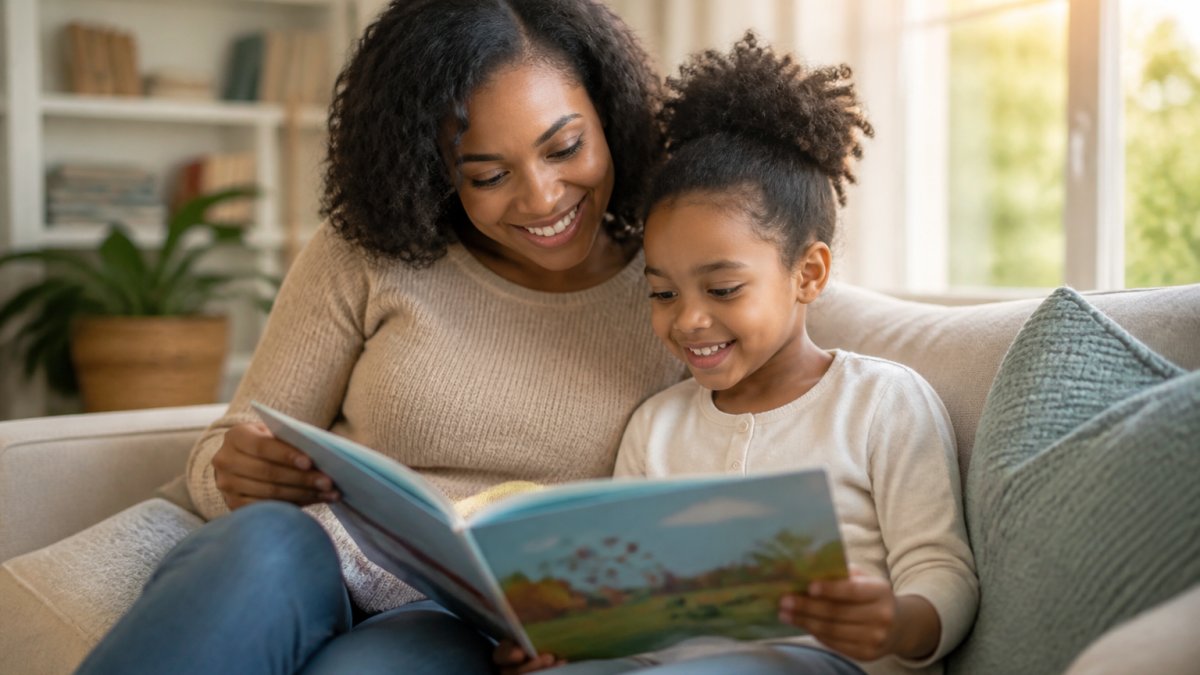
Look for characters who struggle and then act, not characters who are simply good. A child who sees effort rewarded learns that confidence is built, not born.
Educational Story Books That Teach Early Literacy and Language Arts
The best literacy titles hide the teaching inside a story worth hearing. Rhyme, repeated phrases, and predictable endings do the work that worksheets cannot.
Curriculum-aligned titles connect to what your child will meet in school: letter sounds, sight words, and story sequencing. Homeschooling parents can build a full language arts block around three or four strong picture books per week.
- Rhyming text builds phonemic awareness
- Repeated refrains invite your child to "read" along before they can decode
- Sequenced events teach beginning, middle, and end
Interactive and Personalized Reading Experiences: Physical vs. Digital
Physical books still win for focus, but the reason is more specific than "screens are distracting." When a child reads print, their eyes and hands move at their own pace. They can pause on a picture, flip back a page, or sit on a single sentence. A screen sets the pace for them. That difference in who controls the tempo is the part most parents never hear, and it is the part that matters most for comprehension.
What the Print-vs-Screen Trade-Off Actually Looks Like
A common pattern in early-childhood reading research is that the same story produces different outcomes depending on the format:
- Print tends to support deeper comprehension. With paper, the child's attention stays on the words and the pictures. There is nothing else to tap.
- Digital can support engagement and access. Narrated storybooks, adjustable text size, and audio support are genuine scaffolds for a struggling reader or a child learning English. A child who cannot yet decode can still follow a story and build vocabulary.
- Enhanced e-books can backfire. When a screen adds animations, sound effects, and tap-to-play games on every page, the extras compete with the story. Children often remember the animation and forget the plot. The bells and whistles are the point, and the reading becomes the side dish.
How to Use Digital Well
Digital narrated storybooks have a real place, especially for struggling readers who need audio support and for families who need a book in the car, the waiting room, or on a flight. Three rules keep the format working for you instead of against you:
- Use narration as a scaffold, not a replacement. Let the audio carry the decoding while the child follows the words with their eyes. Once they read a title confidently on their own, move that story to paper.
- Turn off the extras. If the app lets you disable animations and sound effects, do it. You want the words and the pictures, not the confetti.
- Keep the read-aloud on paper. The bedtime story is a conversation, not a screen session. Paper keeps the child's eyes on the text and yours on the child.
Personalized Reading Experiences
Personalization is the other half of this section, and it is where digital genuinely earns its keep.
You can personalize without buying anything, too. Swap your child's name in for the main character's as you read aloud. Ask them to pick what the character does next. Let them choose tonight's book from a curated three rather than an open shelf.
STEM-Focused Reading and Neurodivergent-Friendly Book Picks
STEM-focused reading and neurodivergent-friendly picks share one trait: they respect how the specific child learns. Some kids need counting and patterns woven into the plot. Others need shorter text blocks and predictable page layouts. Most roundups treat these as two separate lists. They belong together, because the same design choices that make a math book land, clear structure, one idea per spread, repetition with variation, are the same choices that make a book work for a reader who processes the world differently.
What to Look For in STEM Story Books
The strongest math and science titles never announce that they are teaching. They let the concept ride on the plot.
- Counting books that rhyme teach math and language together, the rhythm carries the number sequence, so the child absorbs order without drilling it
- Pattern and sorting stories (repeating shapes, alternating colors, "what comes next?") build the early algebraic thinking that kindergarten screening looks for
- Nature and life-cycle titles build vocabulary through real-world curiosity, a child who has followed a seed to a flower has a mental model for the word "sprout" that a flashcard cannot give
- Cause-and-effect science stories (float vs. sink, day vs. night) mirror the narrative structure kids already understand from fiction
A quick test: cover the illustrations and read the text aloud. If the story still works, the concept is doing its job. If it collapses into a list of facts, it is a worksheet wearing a picture-book cover.
A Neurodivergent-Friendly Reading Checklist
This is the gap most "educational story books" roundups skip entirely. For a child with dyslexia, ADHD, sensory processing differences, or autism, the wrong book is not just boring, it is exhausting. The right book is the difference between a nightly fight and a nightly habit.
Look for these design features:
- High-contrast, uncluttered illustrations. Busy backgrounds compete with the text for attention. One focal image per page lowers the load.
- One idea per page. A spread that introduces a new character, a new setting, and a new concept at once gives a dyslexic or ADHD reader three things to track instead of one.
- Predictable page structure. Repeated refrains, consistent text placement, and a clear rhythm let the reader anticipate what comes next, which reduces anxiety and frees working memory for the words themselves.
- Dyslexia-friendly typography. Sans-serif fonts, generous line spacing, and text that does not sit on top of a busy illustration all help. Some publishers now print dedicated dyslexia-friendly editions with cream or tinted paper instead of bright white.
- Short text blocks. A page with two sentences is a page a struggling reader can finish and feel successful on. Success is what keeps them coming back.
- Characters who think differently, and are fine. Inclusive literature matters here both as a mirror and a window. A story where the main character's unusual way of solving a problem turns out to be the strength is worth more to a neurodivergent child than a dozen books about fitting in.
Building a Mixed Shelf
You do not need two libraries. A single shelf can hold a rhyming counting book, a nature life-cycle story, and a predictable-refrain title that works for a sensory-sensitive reader. Rotate three or four at a time rather than stacking twenty. The goal is not coverage of every subject, it is a child who reaches for a book on their own.
Parent-Child Discussion Prompts and Read-Aloud Techniques
A good question after the last page turns a story into a conversation. Ask "What would you have done?" instead of "What was the lesson?" The first invites thinking; the second invites a test answer.
Try these openers:
- "How do you think she felt when that happened?"
- "What would you do if you were him?"
- "What do you think happens next?"
Pricing and Value: What to Expect from a Quality Educational Story Book Set
A premium picture book set costs more than a bargain-bin stack, and it usually earns the difference. Thicker pages survive toddlers, and stronger stories survive the twentieth read.
The Bravo Bear Complete Set is $79.99, a full edu-tainment series built around kindness, confidence, and courage. Created by CJ Hainsworth, the stories are made to be re-read, which is the real test of value. A book your child asks for nightly costs pennies per reading; one that bores them after a week costs the full price for nothing.
| What You're Paying For | Why It Matters |
|---|---|
| Durable binding | Survives toddler hands and repeated reads |
| Story depth | Holds up past the first week |
| Character lessons | Kindness, confidence, courage built in |
Frequently Asked Questions
What are the benefits of reading educational story books to children?
Reading educational story books to children supports early learning, literacy development, and social-emotional growth. Stories introduce new vocabulary, build phonemic awareness, and help children understand emotions and relationships. Regular read-aloud sessions also strengthen reading comprehension and critical thinking as kids connect plot events to real-life situations. For children ages 3 to 8, these shared reading moments create a foundation for lifelong learning and stronger parent-child bonds.
How do educational story books help with emotional development?
Educational story books give children a safe way to explore feelings like frustration, joy, and fear through characters they trust. When a story shows a character facing a challenge and finding courage, kids see a model they can apply to their own lives. Books for emotional intelligence often include themes of kindness, empathy, and perseverance, which support social-emotional growth. Parents can reinforce these lessons by asking simple questions during reading, such as how the character might feel.
What should I look for when choosing educational books for toddlers?
For toddlers, look for board books with sturdy pages, simple sentences, and bright, clear pictures that support visual literacy. Choose stories with repetitive phrasing to build vocabulary and phonemic awareness. Age-appropriate content matters: a book for a 3-year-old should have short text and familiar routines, while books for ages 5 to 8 can include longer narratives and more complex ideas. Check that the book's educational value matches your child's current developmental stage.
Can educational story books work as part of a homeschool curriculum?
Yes. Educational story books can supplement a homeschool curriculum by covering language arts, social-emotional learning, and even STEM-focused reading in one activity. Choose titles that align with your weekly theme, then pair them with discussion prompts or a simple journal entry. For structured learning, rotate between fiction and nonfiction picture books and track reading comprehension through oral narration. Many homeschooling parents use storybooks as the anchor for unit studies across multiple subjects.
The real challenge isn't finding books; it's finding ones your child will ask for again next week. Bravo Bear built its series around exactly that test, with stories designed to be memorable and lessons that stick: kindness, confidence, and courage woven into every adventure. If you want a set that earns its shelf space, get started with Bravo Bear and give your child stories worth hearing twice.


