

Why Daily Habits Build Resilient Children
Table of Contents
- Why Daily Habits Build Resilient Children
- How Predictable Rhythms Create Emotional Security
- Parenting Strategies for Resilient Children
- Resilience Activities for Children That Fit Into the Day
- How Chores Build Resilience in Children
- How to Help Children Cope with Setbacks
- When a Habit Stops Working: Troubleshooting Resistance
- Conclusion
- Frequently Asked Questions
Last Updated: October 19, 2026
Why Daily Habits Build Resilient Children
Resilient children are not born tough. They are built, one small repeated action at a time. At Bravo Bear, we create stories that help kids grow with kindness, confidence, and courage, and the same principle shows up again and again: kids feel braver when their world feels predictable.
That is the quiet power of daily habits. A regular morning, a set bedtime, and a few simple chores do more for a child's emotional well-being than most grand gestures ever will. Below, we will show you exactly how to build those rhythms, adapt them by age, and troubleshoot when they fall apart.
How Predictable Rhythms Create Emotional Security
Predictable rhythms create emotional security because they tell a child's brain what comes next. When a child knows breakfast comes before school and stories come before bed, the brain stops scanning for danger and saves its energy for learning.
Many parents find that the meltdowns cluster around chaos, not defiance. A rushed morning or a skipped nap often triggers the tears.
- Regular mealtimes anchor the day
- Consistent bedtimes protect rest and mood
- A set goodbye routine eases school drop-off
- A predictable weekend rhythm calms Monday anxiety
The American Academy of Pediatrics guidance on healthy sleep routines points out that consistent routines help children feel safe and supported. Stability is not boring. It is the ground a child stands on.
Parenting Strategies for Resilient Children
Parenting strategies for resilient children come down to warm limits and steady follow-through. Children borrow calm from the adults around them, so your own reaction sets the tone.
Try these approaches:
- Name the feeling before fixing the problem
- Keep rules short and repeat them the same way
- Let your child make small choices inside the routine
- Praise effort, not just results
- Protect the habit even on hard days
A common mistake is rescuing a child too fast. Letting them struggle a little with a zipper or a puzzle builds problem-solving and independence. In practice, this means stepping back one small notch at a time.
Resilience Activities for Children That Fit Into the Day
Resilience activities for children work best when they hide inside ordinary moments. You do not need a workbook or a special class. You need a few minutes and some consistency. What most articles skip is the part parents actually need: a repeatable plan. Here is one you can run this week.
A sample resilience day (about 12 minutes total):
- Morning (2 minutes): a "brave choice" question at breakfast, "What's one thing today that might feel a little hard, and what's your first step?"
- After school (3 minutes): a two-minute check-in about one good thing and one hard thing. Name the feeling before fixing the problem.
- Chores (5 minutes): one small contribution, matched to age (see the chores section).
- Play (any length): turn-taking games that teach patience and losing without falling apart.
- Bedtime (2 minutes): a story where the character faces a setback and tries again.
A repeatable weekly rhythm:
- Monday: name one small challenge for the week
- Wednesday: midweek check-in, "What's been harder than you expected?"
- Friday: review, "What did you try that didn't work, and what did you try next?"
- Weekend: one family contribution task, such as a meal or a shared cleanup
Stories are one of the easiest tools here. A tale about a character who stumbles and tries again gives a child language for their own challenges. That is the heart of what we create at Bravo Bear: memorable stories that carry meaningful life lessons about courage and kindness.
Adapting the plan for real life. Not every family has a calm morning or a predictable after-school window. If your schedule is unstable, shrink the plan to one anchor, usually bedtime, and protect that first. If your child is neurodivergent or needs movement, swap the after-school check-in for a walk-and-talk. A shy child may do better with a quieter wind-down. The plan is a template, not a test.
What progress looks like. Do not expect a child to be resilient all the time. Watch for small observable shifts instead: they name a feeling without being prompted, they try a second strategy before giving up, they ask for help instead of shutting down. Those are the signals that the habits are working, not a child who never struggles.
How Chores Build Resilience in Children
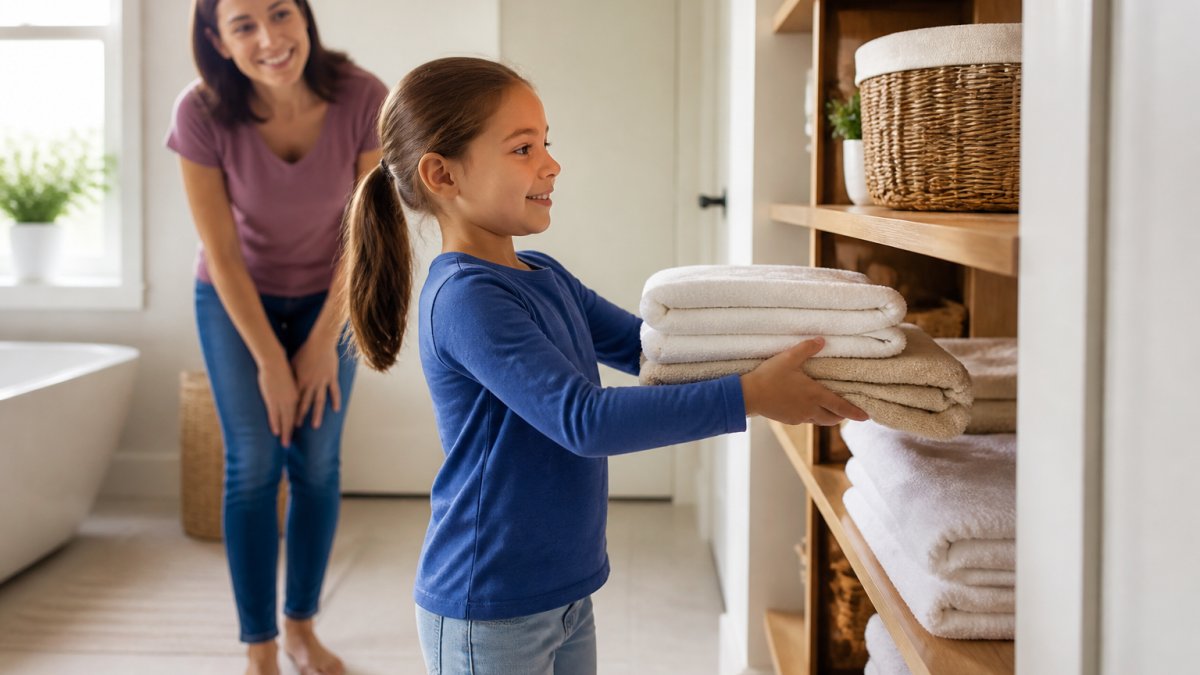
How chores build resilience in children is simple: chores hand a child real responsibility and a real sense of capability. A child who folds towels learns that their effort matters to the family, and that lesson transfers to schoolwork, friendships, and setbacks.
The mechanism is worth naming. A completed chore gives a child three things at once: a clear cause-and-effect (I did this, that happened), a visible contribution to the household, and a small dose of tolerable frustration when the task is a little hard. That combination is the same raw material resilience is built from. A child who has practiced finishing a boring task is better equipped to finish a hard one.
Start small and match the task to the age:
- Ages 2-3: put toys in a bin, carry a light bag to the door
- Ages 4-5: set napkins on the table, water a plant with a small cup
- Ages 6-7: sort laundry by color, feed a pet with pre-measured food
- Ages 8-9: pack their own lunch with a checklist, sweep a small area
- Ages 10-12: help plan and prepare a simple meal, manage a weekly recycling run
- Teens: own a recurring responsibility end to end, such as laundry for their own clothes or a weekly family meal
Three parent moves make chores build resilience instead of resentment:
- Assign, don't ask. "It's your job to set the table" lands differently than "Can you set the table?" A standing role signals belonging.
- Describe, don't grade. Say "You got all four plates on the table" rather than "Good job." Specific feedback teaches a child to evaluate their own effort.
- Let the result be imperfect. Redoing a chore in front of your child quietly tells them their effort was not good enough. Let the folded towels be a little crooked.
The goal is not a spotless house. The goal is a child who tries, finishes, and feels useful. A common mistake is rescuing a child too fast, taking back the task the moment it gets slow or messy. In practice, step back one small notch at a time and let the child stay in the driver's seat.
One more trade-off worth naming: chores build resilience only when they are framed as contribution, not punishment. A child who is told to clean their room "because they were bad" learns compliance, not capability. A child who is told "we all pitch in because we're a family" learns that their effort is part of something larger, which is exactly the belief resilient kids carry into adulthood.
How to Help Children Cope with Setbacks
How to help children cope with setbacks starts with how you respond in the first ten seconds. Your calm face teaches more than any lecture.
Try this sequence:
- Pause and breathe with your child
- Name the setback out loud
- Ask what they might try next
- Offer help without taking over
- Point back to a time they recovered before
Setbacks, failure, and change are not the enemy. They are the training ground for adaptability and perseverance. The CDC guidance on supporting children's mental health notes that supportive relationships and coping skills help children handle stress.
When a Habit Stops Working: Troubleshooting Resistance
Resistance is normal, and it is information, not failure. When a child pushes back on a routine, the habit usually needs adjusting, not abandoning.
Here is how to respond:
| Problem | Likely Cause | Fix |
|---|---|---|
| Bedtime battles | Routine too long or too late | Shorten it and start earlier |
| Morning meltdowns | Too many steps at once | Post a simple picture checklist |
| Chore refusal | Task too hard for age | Shrink the task |
| Sudden withdrawal | Stress or a big change | Add connection time first |
Adapt habits for different ages, temperaments, and neurodivergent children. A child who needs movement may do better with a wiggle break before homework. A shy child may need a quieter wind-down. The Child Mind Institute resources on children's behavior reminds parents that behavior often signals an unmet need.
One more thing worth saying: do not expect a child to be resilient all the time. Some days they need to be held, not stretched. That is not weakness. It is how recovery works.
Conclusion
Building resilience is a long game, and the small daily habits you protect today do the heavy lifting. If you want help making those lessons stick, our Bravo Bear edu-tainment series blends heart and fun with meaningful life lessons about kindness, confidence, and courage. Our stories give kids a character to root for and a lesson to carry into their own day. Explore the Bravo Bear series and turn story time into a habit that builds brave, kind kids.
Frequently Asked Questions
What are the 7 C's of resilience for children?
The 7 C's are competence, confidence, connection, character, contribution, coping, and control. Each one grows through repetition, not through a single talk. Daily habits feed several at once: a child who sets the table builds competence and contribution, while a predictable bedtime builds control and coping. Parents can use the list as a checklist rather than a curriculum, noting which C's their child already shows and which need more practice at home.
Which daily habits help children cope with setbacks?
Three habits do the most work: naming feelings out loud, breaking a problem into one small next step, and returning to a normal routine after a hard day. A child who practices these in calm moments can reach for them when something goes wrong. Keep the language short and repeatable, such as 'name it, shrink it, restart it.' The goal is a response the child can run without a parent prompting every time.
How do chores help children become more resilient?
Chores give children a real role in the household and a visible result they caused. That builds competence and responsibility, two protective factors linked to how well kids handle adversity. Start with one age-appropriate task, such as sorting laundry or feeding a pet, and let the child own it without correction. When a chore goes wrong, treat it as practice in recovery rather than a failure.
How can parents encourage independence without overwhelming a child?
Match the ask to the child's age and temperament, then add difficulty in small steps. A five-year-old can choose between two outfits; a seven-year-old can pack a school bag from a picture list. Watch for signs of toxic stress, such as sleep changes or frequent meltdowns, and scale back if they appear. Healthy challenge stretches a child; overwhelming stress shuts learning down.


