

7 Ways to Help a Child Identify Emotions
Table of Contents
- 1. Start with a Feelings Check-In Routine
- 2. Use Emotion Cards for Children to Build a Feelings Vocabulary
- 3. Name Your Own Feelings Out Loud
- 4. Match Facial Expressions and Body Language to Words
- 5. Use Play-Based Feelings Activities for Kids
- 6. Learn How to Talk to Kids About Big Feelings
- 7. Teach How to Help Kids Express Their Emotions in Healthy Ways
- Conclusion: Building Emotional Literacy One Feeling at a Time
- Frequently Asked Questions
Last Updated: October 18, 2026
1. Start with a Feelings Check-In Routine
The fastest way to help a child identify emotions is a short daily check-in: a brief, repeated moment where a child names what they feel right now, and this simple habit helps a child identify emotions with ease. Repetition builds the habit.
One big "feelings talk" rarely sticks. A 60-second routine, done most days, does far more.
How to Run a 60-Second Check-In
- Pick a fixed time: breakfast, the school run, or bedtime.
- Ask one open question: "What's one feeling you have right now?"
- Offer a menu if your child stalls: "Happy, tired, worried, or something else?"
- Share your own answer first. Modeling feelings shows it is normal.
- Accept the answer without fixing it. "Thanks for telling me" is enough.
Keep it short. If your child shrugs, move on and try again tomorrow. The goal is comfort with the question, not a perfect answer.
2. Use Emotion Cards for Children to Build a Feelings Vocabulary
Emotion cards for children turn a fuzzy feeling into a concrete word. Each card shows a face and a feeling name, so a child who can point at "frustrated" has a new tool.
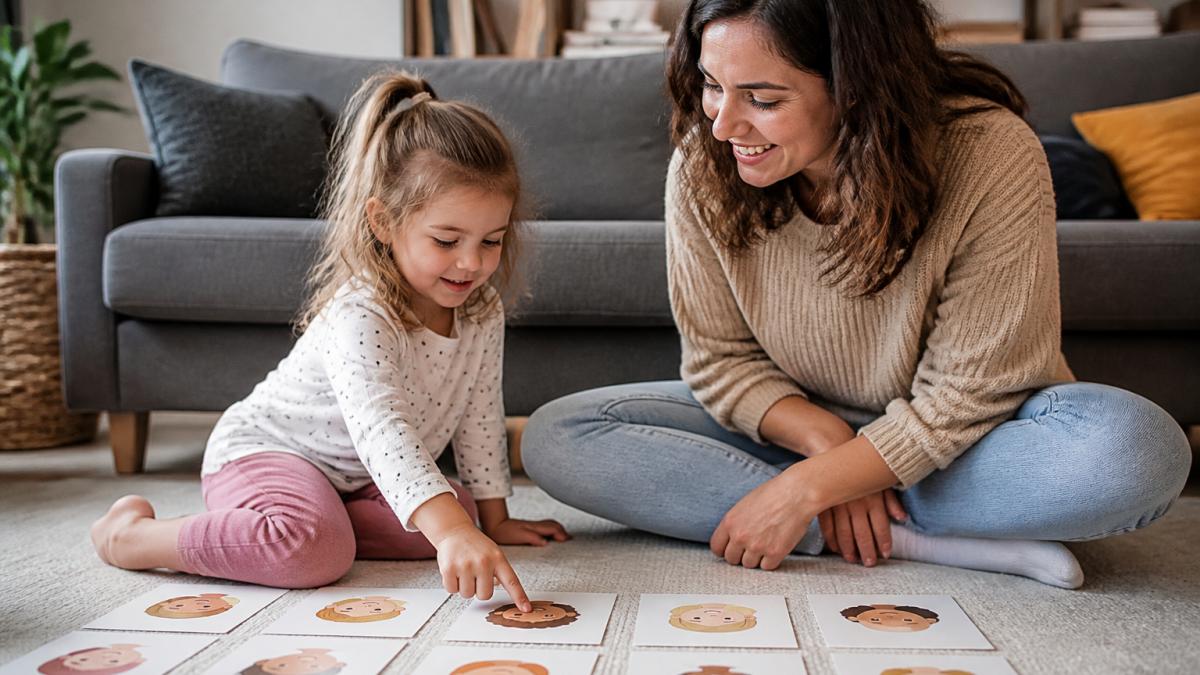
[IMAGE: A parent and young child sitting on a cozy living room floor, looking at a set of illustrated emotion cards spread out between them. The child is pointing at a card while the parent smiles warmly | section:2.
Pick the Right Card Set for Your Child's Age
Match the card format to your child's developmental stage:
- Toddlers (roughly 18 months to 3 years): Use photo cards of real faces, not cartoons. Toddlers read real expressions more reliably than stylized drawings. Keep the set to four to six core feelings: happy, sad, mad, scared.
- Preschoolers (3 to 5 years): Illustrated cards with a single face and one word work well. Add a second tier of feelings such as surprised, tired, excited, and frustrated. Cards with a body pose as well as a face help children who focus on the whole body.
- School-age children (6 to 10 years): Move to cards with more nuanced labels: proud, embarrassed, disappointed, jealous, nervous, grateful. Some sets include a short scenario on the back ("You lost your turn") so the child can match the feeling to a situation.
If no set fits, make your own: photograph family members acting out feelings and write the word on the back. Familiar faces land better.
How to Use the Cards Without Turning Them Into a Test
A common mistake is treating the cards like a quiz. The goal is familiarity, not a correct answer. Try these low-pressure routines:
- Leave them out. Keep a small stack on the kitchen table or in a basket in the car. Let your child pick one up on their own.
- Ask a side-by-side question. "Which one feels like today?" works better than "How do you feel?" because the card does the naming for the child.
- Use two cards at once. "Do you feel a little happy and a little worried?" This teaches that mixed feelings are normal, a point most guides skip.
- Match the card to a real moment. After a meltdown passes, point to the "angry" card and say, "I think this was the one earlier. Was it?" You are helping your child connect the feeling to the event.
- Let your child correct you. If they say "no, it was frustrated," that is a win. They are doing the identification work.
What to Do When a Child Won't Pick a Card
Some children freeze when asked to choose. Don't push, offer lower-pressure alternatives:
- Point instead of name. "Just point to one. You don't have to say it."
- Narrow to two. Hold up two cards and ask, "This one or this one?" A forced choice is easier than an open menu.
- Draw it. Hand your child a crayon and say, "Can you draw what it feels like?" Many children who won't speak will scribble.
Emotion charts work the same way: hang one at kid height and point to it during real moments. Visual supports help children who struggle to find words, including neurodivergent kids. For language delays, a chart with photos and one word per feeling beats a busy twenty-face poster.
Avoid correcting a child's card choice. If your child points to "sad" when you think they look angry, do not say "no, you're angry." Say, "Thanks for showing me. Tell me more about the sad." The card is a starting point for conversation, not a diagnosis.
3. Name Your Own Feelings Out Loud
Children learn emotion vocabulary by hearing it. If you never say how you feel, your child has nothing to copy.
Try short, honest statements during the day:
- "I'm frustrated the printer broke again."
- "I feel calm after that walk."
- "I'm a little worried about tomorrow."
Keep it brief and real. You are not asking your child to manage your feelings, just showing that everyone has them and words help.
What most guides miss is the power of repair. After a hard moment, say, "I got angry earlier.
4. Match Facial Expressions and Body Language to Words
Feelings show up in the body before they show up in words. Teaching a child to read facial expressions and body language gives them clues to work with. Make it a game: in a picture book, ask, "How does that character feel? How can you tell?" Point to tight fists, a droopy mouth, wide eyes. Do the same with your child's body: "Your shoulders are up near your ears.
Avoid telling a child what they feel. "You're not scared, you're fine" shuts the lesson down. Offer a guess instead: "Your face looks unsure. Am I close?" Guessing invites a reply. Telling ends the talk.
5. Use Play-Based Feelings Activities for Kids
Feelings activities for kids work because play lowers a child's guard, a child who won't talk about a hard day will often act it out with toys. Match the activity to your child's age and keep the pressure off naming the feeling until they're ready.
A Simple Progression by Age
A toddler and a second grader need different entry points, so build a short progression:
Toddlers (roughly 18 months to 3 years): Keep it physical and face-based. Try these:
- Mirror play. Sit facing your child and make a happy face, then a sad face. Name each one. Toddlers learn to read faces by watching yours.
- Peekaboo with feelings. Hide behind a cushion, pop out with a surprised face, and say "surprised!" Repeat with happy and sleepy.
- Body-labeling during play. While tickling or swinging, narrate: "Your body feels excited. Your heart is fast." This pairs the feeling with the physical signal.
Preschoolers (3 to 5 years): Add pretend play and simple choice-making.
- Puppet shows. Have two puppets argue over a toy, then make up. Pause and ask, "How does the blue puppet feel?" The puppet gives the child distance to talk about a hard feeling.
- Feelings charades. Take turns acting out a feeling for others to guess. Start with big, easy feelings: happy, sad, angry, scared. Add surprised and sleepy as confidence grows.
- Drawing feelings. Ask your child to draw what anger looks like. Scribbles count. Ask, "What color is your mad?" rather than "Why are you mad?"
School-age children (6 to 10 years): Move to scenario play and reflection.
- Role-play a real scene. Act out a scene where a toy loses a game, or a friend won't share. Let your child play both parts. Playing the "winner" and the "loser" builds perspective-taking.
- Feelings detective. Read a picture book and stop on a page. Ask, "What clues tell you how this character feels?" Point to tight fists, a droopy mouth, wide eyes. This links faces and bodies to words.
- Two-feeling stories. Ask your child to tell a short story where the character feels two things at once, like excited and nervous on the first day of school. This teaches mixed feelings.
Scripts That Keep Play Low-Pressure
The words you use during play matter as much as the activity. Try these scripts:
- Instead of "How do you feel?" try "I wonder what the puppet feels." The third-person framing takes the spotlight off the child.
- Instead of "You're being silly" try "Your body looks wiggly. That's a lot of energy." You are naming the body signal, not judging the behavior.
- Instead of "Calm down" try "Let's do three big breaths together." You are offering a co-regulation tool, not a command.
What to Do When a Child Won't Engage
Some children refuse play-based activities, especially after a hard day. Do not force it. Try these alternatives:
- Parallel play. Sit near your child and play with your own toy. Narrate your toy's feelings out loud. Many children join in without being asked.
- Draw together. Put out paper and crayons and draw your own feeling. Your child may copy you.
- Use a book. A story gives a character to watch and a safe distance to talk from. Pause and ask about the character, not the child.
Books about feelings belong here too. Our Bravo Bear stories are built around kindness, confidence, and courage, so the emotional lessons arrive through the adventure rather than a lecture, often the easiest entry point for a child who resists direct feelings talk.
Play is the practice ground. A child who acts out anger with a puppet, draws sadness with a crayon, or guesses a character's feeling in a book is building the same skill you want at the dinner table: noticing a feeling and giving it a name.
6. Learn How to Talk to Kids About Big Feelings
Big emotions need a different approach than small ones. When a child is flooded, logic does not land, calm the body first, then teach.
Here is how to talk to kids about big feelings:
- Get low and quiet. Match your calm, not their chaos.
- Name it simply: "You're really angry right now."
- Validate it: "That makes sense. Losing a turn is hard."
- Wait. Let the storm pass before you problem-solve.
- Talk it through later, once everyone is steady.
Active listening means hearing the feeling under the words. A child yelling "I hate my brother" is often saying "I want your attention." Reflect that back: "It sounds like you felt left out."
Validation is not agreement. You can accept a feeling while still holding a limit. "It's okay to be mad. It's not okay to hit."
7. Teach How to Help Kids Express Their Emotions in Healthy Ways
Knowing the name of a feeling is only half the job. Children also need safe ways to let it out. This is where self-regulation and healthy coping strategies come in.
Build a calming kit together. Let your child choose the items, which boosts buy-in:
- Stress balls or fidget toys
- A cozy corner with a soft blanket
- Paper and crayons to scribble out anger
Co-regulation comes first. A young child borrows your calm before they can create their own. Sit with them, breathe slowly, and let your steady presence do the work.
Every feeling is allowed. Every behavior is not. Children who learn this difference build emotional regulation without shame, and that lesson lasts well past childhood.
Conclusion: Building Emotional Literacy One Feeling at a Time
Emotional literacy is not a single talk but a slow build of small moments: a check-in at breakfast, a card on the floor, a parent naming their own frustration out loud.
Some children won't label a feeling, and that's okay, offer words, wait, and try again another day.
At Bravo Bear, our edu-tainment stories give families a warm, screen-free way to explore feelings together.
Frequently Asked Questions
When should children be able to name their feelings?
Most children begin labeling basic emotions like happy, sad, and angry between ages 2 and 3. By age 4 or 5, many can identify more complex feelings such as frustrated, worried, or excited with adult support. Keep in mind that every child develops at their own pace. If your child is 5 or older and still struggles to recognize basic emotions in themselves or others, it may be worth mentioning to your pediatrician.
What are simple ways to help young children understand emotions?
Start with a daily feelings check-in where your child points to or names how they feel. Use emotion cards for children to give them words for different feelings. Name your own emotions out loud throughout the day so they hear the vocabulary in context. Play matching games with facial expressions, and read books that show characters experiencing a range of emotions. Keep it playful and low-pressure.
How can I help my child express their emotions without tantrums?
Teach calming tools like deep breathing, squeezing a stress ball, or using a feelings chart before big emotions hit. When your child is upset, get down to their level, name what you see, and validate without judgment. Offer choices like drawing how they feel or using an emotion card to show you. Practice these strategies during calm moments so they become automatic when feelings get big.
My 4-year-old won't stop crying. What should I do?
Get close, stay calm, and name the feeling you notice without trying to fix it right away. Say something like, 'You seem really sad that your tower fell down.' Validation helps your child feel understood, which often shortens the crying spell. Offer a calming tool like a hug or a stress ball. Once they're calm, talk about what happened and practice naming the feeling together.


