

Teaching Resilience to 5-Year-Olds: A Parent's Guide
Table of Contents
- What Resilience Means for Young Children
- How to Talk to Kids About Failure and Setbacks
- Teaching Emotional Regulation and Naming Feelings
- How to Help Children Overcome Fear Through Gradual Exposure
- Activities to Build Resilience in Preschoolers
- Modeling Resilience as a Parent or Caregiver
- Building Your Child's Resilience Toolkit
- Frequently Asked Questions
Last Updated: September 19, 2026
What Resilience Means for Young Children
Teaching resilience to 5 year olds is one of the most valuable skills you can help your child develop. Resilience isn't about being tough or never feeling sad. It's the ability to bounce back from disappointment, try again after failure, and keep going when things get hard.
At this age, your child is learning how the world works. They're discovering that not every attempt succeeds. Not every game goes their way. These moments are golden opportunities to build emotional strength.
Resilience in young children looks like this: your child tries to build a tower, it falls down, and instead of giving up, they try again. They lose a game and feel upset, but they play another round tomorrow. They're scared of the dark but slowly get braver each night.
This isn't something kids are born with. You build it together, day by day, through small moments and patient guidance.
How to Talk to Kids About Failure and Setbacks
The way you respond when your child fails shapes how they handle challenges for years to come. Most parents instinctively try to fix the problem or make the disappointment go away. That actually works against resilience.
Instead, validate what they're feeling first. Say things like:
- "I see you're frustrated. That's okay."
- "You wanted that to work, and it didn't. That's disappointing."
- "You tried hard and it was still difficult."
Let them sit with the feeling for a moment. Don't rush to cheer them up or offer solutions right away.
Then ask simple questions:
- "What happened?"
- "What could you try next time?"
- "Do you want to try again, or do something else?"
These questions help your child think through the problem instead of just hearing your answers. That's where the learning happens.
When your child does try again after failing, that's the moment to celebrate effort, not just success. Say "You didn't give up" or "You tried a different way" rather than only praising the outcome.
American Academy of Pediatrics guidance on child development emphasizes that children learn resilience through experiencing manageable challenges and receiving supportive responses from caregivers.
Teaching Emotional Regulation and Naming Feelings
Young children often can't tell you what they're feeling because they don't have the words. But there's a neurobiological reason this matters: when a child is upset, the amygdala (the brain's alarm center) is activated, and the prefrontal cortex (responsible for language and logic) is temporarily offline. Naming the feeling, whether the child does it or you do, actually helps activate that prefrontal cortex again. This is why "You're frustrated" is not just comforting; it's literally helping your child's brain regain control.
Teaching emotional vocabulary is foundational to emotional regulation and building resilience. Start by naming feelings you see in the moment:
- "You're smiling. You look happy."
- "Your face looks sad right now."
- "You seem frustrated."
Then introduce feeling words during calm moments, not just when emotions are running high. Read books together and talk about how characters feel. Use feeling charts with pictures. Play games where you make different emotion faces.
Once kids can name feelings, they can manage them better. A child who says "I'm frustrated" is already partway to handling it. A child who just screams hasn't found the words yet.
What to Say in the Moment: Scripts for Common Scenarios
Parents often freeze when their 5-year-old melts down. Here are specific phrases for real situations:
Scenario: Your child loses a game and starts crying
Instead of: "Don't cry, it's just a game."
Try: "You really wanted to win, and you didn't. That feels terrible right now. I see you're upset. Let's sit together for a minute."
Wait for the crying to settle, then: "What was the hardest part for you?" Listen. Then: "Do you want to play again, or do you need a break?"
Scenario: Your child can't do something and throws a tantrum
Instead of: "You can do it, just try harder."
Try: "This is really hard for you right now. Your body is telling me you're frustrated. Let's take some deep breaths together, and then we can figure out what to do."
Then: "Do you want help, or do you want to try a different way?"
Scenario: Your child is scared or anxious
Instead of: "There's nothing to be scared of."
Try: "I notice you're feeling worried. That's a feeling your body has sometimes. I'm right here, and you're safe. What would help you feel better?"
Teach simple calming strategies and practice them during calm times so they're available when big feelings arrive:
- Deep breathing: Pretend to smell a flower (slow inhale through nose), then blow out birthday candles (slow exhale through mouth). Do this 3-5 times.
- Body scan: "Can you feel your feet on the ground? Your hands? Your bottom in the chair?" This grounds them in their body.
- Taking a break in a quiet space: A designated calm-down corner with soft items, not as punishment but as a reset tool.
- Moving their body: Jumping, dancing, running, or stretching. Physical movement helps discharge the stress hormone cortisol.
- Holding something soft: A stuffed animal, blanket, or stress toy.
Practice these when your child is calm. Then when big feelings come, they already know what to do. The key is repetition: a child who has practiced deep breathing 20 times during calm moments will be able to access it during distress.
American Academy of Pediatrics guidance on child development emphasizes that children learn emotional regulation through experiencing manageable challenges and receiving supportive responses from caregivers, which is exactly what these scripts provide.
How to Help Children Overcome Fear Through Gradual Exposure
Fear is normal at this age. The dark, loud noises, new situations, separation from you. The instinct to protect your child by avoiding these things is strong. But avoiding fear actually makes it bigger.
Instead, use gradual exposure. This means facing the fear in small, manageable steps.
If your child is afraid of the dark:
- Start with lights on, then dim them slightly
- Read stories with the lights dimmed
- Play games in a darker room for short periods
- Gradually spend more time in darker spaces
- Eventually, turn off the lights for just a few minutes
Each step should feel manageable, not terrifying. Your child should feel safe. You're there, and nothing bad happens.
The key is consistency. Small exposures repeated over weeks build confidence faster than one big brave moment.
Stay calm yourself. Kids pick up on your anxiety. If you seem worried about the dark, they will too. Show them through your actions that you're not afraid.
Celebrate small wins. "You stayed in this room with the lights off for two minutes. That took courage."
Activities to Build Resilience in Preschoolers
Resilience grows through doing, not just talking. These activities build problem-solving skills, emotional strength, and confidence.
Building and Creating
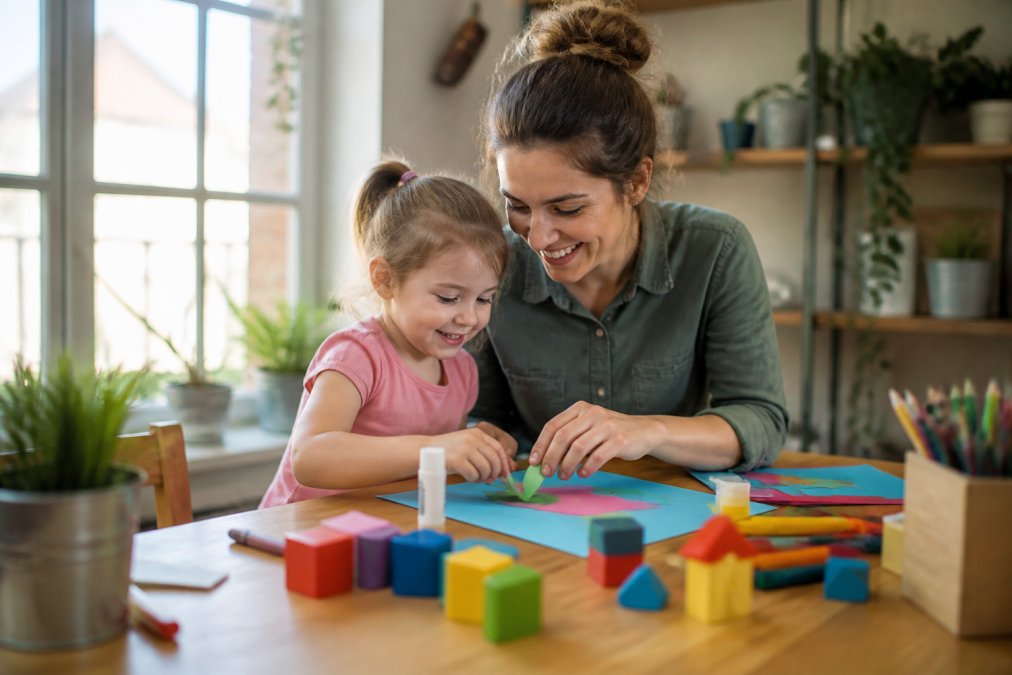
Give your child open-ended materials: blocks, Legos, cardboard boxes, art supplies. Let them build, create, and fail without your help. When it falls apart, resist the urge to fix it.
Problem-Solving Games
Role-Playing
Physical Activities
Helping Others
Story Time with Purpose
Modeling Resilience as a Parent or Caregiver
Your child watches how you handle disappointment, failure, and fear. What you model matters more than what you say, and there's neuroscience behind it. Children have mirror neurons that fire both when they perform an action and when they watch someone else perform it. When your child sees you struggle and persist, their brain is literally rehearsing that same behavior.
Real-Life Scripts for Modeling Resilience
When you make a mistake:
Your child learns: mistakes are information, not catastrophe.
When you don't know something:
When you're nervous about something new:
Your child learns: fear and courage coexist.
When you ask for help:
Your child learns: strong people ask for support.
When you're frustrated:
Building Your Child's Resilience Toolkit
A resilience toolkit is a collection of strategies and resources your child can use when things get hard. Build it together.
Physical Items
Words and Phrases
Teach your child phrases they can say to themselves:
- "I can try again."
- "It's okay to feel sad."
- "I'm learning."
- "I can ask for help."
Practice these regularly so they're ready when needed.
People and Connections
Routines and Rhythm
Stories and Examples
Celebrating Effort
Frequently Asked Questions
At what age can children start learning resilience?
Children begin developing resilience skills around age 3, but 5-year-olds are at an ideal stage to actively practice emotional regulation, problem-solving, and coping strategies. At this age, they can understand cause-and-effect, name basic emotions, and learn from mistakes. Teaching resilience to 5-year-olds builds a foundation that strengthens throughout their lives. Early exposure to manageable challenges helps them develop confidence and adaptability.
How do I know if activities to build resilience in preschoolers are actually working?
Look for small shifts: your child attempts a task after initial failure, expresses feelings using emotional vocabulary, or asks for help instead of shutting down. Watch for increased willingness to try new things, calmer responses to frustration, and more independence in problem-solving. Progress isn't always linear, setbacks are normal. Track changes over weeks and months rather than days. Stories and role-play games can reveal how your child thinks about challenges.
What should I do if my child refuses to try something after one failure?
Validate their feelings first: 'That was hard, and I see you're frustrated.' Then reframe the experience: 'You tried something new, that takes courage.' Offer a smaller version of the task, break it into easier steps, or try it together. Avoid pushing too hard; instead, model how you handle your own setbacks. Return to the activity later when emotions settle. This teaches that failure isn't permanent and that support is available, building self-efficacy over time.
How can Bravo Bear stories support my child's resilience development?
Bravo Bear's edu-tainment series uses memorable stories filled with heart and meaningful life lessons to teach kindness, confidence, and courage. Reading these stories together creates opportunities to discuss how characters handle challenges, overcome fears, and solve problems. The narratives model resilience in action, helping children see themselves in characters who persist through adversity. The Bravo Bear Complete Set ($79.99) or Monthly Book Club ($14.99) provides consistent exposure to character-building content that reinforces resilience lessons you're teaching at home.
Teaching resilience to 5 year olds isn't about preventing hard moments. It's about preparing your child to handle them. You do this through validation, modeling, gradual challenges, and consistent support. The stories your child hears, the way you respond to setbacks, and the tools you give them all build this crucial skill. Start today with one small conversation about feelings or one moment where you let your child struggle a bit before offering help. That's where resilience begins.


