

Character Building Games for Siblings: 5 Best Picks
Table of Contents
- Why Character Building Games Work for Siblings
- Quick Comparison: 5 Character Building Games at a Glance
- 1. The Kindness Quest: Practicing Empathy and Encouragement
- 2. Cooperative Games for Siblings: The Bridge Builders Challenge
- 5. The Patience Tower: Building Resilience and Self-Control
- Games for Siblings of Different Ages: How to Adapt Each Game
- Frequently Asked Questions
Last Updated: October 8, 2026
Why Character Building Games Work for Siblings
Character building games are structured play activities that teach empathy, fairness, patience, and teamwork through shared goals rather than competition. The right game turns everyday sibling friction into a chance to practice kindness and cooperation. The five games below each target one trait and take under 30 minutes to set up.
Sibling relationships are a child's first classroom for social skills. Negotiating who holds the cardboard bridge piece or whose turn it is to hide the clue is real-time practice in negotiation, active listening, and self-control.
Below, we break down five character building games, the trait each develops, and how to adapt them for siblings of different ages. The game matters less than the framing: a parent prompt before play does more for cooperation than any rulebook.
Quick Comparison: 5 Character Building Games at a Glance
Each game maps to one core character trait, a realistic setup time, and an age range that works for most families.
| Game | Character Trait | Setup Time | Play Duration | Best Age Range |
|---|---|---|---|---|
| The Kindness Quest | Empathy, encouragement | 10 min | 20-30 min | 4-9 |
| Bridge Builders Challenge | Teamwork, collaboration | 5 min | 20-40 min | 5-10 |
| Fair Play Detective | Fairness, conflict resolution | 15 min | 30-45 min | 6-11 |
| Storytellers' Circle | Communication, creative thinking | 5 min | 15-25 min | 3-10 |
| Patience Tower | Resilience, self-control | 5 min | 15-30 min | 4-9 |
Setup stays short on purpose. Long preparation kills momentum, and momentum keeps siblings engaged long enough for the trait to stick.
1. The Kindness Quest: Practicing Empathy and Encouragement
The Kindness Quest is a scavenger hunt where siblings collect "kindness tokens" by completing small acts for each other. The goal is not to win but to notice and name kind behavior out loud.
Before play, write five kindness prompts on slips of paper: "Give your sibling a genuine compliment," "Help them find something they lost," "Let them pick the next snack," "Say thank you for something specific," and "Cheer for them during a hard task." Hide the slips around the room.
The trait being built is empathy, plus the habit of encouragement. What most guides miss is that kindness needs a witness to become a habit. When a parent names the act ("You saw your brother was frustrated and helped him without being asked"), the behavior gets reinforced far more than the token does.
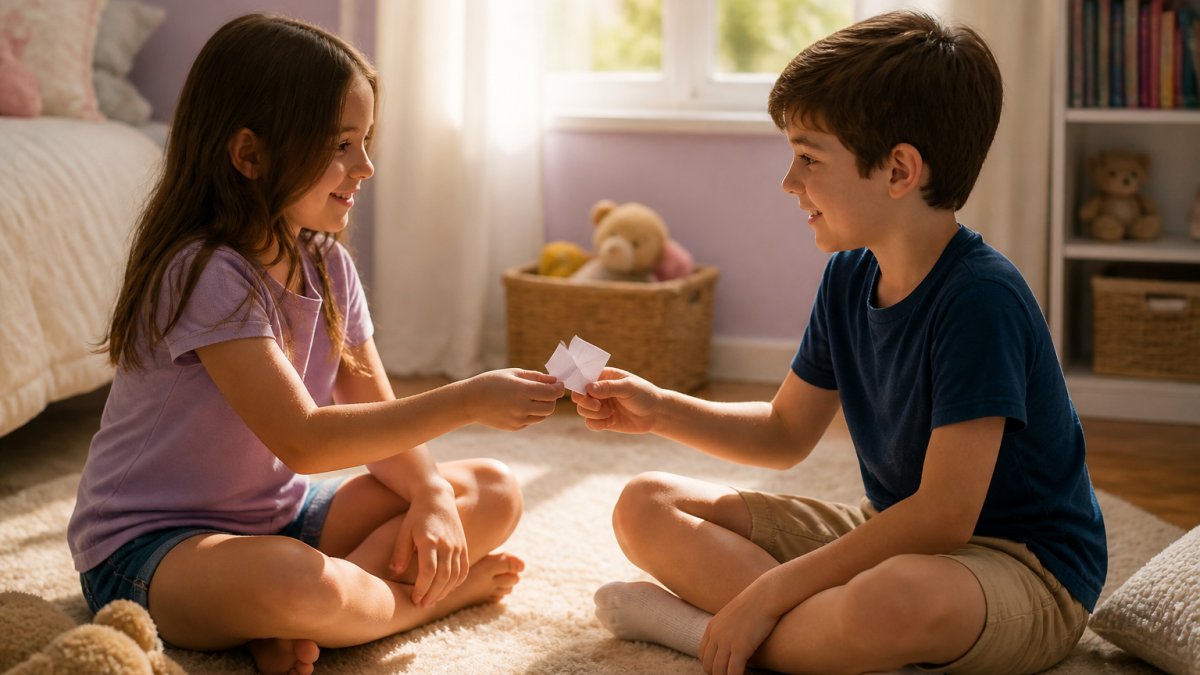
2. Cooperative Games for Siblings: The Bridge Builders Challenge
The Bridge Builders Challenge is a cooperative game where siblings build one bridge together using blocks, cardboard, or cushions, with a shared goal instead of competing designs.
Cooperative games for siblings work because they remove the win-lose structure that fuels most sibling rivalry. There is no loser when the goal belongs to the team.
How to set it up:
- Place the two chairs about 18-24 inches apart, wide enough to be a real problem, narrow enough that a first attempt can succeed.
- Put all materials in one shared pile between the children, not two separate piles. A single pile forces negotiation over who gets the long tube.
- State the goal out loud: "Your job is to build one bridge that holds the toy, and you both have to be able to point to a piece the other person added."
- Let them build. Stay nearby but do not solve the wobble for them.
- When the toy crosses, run a 60-second debrief: each child names one thing their sibling did that helped.
Roles for uneven skill levels. If one child is clearly more capable with construction, assign roles instead of splitting the same task.
Fair-play rules to state before you start:
- One piece at a time. No grabbing from a sibling's hand.
- If you disagree about a piece, each person gets 20 seconds to say why, then you try the other person's idea first.
- If the bridge collapses, no blaming. The only allowed question is "what should we change?"
- The build is finished when both children agree it is finished, not when one child says so.
5. The Patience Tower: Building Resilience and Self-Control
The Patience Tower is a building challenge where siblings take turns placing one block at a time, and any rushed move that topples the tower restarts that round. The trait is patience, resilience, and self-control.
The twist that makes it work: the waiting child must give one piece of encouragement before the other places their block. This keeps them engaged instead of bored and turns a test of patience into a team effort. When the tower falls, the parent prompt is not "that's okay" but "what will you try differently this time?" That question builds resilience by pointing at the next attempt.
Games for Siblings of Different Ages: How to Adapt Each Game
Games for siblings of different ages need one adjustment: give each child a role matched to their level, not the same task.
The reason is developmental, not just fair. Younger children are still building the ability to wait, share, and hold a rule in mind, while older children are ready for strategy and turn-taking with less adult support.
Here is how to adapt each game by age and developmental stage:
- Kindness Quest: Younger children draw pictures instead of writing prompts; older children read the prompts aloud and model the acts. For a 3-4 year old, reduce to three prompts and keep them physical (a hug, a high-five, fetching a sibling's shoes).
- Bridge Builders: Give the younger child the "materials manager" role (handing pieces, holding the base) and the older child the "designer" role. Swap on the second build.
- Fair Play Detective: Shorten the younger child's turn and pair them with the older sibling as a team rather than solo turns. For a 6-7 year old, cap the lead-detective turn at 5 minutes.
- Storytellers' Circle: Let the younger child add a sound or a gesture instead of a full sentence. Older children can be asked to build on the younger child's sound, which flips the usual dynamic.
- Patience Tower: Use larger, easier blocks for younger hands and smaller ones for older children so both face a fair challenge. If the younger child keeps knocking the tower down, give them the "encourager" role for one round.
The principle across all five: match the difficulty to the child, not the game to the age. When both siblings feel capable, cooperation replaces competition.
What to do when the younger child loses interest. Shorten the round rather than pushing through. A 10-minute round that ends on a good note beats a 30-minute round that ends in tears.
Fair-play reset for when competition creeps back in. If a game turns into a fight, pause it and run a short reset:
- Each child says one sentence about what they wanted.
- Each child says one sentence about what they think their sibling wanted.
- Together, they pick one change to the rules for the next round.
- Restart the round fresh. No score carries over.
This reset moves the children from arguing about the past to designing the next round together, and it is where conflict resolution gets practiced on purpose rather than lectured about.
For families who want to reinforce these lessons between game sessions, the Collaborative for Academic, Social, and Emotional Learning framework maps social-emotional skills to everyday activities, and screen-free activities for young children pair well with read-aloud time. The National Association for the Education of Young Children on play-based learning also emphasizes that guided play, not instruction, is what builds these traits in early childhood.
Frequently Asked Questions
What is the best game for siblings?
The best game depends on your children's ages and the trait you want to practice. The Kindness Quest works well for empathy and encouragement, while the Bridge Builders Challenge builds teamwork and communication. For siblings of different ages, the Storytellers' Circle adapts easily because older children can lead the story while younger ones add details. Try two or three games and see which one your children ask to play again.
How can games help siblings get along?
Games give siblings a shared goal instead of a competition. When children work toward the same outcome, they practice taking turns, listening, and solving problems together. Cooperative games for siblings also reduce the pressure to win, which is a common source of sibling disagreements. Over time, these positive interactions build trust and make sibling bonding activities feel natural rather than forced.
How do you adapt games for siblings of different ages?
Adjust the rules so each child has a role that matches their ability. For a 3-year-old and a 7-year-old, let the younger child handle simple tasks like handing over blocks while the older child plans the structure. You can also shorten rounds for younger children or let older siblings act as coaches. The goal is participation, not perfect fairness. Games for siblings of different ages work best when both children feel needed.
How long should a sibling game last?
Most young children stay engaged for 10 to 20 minutes per game. For ages 3 to 5, aim for 10 minutes and stop while they are still having fun. For ages 6 to 8, 20 minutes is usually comfortable. If you notice frustration or wandering attention, end the game and try again later. Short, frequent screen-free activities for young children build the habit better than one long session.


