

Teach Children to Apologize Sincerely Without Forcing
Table of Contents
- Why Forced Apologies Backfire
- Understand the Difference Between Accidental Harm, Impulsive Behavior, and Intentional Harm
- Help Your Child Recognize What Happened and Understand Impact
- Build Empathy: Teaching Kids to See the Other Person's Feelings
- What to Say Instead of Sorry for Kids: Words That Build Genuine Remorse
- Ways for Children to Make Amends Beyond Words
- Teaching Kids to Take Responsibility and Prevent Future Conflicts
- How to Respond When a Child Refuses to Apologize
- Frequently Asked Questions
Last Updated: October 17, 2026
Why Forced Apologies Backfire
When a child says "I'm sorry" on demand, the words become hollow. Research shows coerced apologies teach compliance, not genuine remorse.
They also backfire: a cornered or shamed child may resent the other person more and internalize apologies as punishment rather than repair.
Here's what matters instead: teach children apologize sincerely by helping them understand the connection between their actions and someone else's pain.
Understand the Difference Between Accidental Harm, Impulsive Behavior, and Intentional Harm
Not all mistakes are the same, and your response should match what happened.
Accidental harm happens without intent, your child knocks over a sibling's block tower while running past.
Impulsive behavior involves a choice without thinking through consequences, grabbing a toy without considering the other child's feelings.
Intentional harm means your child knew it would hurt and did it anyway, hitting out of anger or saying something mean deliberately.
The distinction matters because it shapes how you approach the conversation:
- For accidental harm: focus on repair and reassurance ("Let's fix this together")
- For impulsive behavior: explore the choice and its impact ("What happened when you grabbed the toy?")
- For intentional harm: address the choice to hurt and work toward understanding why ("You knew that would hurt. What were you feeling?")
Help Your Child Recognize What Happened and Understand Impact
Before your child can teach children apologize sincerely, they need to understand what happened. Adults often jump straight to "Say sorry," which is backwards.
Wait until emotions settle, then ask open questions:
- "What happened just now?"
- "What did you do?"
- "What do you think happened after that?"
Listen, then help them connect the dots: "You grabbed the toy. Then your sister started crying." Use simple language, avoid lectures, and aim for recognition, not guilt.
Once your child can describe what happened, move to impact: "How do you think your sister felt?" "What do you notice about how they're acting now?" Some kids answer immediately; others need time.
Build Empathy: Teaching Kids to See the Other Person's Feelings
Empathy is the bridge between "I did something" and "I care that I hurt someone." Without it, apologies feel empty even to the child saying them. It develops on a predictable timetable, so build it in calm moments.
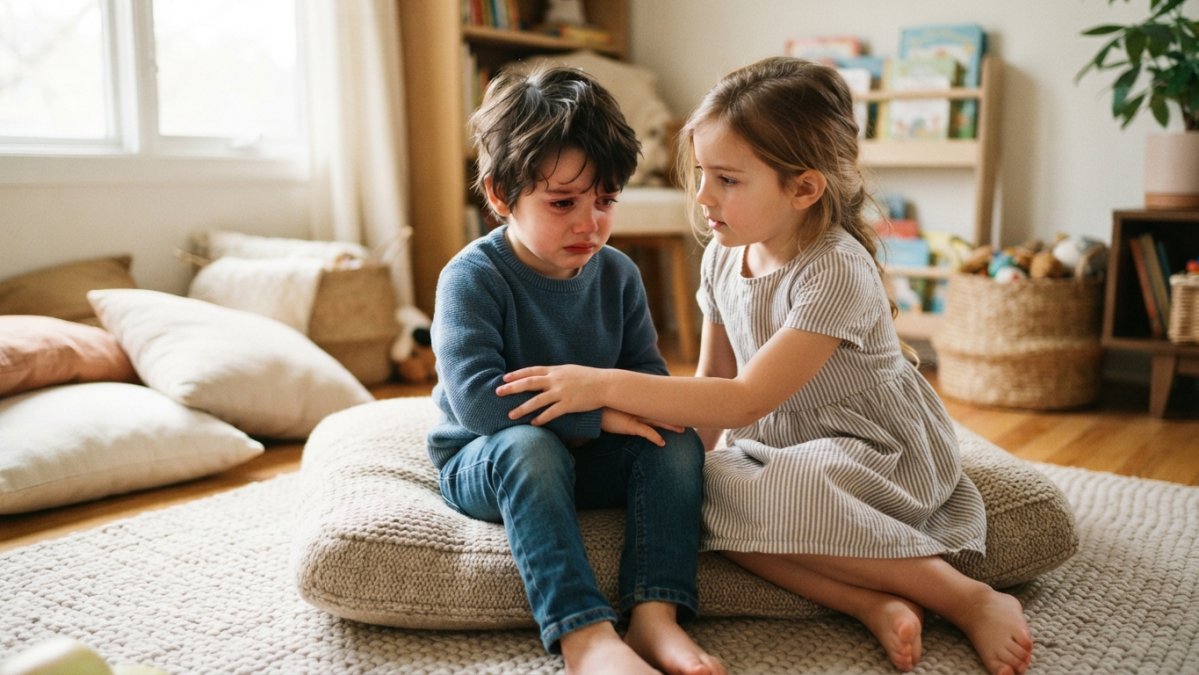
What children can actually understand at each age
Empathy develops in stages. Matching expectations to the stage prevents demanding insight a child's brain can't yet produce.
-
Toddlers (roughly 18 months to 3 years): They notice another child crying but can't separate their own feelings from the other person's. Narrate feelings ("Maya is sad. She dropped her cracker") and model comfort.
-
Preschoolers (roughly 3 to 5 years): They can name basic emotions but struggle to hold two perspectives at once. Point out cause and effect in real time ("You took the truck. Now he's crying") and rehearse perspective-taking through pretend play and picture books.
-
Early elementary (roughly 6 to 8 years): Genuine perspective-taking takes off. Kids connect actions to consequences with prompting and start to understand intent ("I didn't mean to, but it still hurt"). Ask open questions and let them reason.
-
Older children (roughly 9 to 12 years): They can hold multiple perspectives and reason about repair, but feel shame acutely, so lectures backfire. Treat them as a thinking partner and let them propose the repair.
Parents tend to overestimate younger children and underestimate older ones. The fix is the same at every age: describe, don't demand.
Scripts that build perspective-taking
Instead of quizzing your child ("How do you think she feels?"), which feels like a test, invite noticing:
- Narrate, don't interrogate: "Look, her shoulders are down and she's quiet. Something changed for her."
- Offer a guess they can correct: "I wonder if that felt embarrassing. Am I close?"
- Connect action to impact: "When you laughed, he stopped talking. I think that hurt."
None require the child to produce the "right" feeling on command. They teach looking, guessing, and checking, what empathy is in practice.
Build the muscle before you need it
The most effective empathy teaching happens outside conflict:
- Read together and pause on feelings. "Why do you think the bear is hiding?" Picture books are no-stakes perspective-taking practice.
- Play "what would you want?" games. At dinner: "If you were the new kid at school, what would you want someone to do?"
- Use real moments, briefly. Name a sibling's or classmate's upset in one sentence and move on. Short and frequent beats long and rare.
What to Say Instead of Sorry for Kids: Words That Build Genuine Remorse
The phrase "I'm sorry" is just the start. Real apologies include acknowledgment, understanding, and commitment to change. Teach your child to say what actually happened ("I grabbed your toy without asking"), then add understanding of impact ("You felt sad because I took your toy"), then offer repair ("What can I do to make it right?").
Here's a full example for a young child:
"I grabbed your toy. You got upset. That wasn't kind. I'm sorry. Do you want to play together?"
Notice what's missing: guilt, shame, or punishment. The focus is what happened, why it mattered, and how to move forward. For older kids, add more nuance:
"I said you were bad at soccer. I know that hurt your feelings because you care about sports. I was being mean because I was frustrated about something else. That wasn't your fault. I'm sorry. I want to be a better friend."
Ways for Children to Make Amends Beyond Words
Actions often speak louder than words. Making amends gives children a concrete way to repair harm and rebuild trust.
Repair the damage: Clean up what they broke, help rebuild the block tower, fix the torn page.
Make a gesture: Draw a picture, make a card saying they're sorry, offer a favorite toy to share.
Let your child choose from real options.
For siblings, repeated conflicts need repeated repair.
Teaching Kids to Take Responsibility and Prevent Future Conflicts
The final piece is helping your child learn from what happened, where genuine apology becomes real growth. Ask reflective questions ("What will you do differently next time?") and help them problem-solve: if they hit when frustrated, "take a breath, tell an adult, go to your calm spot"; if they grab toys, "ask first, and if they say no, find something else or ask for a turn." Make a simple plan together, write it down or draw pictures if your child is young, and review it occasionally without shame.
How to Respond When a Child Refuses to Apologize
Some children refuse to apologize, "I'm not sorry," or silence. It's frustrating but also information. A refusal isn't proof your child is cruel or your parenting failed; it usually means one of several things, and the right response depends on which, and on your child's age.
Read the refusal before you respond
- They don't understand what happened. Common in toddlers and preschoolers who didn't track the sequence or the other child's reaction.
- They feel ashamed or overwhelmed. Shame shuts down speech; an exposed child may go silent or defiant rather than admit fault.
- They're testing boundaries. Older kids may refuse to see whether the adult will force the issue.
Age-by-age expectations for the refusal
- Toddlers and young preschoolers (roughly 2 to 4): They can't reliably produce a sincere apology; demanding one teaches parroting. Don't push words, focus on physical repair: bring a tissue, hand back the toy, sit with the other child. Narrate: "We're going to help him up. He's sad." The lesson is that harm gets repaired, not that the child performs remorse.
- Preschoolers (roughly 4 to 5): They can often say a simple apology with a prompt, but sincerity is limited. If they refuse, don't escalate, offer two repair actions ("Do you want to bring her the blanket or help me fix the tower?") and let the action carry the message. Come back later, when calm: "What happened with your friend today?"
- Early elementary (roughly 6 to 8): They're capable of genuine apology but may refuse out of pride, embarrassment, or a sense the other child started it. Slow down and get the story straight before assigning fault, ask each child separately. Often the "refuser" has a real grievance of their own.
What to say in the moment
Keep it short and non-coercive:
- "I'm not going to make you say sorry. But we do need to help him feel better. What could we do?"
- "You don't have to apologize right now. I do need you to stay here while we figure out what happened."
- "It looks like you're really upset. Let's take a break and talk in a few minutes."
The pattern: words are optional, repair is not. That preserves your child's agency while holding the line that harm gets addressed.
Siblings and recurring conflicts
Refusals are most common between siblings, long history, ongoing power dynamic, shared audience. A few principles help:
- Don't assign blame before hearing both sides. The child who hit may have been hit first; the one crying may have started it. Get each account separately, then bring them together.
- Separate the pattern from the incident. If the same fight happens daily over the same toy, the setup is the problem, not the apology. Solve the structure: a timer, a rotation, a designated shelf, a rule that the toy goes away if it causes a fight.
- Avoid "aggressor" and "victim" roles. They harden fast. Describe behavior, not identity: "You grabbed. He pushed. You both got hurt."
When an apology is not appropriate or safe
Most advice skips this: sometimes pushing a child to apologize is the wrong move.
- When the child was setting a boundary. If your child said "stop" or "don't touch me" and the other person's feelings were hurt, don't ask for an apology. That teaches children other people's discomfort outranks their own boundaries, a hard lesson to unlearn.
- When the child is being pressured to reconcile with someone who harmed them. If another child has been bullying or hurting your child, a forced apology (for reacting, avoiding, or telling an adult) is silencing, not repair. Address the harm done to your child first.
- When the "harm" was normal developmental behavior. A toddler who won't share, a preschooler who says "you're not my friend", stage-typical, not moral failures. Correct gently and move on; no formal apology required.
Close the loop later
A refusal isn't the end of the lesson. Come back when everyone is calm, later that day or the next, and revisit it briefly: "What was going on for you?" "What would you want to do differently next time?" "Do you want to do anything now to help her feel better?" Sometimes the genuine apology arrives then, unprompted; sometimes the repair action is enough.
The refusal is often the teaching moment. It shows your child that you care more about real repair than about extracting the words, and that builds the trust that makes genuine apology possible later.
Frequently Asked Questions
Should you force a child to say sorry?
No. Forced apologies teach children that words matter more than genuine remorse and can actually undermine accountability. When you demand the words 'I'm sorry,' children learn to perform apologies rather than understand the harm they caused. Instead, focus on helping them recognize the impact of their behavior and feel authentic remorse. This builds real responsibility and teaches them that sincere apologies involve understanding, empathy, and a commitment to change.
What should a child say instead of 'sorry' for kids to show genuine remorse?
Meaningful alternatives include: 'I see that I hurt you, and that was wrong,' 'I know my actions made you feel sad/angry, and I want to make it better,' or 'I'm going to try harder not to do that again.' These phrases show the child has recognized the harm, understands the other person's feelings, and is committing to change. The specific words matter less than the genuine acknowledgment of wrongdoing and the intention to repair the relationship.
How can I help my child understand how their actions affected someone?
Use calm, curious questions to guide reflection: 'What do you think happened when you did that?' 'How do you think that made them feel?' 'What did you notice about their face or body?' Help them connect their behavior to the other person's emotional response. For younger children (ages 3-5), you may need to name the emotion: 'You knocked over their blocks. See how sad they look?' This perspective-taking builds empathy and helps children develop the emotional awareness needed for genuine apologies.
What do you do when a child refuses to apologize?
Stay calm and avoid power struggles. Forcing the issue often makes refusal stronger. Instead, acknowledge their feelings ('I see you're upset'), set a boundary ('We need to fix this'), and give them time and space. You might say, 'You don't have to say sorry right now, but we do need to talk about what happened when you're ready.' Model the behavior you want to see, repair the harm yourself if needed, and circle back later. Sometimes children need to calm down and reflect before they can genuinely acknowledge wrongdoing.


