

Best Bedtime Stories for Ages 3–8 (2026 Guide)
Table of Contents
- Why Bedtime Stories Matter for Ages 3-8
- Short Bedtime Stories for Kids: Top Picks by Age Group
- Bedtime Story Length for 5 Year Olds (and the Whole 3-8 Range)
- Books That Teach Emotional Intelligence at Bedtime
- Classic Fairy Tales, Folk Tales, and Timeless Storybooks
- How to Read Bedtime Stories Effectively
- Audiobook and Narration Options for Bedtime
- Frequently Asked Questions
Last Updated: September 1, 2026
Why Bedtime Stories Matter for Ages 3-8
Bedtime stories are powerful tools for early childhood development. For children between ages 3 and 8, the bedtime routine supports vocabulary building, listening skills, and emotional development. According to the American Academy of Pediatrics' literacy guidance, reading aloud to children from infancy onward supports language acquisition, attention span, and school readiness in measurable ways.
The type of story matters as much as the act of reading itself. A story that teaches courage, kindness, or resilience does more than soothe, it helps the child develop emotionally. Bedtime stories also require children to generate their own mental images, building the cognitive scaffolding that supports reading comprehension and creative thinking well into the school years.
The 3-8 age range is particularly important because it spans enormous developmental leaps. A 3-year-old needs simple, repetitive, calming tales. An 8-year-old is ready for moral complexity and character arcs. The best bedtime stories grow with the child.
Short Bedtime Stories for Kids: Top Picks by Age Group
Short bedtime stories combine age-appropriate vocabulary, a satisfying narrative arc, and gentle themes that ease the transition into sleep.

Stories for Toddlers and Preschoolers (Ages 3-5)
Toddlers and preschoolers thrive on repetition, rhythm, and familiar objects. Stories work best when they mirror the child's own world, a bedroom, a family, a routine, and gently guide them toward sleep.
1. Goodnight Moon by Margaret Wise Brown is the gold standard for this age group. Its gentle, rhythmic text follows a young bunny saying goodnight to everything in its room. The repetitive structure is deliberately calming, and the familiar objects make it immediately relatable.
2. Llama Llama Red Pajama by Anna Dewdney addresses bedtime anxiety directly, making it especially useful for children who resist sleep. The rhyming text soothes while validating the child's feelings.
3. The Very Hungry Caterpillar by Eric Carle teaches counting and the days of the week through a caterpillar's journey from egg to butterfly. The die-cut pages are genuinely interactive, and the transformation into a butterfly makes a lovely metaphor for going to sleep and waking up changed.
4. Bravo Bear's Day of Adventure by CJ Hainsworth blends heart and fun with real life lessons about kindness, confidence, and courage. Designed for ages 3-8, it works across the full preschool range without talking down to children. One parent described the series as "a shining top quality edu-tainment series. Highly recommended!"
Stories for Early Readers (Ages 6-8)
Children in this range are ready for more complex narrative structure, moral lessons, and characters who face real consequences. They still benefit from being read to, even as their independent reading skills develop.
5. Where the Wild Things Are by Maurice Sendak maps directly onto the emotional experience of a child who has had a hard day. Max's journey through imagination, anger, and return to love is psychologically rich and layered enough to prompt real conversation.
6. The Gruffalo by Julia Donaldson teaches wit, resourcefulness, and the value of thinking under pressure. The rhyming couplets make it a pleasure to read aloud, and children in this age group often memorize it quickly.
7. Pete the Cat: I Love My White Shoes by Eric Litwin teaches resilience through repetition and color. Pete's unwavering positive attitude in the face of change is exactly the kind of emotional modeling that 6-8 year olds need.
8. Don't Let the Pigeon Drive the Bus! by Mo Willems turns the reader into a character. Children in this range love the power of saying "no" to the pigeon, and the book teaches boundary-setting in a genuinely funny way.
| Story | Best Age | Core Theme | Read-Aloud Length |
|---|---|---|---|
| Bravo Bear's Day of Adventure | 3-8 | Kindness, confidence, courage | Short-medium |
| Goodnight Moon | 3-5 | Calming routine | Very short |
| Llama Llama Red Pajama | 2-5 | Bedtime anxiety | Short |
| The Very Hungry Caterpillar | 2-6 | Counting, transformation | Short |
| Where the Wild Things Are | 4-8 | Emotions, imagination | Short |
| The Gruffalo | 3-7 | Wit, courage | Short-medium |
| Pete the Cat | 4-8 | Resilience, positivity | Short |
| Don't Let the Pigeon Drive the Bus! | 3-8 | Boundaries, humor | Short |
Bedtime Story Length for 5 Year Olds (and the Whole 3-8 Range)
The ideal bedtime story length for a 5-year-old is 5 to 10 minutes of read-aloud time, typically corresponding to picture books running 500 to 1,000 words. This duration is long enough to engage the imagination but short enough to avoid overtiring a child already fighting sleep.
Across the full 3-8 range, story length should scale with age:
- Ages 3-4: 3-5 minutes, simple repetitive text, under 500 words
- Ages 5-6: 5-10 minutes, mild narrative arc, 500-1,000 words
- Ages 7-8: 10-15 minutes, chapter book excerpts or longer picture books, 1,000-2,000 words
A common mistake is choosing a story that is too long for the child's current energy level. Reading a shorter story well, with voices and pauses, is always more effective than rushing through a longer one. According to the National Sleep Foundation's sleep hygiene guidelines, a predictable pre-sleep sequence, including a fixed story length, helps children fall asleep faster and stay asleep longer.
Books That Teach Emotional Intelligence at Bedtime
Books that teach emotional intelligence are not preachy. The most effective approach is narrative: a character faces a feeling, makes a choice, and experiences a consequence. Children absorb the lesson without being lectured.
Bravo Bear takes this approach: the stories created by CJ Hainsworth put characters in real situations where kindness, courage, and confidence are tested, not just described. For parents looking specifically for books that address emotional regulation, look for stories that show a character experiencing a negative emotion, model a healthy coping response, and end with earned resolution rather than imposed comfort.
Where the Wild Things Are remains the classic example: Max's anger is real, his fantasy is vivid, and his return home is genuinely comforting. Llama Llama Red Pajama handles separation anxiety with similar honesty.
Diversity and Inclusion: What to Look For in Story Collections
A well-rounded bedtime story collection should reflect the world a child actually lives in. Look for collections that include characters of different racial and ethnic backgrounds in everyday roles, diverse family structures, characters with disabilities as protagonists, and folklore from cultures outside the Western European tradition.
Folk tales from West African, Indigenous, Asian, and Latin American traditions introduce children to different narrative structures and moral frameworks. Many are also excellent bedtime stories: short, satisfying, and built around memorable characters. According to the American Library Association's resources on diverse children's books, diverse representation in early childhood reading supports both identity development and empathy development.
Classic Fairy Tales, Folk Tales, and Timeless Storybooks
Classic fairy tales and folk tales have survived for centuries because they take children seriously. The stakes are real, the villains are genuine, and the heroes earn their happy endings.
For ages 3-5, gentler fairy tale adaptations work best. Look for versions of Cinderella, The Three Little Pigs, and Goldilocks that preserve narrative tension without the more violent original elements. The repetitive structure of folk tales, three brothers, three tasks, three chances, is naturally suited to young children's love of pattern.
For ages 6-8, the original Grimm and Andersen tales become more accessible. Stories like The Ugly Duckling and Thumbelina carry genuine emotional weight about belonging and identity that resonates with early school-age children navigating social complexity for the first time.
What separates quality literature from filler is narrative structure. A great bedtime story has a beginning that establishes stakes, a middle that tests the character, and an end that resolves with meaning. Children recognize this structure intuitively, and stories that deliver it become the ones they ask to hear again.
How to Read Bedtime Stories Effectively
Reading bedtime stories effectively is a skill most parents are never taught. A few simple techniques transform an ordinary read-aloud into a genuinely memorable experience.
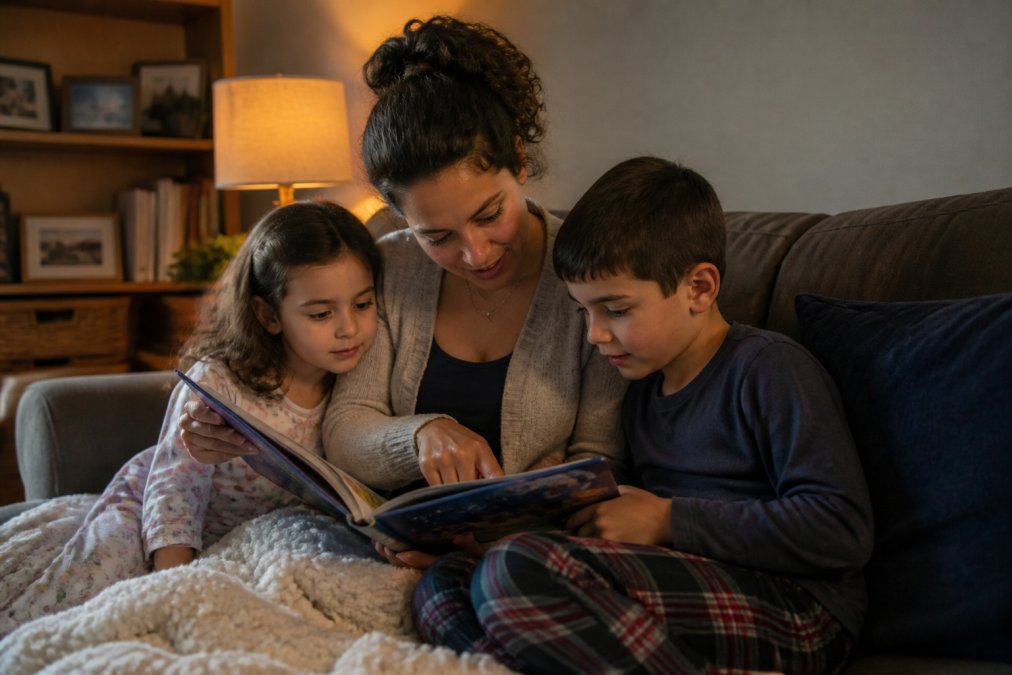
The single most important technique is pace. Slow down by 30%, pause at the end of sentences, and let the illustrations breathe. Children process images and words simultaneously, and rushing denies them that processing time. Vary your voice for different characters, a slightly lower voice for the bear, a slightly higher one for the mouse, to signal character shifts and hold attention.
Interactive Reading Prompts That Build Listening Skills
Interactive reading prompts transform a passive listening experience into an active one. Effective prompts include prediction ("What do you think happens next?"), connection ("Has anything like that ever happened to you?"), vocabulary building, retelling, and character feeling. Use prompts sparingly, one or two per story, to maintain engagement without making bedtime feel like a quiz.
Using Stories for Emotional Regulation and Anxiety Reduction
Bedtime stories are one of the most effective tools for emotional regulation in young children. A story externalizes a feeling, allowing a child who is anxious about starting school to watch a character navigate that exact fear and arrive at sleep with a lighter emotional load.
For children who struggle with bedtime anxiety, choose stories that feature a character who is scared and becomes calm, end with a clear, safe resolution, and include a reassuring parent or caregiver figure. Reading the same story multiple nights in a row is beneficial, not boring. Repetition builds predictability, and predictability reduces anxiety.
Audiobook and Narration Options for Bedtime
Audiobook narration is a legitimate and valuable bedtime tool, particularly for exhausted parents or families navigating multiple bedtimes simultaneously. Many classic children's books have professionally narrated audio versions available through library apps and streaming platforms. According to the Children's Book Council's resources on audio and literacy, listening to professionally narrated stories supports vocabulary development and listening comprehension in ways that closely parallel live read-alouds.
Audio narration works best as a supplement, not a replacement. A child who listens to an audiobook alone misses the physical closeness, the page-turning, and the interactive prompts that make shared reading developmentally rich. Used together, a parent reading three nights a week and an audiobook filling the other nights, the combination is excellent.
For the 3-5 age group, look for narrations that are slow, clear, and accompanied by gentle music. For the 6-8 range, chapter book audio adaptations work well, especially for children building independent reading skills. Many public libraries offer free access to audiobook platforms for children.
| Reading Method | Best Age | Key Benefit | Limitation |
|---|---|---|---|
| Parent read-aloud | 3-8 | Bonding, interactive prompts | Requires parent energy |
| Audiobook only | 4-8 | Consistent pacing, vocabulary | Misses physical closeness |
| Parent + audiobook combo | 3-8 | Balances both benefits | Requires planning |
| Child reads aloud | 6-8 | Builds reading confidence | Slower, less fluent |
| Silent independent reading | 7-8 | Autonomy, comprehension | Less social bonding |
Bedtime stories work best when they are chosen with intention, read with presence, and matched to the child's developmental stage. If your child resists sleep, struggles with anxiety, or needs a screen-time alternative that actually engages them, the Bravo Bear series was built for exactly that challenge. Created by CJ Hainsworth with a focus on kindness, confidence, and courage, these stories blend genuine heart with meaningful life lessons that children carry with them long after the lights go out. Shop the Bravo Bear collection and find the story your child will ask for every night.
Frequently Asked Questions
What is the best bedtime story for a 3-year-old?
For a 3-year-old, the best bedtime stories are short, rhythmic, and built around familiar feelings. Classics like Goodnight Moon and Llama Llama Red Pajama work well because their repetitive text and gentle themes help toddlers wind down. Stories that name emotions and end on a warm, reassuring note support both the bedtime routine and early emotional development. Aim for books you can finish in 5-8 minutes so the story itself becomes a calming signal that sleep is near.
What is a good bedtime story for an 8-year-old?
Eight-year-olds are ready for stories with a real narrative arc, a clever twist, or a moral lesson they can think about after lights-out. Folk tales and trickster stories like The Gruffalo reward their growing comprehension skills, while character-driven series that blend adventure with values keep them genuinely engaged. Look for age-appropriate stories that build vocabulary and spark conversation the next morning. Edu-tainment series focused on kindness and courage, such as Bravo Bear, are a strong fit for this age.
How do bedtime stories help with child development?
Bedtime stories support literacy development, vocabulary building, and listening skills all at once. The shared reading experience also strengthens the parent-child bond and signals to a child's nervous system that it is safe to relax. Stories with moral lessons or characters who manage difficult emotions give children a low-stakes way to process their own feelings. Research consistently links regular read-aloud sessions to stronger reading comprehension and imaginative play in early childhood.
How do I choose the right bedtime story for different age groups?
Match the story's complexity to your child's developmental stage. Toddlers and preschoolers (ages 3-5) need short stories with repetition, simple vocabulary, and calming themes. Children ages 6-8 can handle longer narratives, richer characters, and stories that pose gentle moral questions. For any age, prioritize gentle themes at bedtime rather than exciting or scary content that raises alertness. A good rule: if the story makes your child ask 'one more chapter,' it is probably the right level of engagement.
Can bedtime stories help reduce anxiety in children?
Yes. Stories that feature characters working through worry, separation, or fear give children a model for their own emotions without direct pressure. Rhythmic, predictable text has a measurable calming effect on young children's nervous systems, similar to lullabies. Books like Llama Llama Red Pajama directly address bedtime separation anxiety, while broader character-building stories, including the Bravo Bear series, help children feel confident and secure over time. Consistent story routines themselves reduce anxiety by making bedtime predictable.
This article was written using GrandRanker


